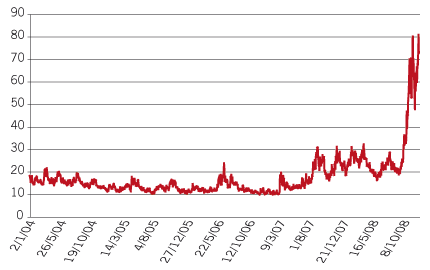
Volatility is at an all-time high and managers and investors are both beginning to realize the opportunities to be had. Volatility is the highest in the US since 1932. On November 20 the Vix, which measures the volatility of the S&P 500, hit an all-time high, closing at 80.86. A spokeswoman for the Chicago Board Options Exchange said that “normal volatility” was annualized at around 17 to 20. In September, October and November of 2008, the Vix has been between 50 and 80.
Up to now interest in volatility as an asset class or strategy has been limited. Sol Waksman, founder and president of Barclayhedge Indices, says that volatility trading has been mainly found in managed futures selling option premiums. “There are not many of those and there are even fewer hedge funds in the space,” says Waksman. As such, the amount of volatility funds and their aggregate performance is a little vague. HFR categorizes volatility funds within its relative value index, which was down more than 15% as of the end of October but volatility traders say that the category is not indicative of volatility trading as it is probably only a small part of the overall category.
Marc Abrams is partner and co-founder of Titan Capital Group, which runs several volatility funds and has $800 million in assets under management. His funds have returned between 17% and 32% over 2008 up to the end of October. “If you are a volatility fund, you should be up double digits this year and last but most certainly this year as are we and the funds we know.” There are several ways of trading volatility. However, the common ones are being purely directional or trading the volatility of one asset versus the volatility of others, which could explain the lower figures,” he says. For example, in terms of directional volatility strategies, it would be easy to look at such gauges as the Vix index in September or October and see that historically it’s never been that high and therefore go from long volatility to short volatility. However, if it goes higher – as it did – then there can be disastrous consequences. Abrams says one reason there has been so much movement at the end of trading each day is because so many traders are short volatility and are having to rehedge then. “Market participants have believed volatility must decline based on historical data. But as we are in a period never seen before in history, they have been caught off guard. In terms of trading the volatility of one asset versus another, the problem is it is basically a correlation trade and given we are in uncharted waters, I’m not sure how much faith to put in historical correlations reverting back or what historical data is valid going forward.”
Protection
Paul Britton is the chief executive of Capstone Holdings Group, a volatility trading firm he started in 2004. “Volatility is still an unknown asset class. People argue it is not one, but the pool of investors interested in volatility is growing by the day.” Britton says investors are predominantly viewing volatility allocation as a form of protection on their portfolios.
There are several approaches to investing in volatility. The most popular at present is long volatility and several new funds that apply this strategy have launched. “Such funds offer an insurance-type return. If volatility goes up, the fund does well and vice-versa. Investors use it to take the beta out of their portfolios,” says Britton.
Volatility of the S&P 500 hits all-time high |
Vix closing price 2004–08 |
 |
Source: CBOE |
Titan runs an opportunistic volatility fund that aims to produce absolute returns. “A lot of market participants are trading options purely as insurance on the underlying security,” says Abrams. “They are focused on this underlying stock, and the price they are paying for the option is just a function of that underlying strategy. In these environments, with people very price insensitive when it comes to buying an option for insurance or selling one for yield, it creates tremendous relative opportunities for volatility strategies focused on relative value trading on the same underlier.” Britton believes volatility is here to stay for the near future. “There are so many funds and banks that have pulled out of the markets that moves are now being accentuated,” he says. “The stat arb guys, for example, have all pulled back as they feel they are in uncharted waters, and they were a good source of liquidity. Those that were short vol and long leverage have had a rough time and those positions are being worked out by risk managers who want to exit fast, selling at any price. That creates more volatility. There is a lot of opportunity right now for those with expertise in volatility trading.”
Abrams agrees. “Unless credit spreads return to levels that we last saw in 2003 or 2004 we will continue to see high volatility of volatility as the markets enter a new era,” he says. “It is unlikely 2003 to 2005 credit spreads and the accompanying leverage will come back any time soon, given the havoc such spreads and leverage have wreaked thus far.”


