When I was buying my first property 25 years ago, the mortgage rate in the UK was around 11.3%. Since then, it has at times been painfully higher, and for the past decade, thankfully lower as the graph of UK banks’ base rates shows. Earlier this year, I negotiated to move on to a tracker mortgage. And while I will allow myself a pat on the back, I will also confess that I never imagined I would see the amount of interest I pay fall to the level it has following the Bank of England’s decision to cut its key rate to just 2%. The astonishing thing is that rates appear to be going even lower.
Clearly, we are in a new paradigm and apparently independent central bankers around the world are playing a new game. Where once they all followed the leader and tried to prove how tough their anti-inflationary credentials were, they are all now, as Bank of America hints in research yesterday, engaged in a rate-cutting championship.
| UK’s central bank base rate |
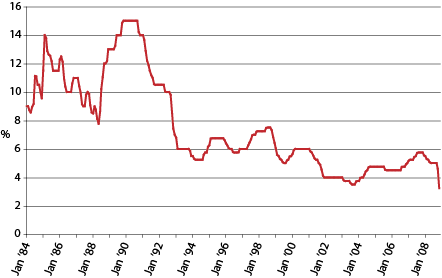 |
| Source: Bank of England |
“Extraordinary times make for extraordinary decisions, and laggards can become front-runners in no time. The Riksbank was the last major central bank to maintain a restrictive stance, hiking its policy rate by 25 bps as late as September 2008,” writes BofA. “After resorting to ‘usual’ 50 bps cuts twice in October, the Riksbank has just once more surprised the market by cutting rates by 175 bps today, exceeding the BoE’s bold move of 150 bps on November 6.”
A bold move indeed. I would have been even more impressed if the Swedish central bank had finished its statement issued with the cut with the following question: “How’re you left?”




