Risk-taking smaller banks buck the consolidation trend
Emerging Europe’s best managed companies
Emerging Europe’s best managed companies: By Country
Emerging Europe’s best managed companies: By Sector
 |
“The reliable operation of the Temelin nuclear power plant makes us raise the anticipated amount of net profit for this year by Kc1.1 billion to Kc35.1 billion compared with the forecast from last December” Petr Voboril, CEZ |
STORIES RECENTLY EMERGED in the Prague media suggesting that the coalition government was preparing a reshuffle at state-run power producer CEZ. The government, it was reported, would appoint new members of the supervisory board and then look to make changes at the senior management level. Were they to look at the results of this year’s Euromoney poll of the best-managed companies in central and eastern Europe, they might have reason to pause before making any sweeping changes. CEZ has topped the poll for the second year running, rewarded for the impressive performance of its share price but praised also by analysts for the openness and accessibility of its management, their success at integrating acquisitions and their willingness to innovate.
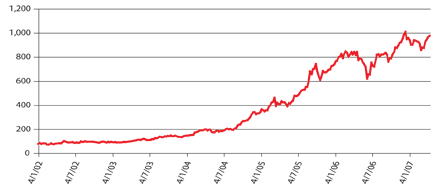
A look at the reasons for CEZ’s repeat success in the poll must begin by acknowledging the share price’s steady upward climb. Analysts seem to agree that the price will continue to appreciate: 14 of the 19 covering the stock on Bloomberg post a “buy” or “overweight” recommendation. Merrill Lynch added CEZ to its list of preferred utilities stocks in an April research note.
“The central investment case for CEZ,” ran the report, “is convergence of Czech Republic wholesale power prices with those of Germany. A reduction in the surrounding region’s generation capacity and the advent of the Czech Republic’s own power exchange in July appears to have precipitated a process that we had expected to take two to three years.”
Is CEZ’s victory in the poll, then, simply a reflection of its exciting prospects and its ability to capitalize on favourable market conditions?
“The main driver of the improvement in CEZ’s share price has certainly been the rising price of energy in the region,” says Petr Novak, an analyst at Czech brokerage Atlantik. “But you can also look at the professionalism of the management: they have a well organized relationship with their investors, they’re very open and they are motivated by the stock option programme, which makes sure that development of the share price is important to them.”
This options scheme, whereby employees are able to buy CEZ stock at the price it was at when they joined the company, is seen as crucial to the firm’s success but has caused it some trouble. Prague police announced in January that they were investigating 10 current and former members of the firm’s supervisory board over allegations that the life insurance and stock options they had been granted might have been illegally awarded. The company responded with a statement defending the legality of the stock options scheme and saying that “the withdrawal of members of the supervisory board from the option programme in 2005 was motivated by changes in the owner’s strategy, not by doubts about the legal accuracy of the programme”.
The case doesn’t seem to have affected the esteem in which the market holds CEZ management; nor has it slowed the firm’s growth. Novak says that CEO Martin Roman is “a great representative of CEZ, an executive who has good relations with local politicians and who represents the firm very well to investors”.
|
A Power surge |
|
Performance of CEZ Share Price (in Czech Korunas) |
 |
|
Source: Bloomberg |
Roman has, however, been frustrated by the government’s reluctance to make an announcement on the possibility of building more nuclear power plants in the Czech Republic. The opening of the firm’s Temelin plant has been repeatedly delayed as technical faults surfaced. “This government has made no decision on building new nuclear sources,” says Novak, “and that could be bad for CEZ. It can’t renew a large portion of its energy portfolio since it cannot build new coal plants without breaching restrictions on mining. Their production capacity after, say, 2010 could be quite diminished.”
CEZ’s Svoboda says that the Czech Republic will become a net importer of energy in the near future. Speaking at an energy seminar he said: “We have five years to reach a smaller power deficit and some 10 to 15 years before the bigger deficit or, if you want, the crisis of the Czech energy industry.”
Further vexing the minds of CEZ’s senior management is the question of what to do with all the spare cash. Net consolidated profits grew 29% to Kc27.7 billion ($1.34 billion) in 2006, bolstered by rising prices, revenues from new units in Poland and Romania and the expected activation of the Temelin plant.
“The reliable operation of the Temelin nuclear power plant makes us raise the anticipated amount of net profit for this year by Kc1.1 billion to Kc35.1 billion compared with the forecast from last December,” said CFO Petr Voboril as he announced that CEZ was the first Czech firm ever to make a profit of more than €1 billion.
Super dividend
There is speculation among shareholders that a super-dividend could be imminent but Voboril says that the cash will be used to make further acquisitions, probably in the Balkans and Ukraine, and to buy back the 7% stake in the firm that the government is selling.
As well as continuing to hunt for acquisition targets, CEZ has begun to trade energy as it seeks to exploit the arbitrage opportunities arising from the large discount at which Czech power trades in comparison with German. The firm’s former trading director, Alan Svoboda, said at a March conference in London that he expected Czech power prices to rise to German levels soon; in the meantime the firm trades both straight day-ahead electricity and futures contracts on the Oslo-based exchange Nordpool. In July this year trading will begin on the Czech Republic’s own energy exchange, and CEZ is expected to benefit.