Albania puts its past behind it
Emerging Europe: Insurance attracts a premium audience
NOT-FOR-PROFIT organizations come in all shapes and sizes but they generally have a common characteristic – they’re as dull as ditchwater. That’s certainly not a charge that could be levelled at the Albanian-American Enterprise Fund, which for more than a decade has been fighting the good fight in Albania. What’s more, it has been winning.
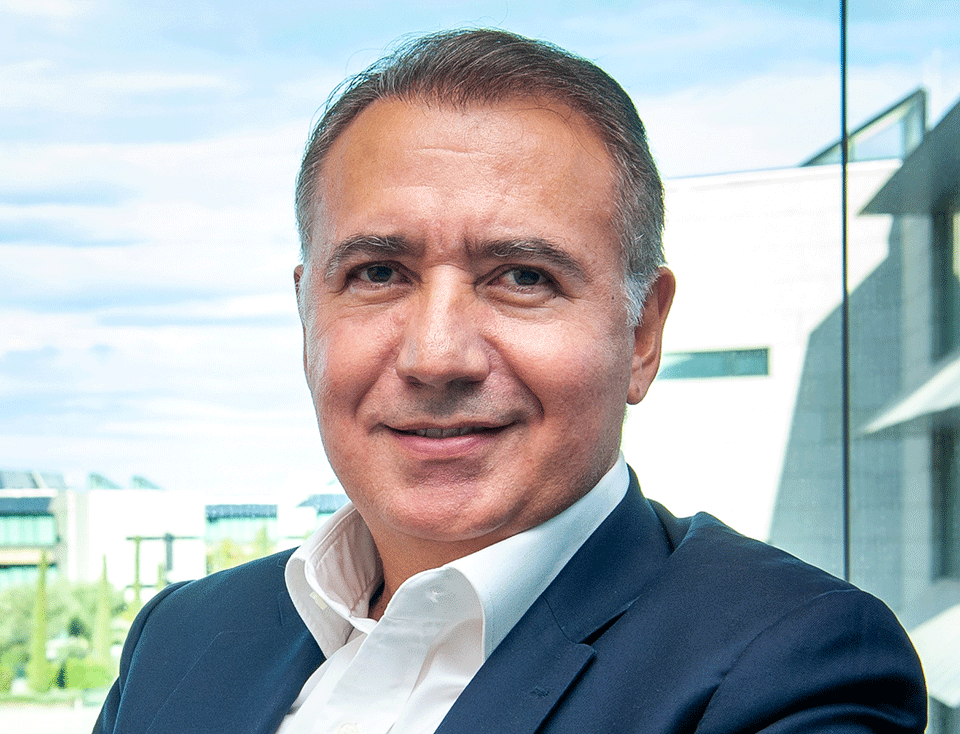
Since its creation by the US Congress in 1995 the AAEF has established a swashbuckling reputation, which would be the envy of any self-respecting emerging market hedge fund manager, let alone an offshoot of the US government. Armed with just $30 million in start-up capital, AAEF’s influence is obvious from the moment you step out onto the tarmac at Tirana’s Mother Teresa airport. As Jeffrey Griffin, AAEF’s president and chief executive, points out, with a 21.3% stake the fund has been a key investor in one of the country’s most ambitious development projects. Furthermore, it’s one that was completed on budget and on schedule – a virtually unheard of outcome in Albania where cost overruns and time delays are the norm.
AAEF is one of three partners in Tirana International Airport (TIA), the others being German airport developer Hochtief AirPort and Deutsche Investitions- und Entwicklungsgesellschaft, the German development agency.
In 2004 TIA secured a 20-year build, own, operate, transfer (Boot) concession to run the country’s premier international gateway – a unique arrangement in the region. The latest fruit of the partnership, which has so far invested around €50 million in facilities, is the gleaming new terminal, designed by Malaysian architect Hin Tan and a shining example of what can be achieved in Albania given the right vision and management strategy. “Albania now has a truly world-class airport,” says Griffin, adding that the Albanian contractors, such as construction company Trima, acquired vital skills and know-how, which they can now transfer to other projects in Albania and abroad.
Although some Albanian nationalist politicians have questioned why the government should have sold its interest in the airport to a foreign partnership, Griffin says the fact that the now state-of-the-art airport is proving highly profitable is justification enough. “We’ve given the government a virtual interest in the airport as they get a 30% share of the profits in addition to taxes paid.” Tirana airport might be AAEF’s most glitzy investment but Griffin is equally proud of less glamorous investments, such as the capital it provided for extrusion machinery for Teqja – the sole ISO 9001 certified pipe manufacturer in the Balkans. That’s a big plus in a region where the entire water and sewerage infrastructure is in dire need of replacement. While Albania’s mafia may be infamous for laundering money, AAEF is famous for providing the money to help you do your laundry.
AAEF has also played an important role in the financial services sector in Albania, setting up what is now effectively the country’s number two bank and helping to fund what has become the number one insurer. It’s a measure of AAEF’s success that both companies have since become takeover targets. Following the pyramid scandal of 1997, which rocked Albania to its core, Griffin says AAEF made a conscious decision to switch from funding relatively small, opportunistic projects to bigger, more strategic investments. As part of this new approach the AAEF stumped up $5 million in 1998 to found the first new full-service commercial bank in Albania since 1991. Thanks to a team of experienced bankers, which the fund brought in to run the bank – chairman Lorenzo Roncari spent decades running banks in emerging markets for Citibank – American Bank of Albania (Ambank) soon established itself as one of the country’s top banks. The net result has been that Italy’s Intesa Sanpaolo agreed to pay $125.6 million for an 80% stake in Ambank last year and is currently working on merging its other Albanian operation, Banca Italo-Albanese, into Ambank. Griffin says that AAEF will maintain its remaining 20% stake for another two years, having already registered a 25-fold return on its initial investment.
Insurance initiatives
The fund has also played a key role in the development of the country’s leading insurer, Sigal. Since 2003 when the fund took a 13.3% stake, the AAEF has acted as its strategic adviser and Sigal has become one of Albania’s most innovative companies. Griffin, who is chairman of Sigal’s board, points out that Sigal was the first company in Albania to establish a holding company structure and the first to adopt IFRS accounting standards. Leading Austrian insurance group Uniqa recently signed a deal whereby it will take a majority stake in Sigal by 2010. “We realized that Sigal needed to add management expertise and identified Uniqa as the best possible strategic partner,” says Griffin.
Like most expatriates in Albania, Griffin acknowledges that there is still much to do – solving the country’s dire energy sector crisis for one. Power shortages in recent years have acted as a brake on economic development and Griffin believes that much more needs to be done on the infrastructure investment front if Albania is to move on to the next stage in its economic development.
Such are the vagaries of the electricity network in Albania that the country uses direct current rather than the more usual alternating current, a peculiarity that can have dire consequences. One of the dangers is massive power surges following blackouts that can blow even the most sturdy of equipment. Griffin recalls: “One day I was at home when a power surge shattered six light bulbs around me – it was like being in a war zone.” Now that’s real perspective on the challenges of life in a frontier market.