 |
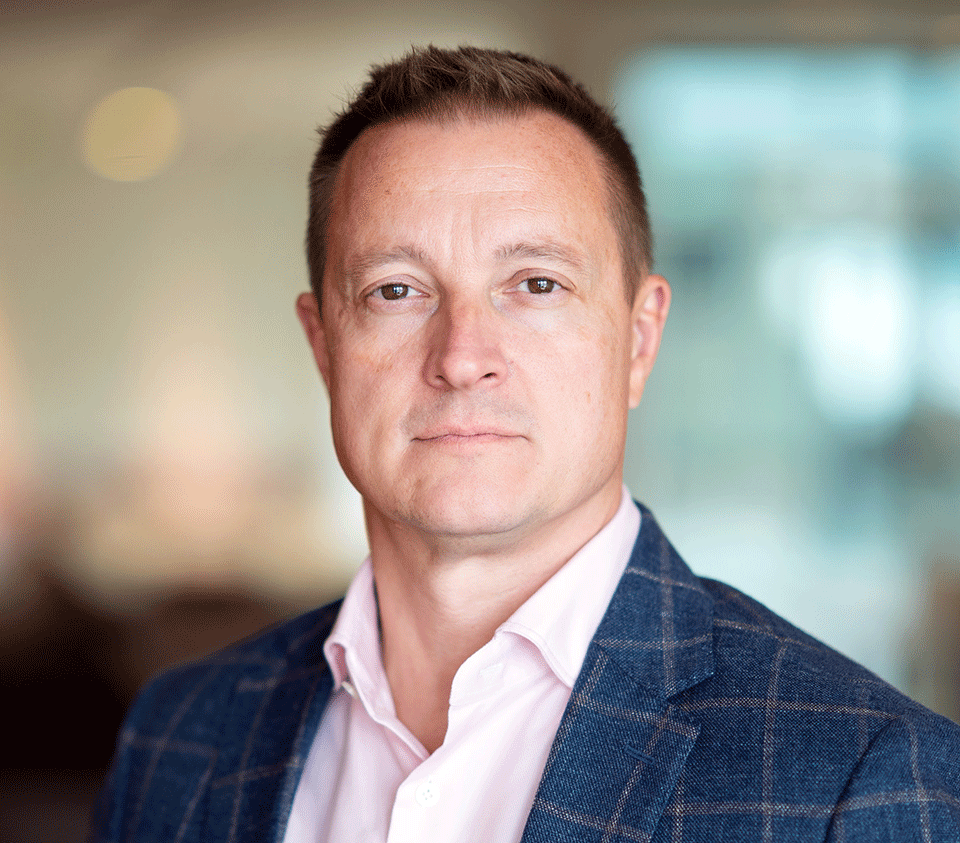
Richard Horlick, Tau: Tau is an obvious investment for investors seeking diversified exposure to a rapidly expanding economy |
THE INITIAL PUBLIC offering in May for Tau Capital, a closed-ended fund established jointly by UK financier Lord Jacob Rothschild’s investment group Spencer House Capital Management (SHCM) and Compass Asset Management (CAM), a leading fund management business in Almaty, is a clear indication of investor appetite for equity exposure to Kazakhstan and its region. Initially targeted to raise $200 million on the Alternative Investment Market segment of the London Stock Exchange, the flotation lead managed by Numis Securities actually raised $250 million.
The fund will be run by Richard Horlick, former head of investment banking at Schroders, and will invest in listed and unlisted mid-market companies in Azerbaijan, Kyrgyzstan, Uzbekistan, Turkmenistan, Tajikistan and Russia, as well as Kazakhstan.
Although some firms lay claim to a long track record of operating in central Asia, it’s usually measured in terms of a few years rather than tens of decades. But Jacob Rothschild’s family owned oilfields in Azerbaijan at the turn of the 20th century and famously employed Josef Stalin as an oil worker before sacking him when he threatened to foment unrest.
Horlick says that more recently the Jacob Rothschild group has invested in the IPOs of leading Kazakh oil firm KazMunaiGas as well as the flotations of leading commercial banks Kazkommertsbank and Halyk Bank.
On the back of the $40 million of seed capital from both SHCM and CAM, Horlick says that Tau Capital’s equity offering gives it the financial wherewithal to take advantage of the booming economic conditions in the region.
Horlick says that the fund will invest in three stages: top-tier quoted companies; second-tier stocks; and then private equity investments spanning venture capital, bridge financing, recapitalizations and pre-IPO funding.
He adds that while Tau Capital will look to invest in the oil and gas and the metals and mining sectors that have been the source of most international investor appetite to date, the increasing wealth of Kazakhstan’s population will form the economic base for investing in consumer-related projects. “With GDP per capita in Kazakhstan now running at $6,000 and rising fast, that’s a real tipping point for a country being a self-sustaining consumer play.” He adds: “When you look at Kazakhstan, the opportunities are fantastic, with corporates and banks that are genuinely world class. There is a huge amount of both domestic and foreign capital available for investment and the country boasts a well-educated workforce.”
Horlick says that the combination of CAM’s local knowledge and SHCM’s international expertise is a powerful one in what is becoming an increasingly competitive private equity market. He says: “Family and cultural ties are very important in Kazakhstan, and CAM gives us those connections. At the same time the Kazakhs know they need foreign capital and know-how if the economy continues to grow at the current pace.” GDP growth in Kazakhstan has averaged just under 10%, outpacing both Russia and Ukraine.
Some 70% of the fund has already been invested in a mixture of liquid and illiquid listed securities. “That’s to give investors some upfront Kazakh beta,” says Horlick, adding that on the private equity front Tau has already conducted due diligence on five transactions. Horlick cautions, however, that Tau will be in no rush to put money to work in private equity without doing all the requisite homework. “As a publicly listed fund you have to be very careful about the investments you make. We don’t want to be a forced seller of public positions in order to fund a private equity position.”
In order to signal its commitment to Kazakhstan, Tau is looking at the possibility of having a secondary listing on the Kazakh bourse in Almaty. “Tau Capital would be an obvious investment for domestic pension funds and mutual funds wanting diversified exposure to the Kazakh economy, and a Kazakh listing would differentiate us from a lot of the other funds targeting the region.”