
|
In association with Hedge Fund Intelligence |
It’s been a crazy few weeks over the summer, with hedge funds seldom far from the headlines. And by some accounts, the industry could be facing further big losses – with various pundits arguing that redemptions from investors could spark a further wave of deleveraging that can only further roil the turbulent markets.
Almost ever since we launched EuroHedge in January 1999, doomsayers have been predicting that the boom in hedge funds would be followed by an inevitable bust – and they have been wrong so many times before that it is tempting to simply dismiss this latest speculation as yet more wild scaremongering. However, with the credit crunch biting so hard that banks have apparently become reluctant even to lend to each other, there is perhaps more genuine concern than at any time since the tumultuous near-collapse of Long-Term Capital Management in 1998.
Some big hedge funds have indeed already been victims of the credit market dislocations, including two Bear Stearns structured credit funds – which had combined assets of some $1.5 billion – recently forced to shut down with almost no capital left to hand back to investors.
Basis Capital, for many years a top-rated credit player from Australia, was also recently obliged to file for liquidation of its Basis Yield fund with losses estimated at 80%. Although famed for its previously impeccable track record, it should be noted that Basis Yield (with assets of about $200 million) was very much the smaller of the firm’s two main strategies – and that its larger $700 million Pac-Rim Opportunity fund is very much still in business, if a little bruised.
There has also been a series of headlines about other so-called hedge funds running into problems in credit. But when you look more closely you will notice that most of the products hit – such as Cheyne Capital’s Queen’s Walk and Cheyne Finance funds, the Cairn High Grade Funding vehicle, as well as Cambridge Place Investment Management’s Caliber and Solent Capital’s Mainsail II vehicles – were actually not hedge funds at all. In fact, these were either pools of asset-backed securities and/or CDOs or special purpose financing vehicles. The hedge funds run by these firms all appear to have survived intact – so far at least.
But the news on hedge funds specializing in credit is far from all bad. Indeed, hedge funds were arguably the first to identify problems in the US sub-prime mortgage market, and to spot the contagion spreading across the credit spectrum. Funds managed by firms such as Paulson, Peloton and FrontPoint have filled their boots with massive returns in recent months.
And they are far from being isolated examples. FRM Credit Alpha, a specialist fund of funds run by Financial Risk Management that invests in credit strategies, reported a punchy 3.2% gain for July (taking its gain to 8.3% in only its first four months since inception). Despite the collapsing credit market in July, this portfolio saw positive performance from 9 of its 13 managers – with some scoring on short sub-prime exposure, others from bets on credit spreads widening, and others simply from trading acumen and security selection.
|
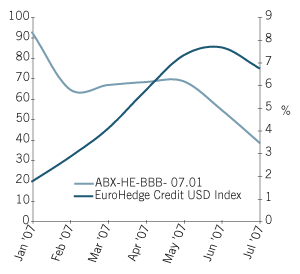
ABX index plotted against the Eurohedge credit funds index |
|
|
Source: HFI |
This perhaps explains why credit hedge funds have on average lost relatively little ground in recent months – even while the ABX index of sub-prime mortgage-related securities has plummeted (see chart). Not surprisingly, there has also been a rush by hedge fund groups to set up new funds aiming to take advantage of dislocations in the credit market – with the opportunities now aplenty on both the short side and the long side.
Nevertheless, the credit crunch has no doubt also caused some unsettling repercussions on hedge funds in other strategy areas. But it was far from apparent that the first impact would be on quantitative equity market neutral strategies – with many of them, such as Goldman Sachs’s big Global Alpha fund, dropping so sharply in the early days of August.
Many of these funds had already rebounded strongly by the end of the month, recovering most of their losses. But the sudden intra-month volatility will no doubt cause some investors to reassess such quant strategies – which had hitherto been viewed by many as relatively low-risk.
Simultaneously, the sudden deleveraging by some of the big quant funds had knock-on effects elsewhere – and notably on long/short equity funds. By the end of August, when the music stopped for the reporting of monthly returns, some of these equity funds looked as if they were still sitting on losses of 5% to 10% for the month, although many seem to have constrained their losses to a more modest 1% to 3%. A minority of the many funds of this type we track were even up on the month.
The good news is that long/short funds in general had enjoyed a strong run over the first seven months of 2007 – so most should still be well in the black for the year whatever their losses in August. Hence, although investors might well be rattled, and there will doubtless be redemptions from some funds – and some who will fall by the wayside – it still does not make sense to me to expect massive net redemptions in the short term.
As our annual surveys in EuroHedge have consistently shown, there has always been a significant failure rate among hedge funds – with roughly 8% to 10% of funds routinely disappearing each year. There were more than 100 hedge fund shutdowns in Europe in 2005 and again in 2006, with most being small and relatively little-known players. The first half of 2007 was incredibly benign – so some increase in the shutdown rate is no doubt overdue.
|
|
In association with Hedge Fund Intelligence |



