Instead, I was going to try and give the column a Sgt Pepper theme this week, as it was 40 years ago today that the Beatles’ seminal album was released. But even with a little help from my friends in the Euromoney office, I couldn’t really get any of the album’s song titles to fit my headlines.
Though they say another day, another dollar neatly describes the vibrancy of the FX market, these days we’d be better off pointing out that history often repeats itself. Just like last year, activity has dwindled and the market appears to have sailed into the summer doldrums rather early. If lessons have been learnt, traders will be battening down the hatches now and trying to make sure that they don’t pee their profits down the toilet – as many did in the latter half of 2006.
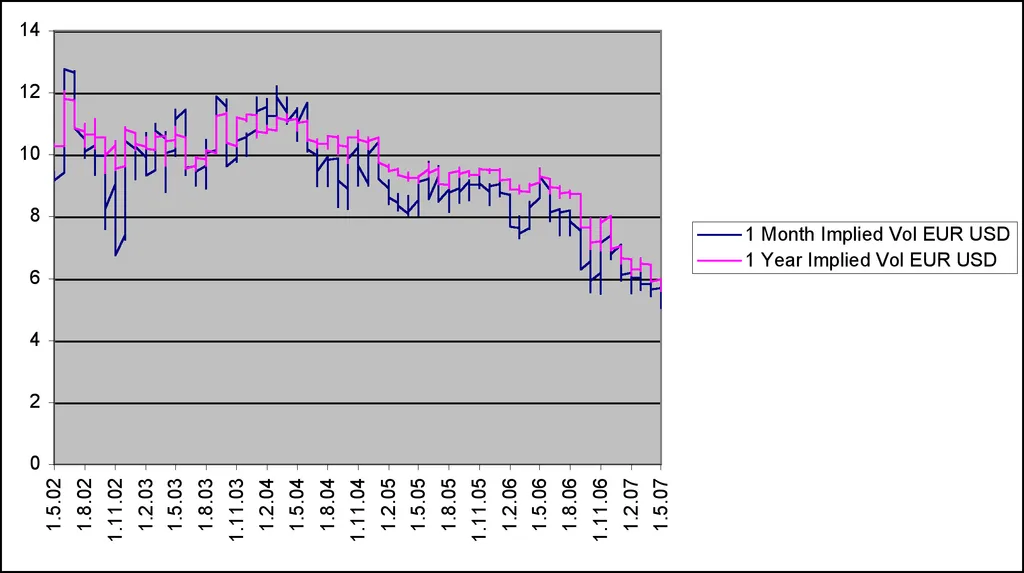
The options market illustrates just how little is going on. Implied volatilities are on the carpet, with euro/dollar being quoted at historical lows (see graph).

Graph shows 1-month and 1-year implied vols for past 5-years. Source: SuperDerivatives.
One of my muckers reckons there’s a generation of option dealers who have never seen double-digit vols. That’s probably a little bit far fetched, but despite the best efforts of many to pick the bottom, implied vols have remained extremely suppressed. FX is not the only asset class this has happened in and it may suggest that the change is structural, not cyclical. I’m no expert on options, but intuitively, if I had to put my cock on the block, I’d probably be trying to pick the bottom too, which sounds extremely dodgy. For instance, the five-year euro/dollar straddle implies there’s a 68% chance that the market will remain sandwiched between 1.2800 and 1.5000. That’s a hell of a call (or more realistically, put) to make over that time period. According to Richard Leighton, global head of FX at Standard Chartered, there is a plausible reason for what is happening. He says a major reason why vols are so low is because of the way Asian companies are using options.
“I think what surprises many people in the market is just how prepared Asian corporates are to sell vol, sometimes as part of their hedging strategies and as a means of gaining some yield,” he says. “People continue to look to pick the bottom. But a real market paradox has developed where corporates keep selling vega and funds keep trying to buy it. It wasn’t meant to be like that – when options first appeared, we all thought they’d be used pretty much as insurance policies, but clearly that’s no longer the case. Our business model in emerging markets FX options is largely built on the premise that we buy vega from corporates in onshore markets and sell to other financial institutions offshore.”
The implication is that this is a story of supply and demand. If it continues – and it’s hard to see why it shouldn’t – I wonder what impact it will have on many of the marginal businesses that currently exist. Many are now totally reliant on volume growth continuing. It’s hard to see how previous growth rates can be maintained.