Euromoney Liquid real estate March 2007
The level of demand – and potential supply – for real estate sukuk deals has been dramatically demonstrated by two new issues over the past three months.
The deals – from Aldar Properties and Nakheel – rode high on the current global wave of demand for Shariah compliant fixed income products.
Nakheel’s deal, worth $3.52 billion, ranks as the largest ever sukuk in any asset class, while Aldar’s $2.53 billion deal was the third largest ever. Both provide the companies with cash for projects, as well as enabling them to improve their financial flexibility and efficiency. Aldar chose National Bank of Abu Dhabi (NBAD) and Barclays Capital to arrange its deal, and Nakheel chose Dubai Islamic Bank (DIB) and Barclays Capital to run the books.
The deals linked into the companies’ equity stories, with Nakheel giving credit holders the right to subscribe to shares in the event of an IPO, and Aldar offering a convertibility option and so giving credit holders the option to convert the paper into shares after a certain period. “The convertible element of sukuk is relatively new concept in this region, but it made the deal even more attractive and gave us the option at maturity to pay back cash or convert the credit into shares depending on our liquidity at that time,” says Shafqat Malik, chief financial officer at Aldar Properties, whose book was five times over-subscribed with the deal pricing tightly at 65bp.
The CFOs of each company appreciate the landmark nature of their deals. This is the first times ukuks have sold well in Europe, with 51% of the Nakheel deal, and 74% of the Aldar deal being allocated to European investors.
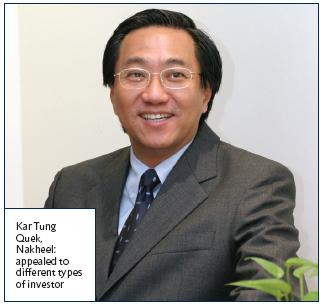
“Our transaction was big by anyone’s standards so we wanted investors from the local region as well as from around the world to participate. By doing a Shariah compliant deal we could appeal both to Islamic and conventional investors,” explains Kar Tung Quek, the chief financial officer at Nakheel.

Malik adds: “The conventional investor world understands Islamic financial principles better now and wants to get involved in this rapidly growing and very liquid market.”
GCC corporate sales of sukuk doubled to $4.95 billion in the first half of 2006, compared with the same period in 2005, according to London-based law firm Trowers & Hamlins. Aldar’s deal was increased from an initial $1.3 billion to $2.53 billion, and Nakheel’s $3.52 billion deal was increased by 40% from the starting figure.
Demand for sukuks has also increased because of the fall in share prices in the GCC region. However, for real estate companies the story is even better. Dubai has taken off as a financial centre already and Abu Dhabi, which controls 10% of the world’s oil and gas, is ready to launch. Laws have changed to allow for increased ownership and tradability.
“In this region there is particular demand for real estate sukuks and related investments. Islamic investors are more interested in real assets, whereas conventional investors seem comfortable with financial investments,” says Stuart Henrickson, head of corporate finance at NBAD.
Malik expects more debt issuance: “This was a very good route for us and I think other corporates will find it an attractive option as well.”
The influx could be the trigger needed for the secondary markets to take off in the region. “The secondary markets in the Middle East have always struggled to develop. However, we think this is going to change. These new issuances are finally attracting investors from around the world, all with different interests and expectations,” says Henrickson.