Euromoney Liquid real estate March 2007
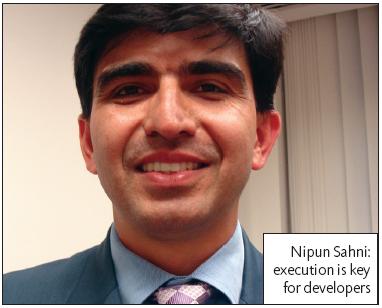
Nipun Sahni has joined DSP Merrill Lynch in India as director and head of India global commercial real estate. He was poached from GE Commercial Finance where he was head of real estate in India.
Indian real estate has been buoyant in recent years with nearly all investments showing good returns. Economic growth has been strong, with forecasts of 9% for 2007, and with the IT sector growing over 30%, real estate is set for another bumper year. Huge potential returns have attracted interest from players including Citi, Goldman Sachs and Morgan Stanley.
But movements in the last six weeks have caused concern. Indian realty equity fell 20%. Speculation that interest rates will continue to increase, and that the government could take further steps to prevent an asset bubble forming partly explain this downturn.
Investors are also acutely aware of limitations in India. A lack of infrastructure and support networks brings growth predictions of 8% to 10% into question. “If infrastructure in certain urban areas is not improved then isolated quality real estate will lose its sheen and values will drop,” explains Kumar Gera, chairman and managing director of Gera Developments.
However, investors such as Ajoy Veer Kapoor, managing director of Saffron Asset Advisors, and Gaurav Dalmia, chairman of Landmark Holdings, along with Sahni, remain confident – though Sahni says investments need careful consideration. “The impact of rising interest rates, higher input costs and a potential slowdown in demand need to be factored in,” he says. However, demand undamentals are still in place, so no downturn is likely to be sustained. Investors believe the market is still undervalued.

Tata is rumoured to be launching a realty fund to invest $1.02 billion, and the first week of February saw Merrill Lynch Capital Markets Espana buy a further 4.73% stake in real estate developer Prajay Engineers Syndicate, raising its stake to nearly 8%.
More complex
Investors accept that the rapid increase in asset prices makes the sector more complex. The government has restricted bank lending dependent on planning approvals and increased interest rates again in February to 7.5%.
However, in contrast it now allows 100% foreign direct investment and has reduced stamp duty. Also, the imminent entry of venture funds into real
estate is expected to enhance growth momentum as a result of affordable financing options and rising disposable incomes.
Further, there are indications that obstacles such as the absence of investment instruments in real estate are likely to be removed. Already, real estate mutual funds can be floated, a move expected to be the precursor for real estate investment trust-like structures.
So with both positive and negative considerations Srinivasa Rangan, senior general manager, corporate planning and finance at Housing Development Finance Corporation is cautious. “I think there will be growth overall but there will be corrections in certain pockets where prices have gone very high,” he says.
Bets will have to be placed more carefully if 2006 profits are to be replicated. As Sahni says: “What will separate the men from the boys in 2007 is the execution capability as developers scale up to the next level.”