Investors rap MBIA over Eurotunnel payout
|
Online Extra: How banks are muscling in on the monolines’ infrastructure busines |
OH, HOW QUICKLY they forget. Having nursed several of the largest structured finance markets through their formative years, the monoline guaranty insurance industry is now having to come to grips with the fact that, in many cases, these issuers simply do not need them any more. They never visit, they never call – like a neglected parent with an empty postbag at Christmas, the monolines have been relegated to the attic of the booming structured finance market. But as any student who has blown his overdraft on too much high living knows, there is a chance that at some stage there will need to be a call home to ask for some much-needed credit enhancement. And as far as the over-leveraged and over-extended credit market is concerned, the monolines are standing by the phone, tapping their feet, just waiting to take that “I told you so” call.
So far the phone is not ringing. And maybe the credit market now has so many options open to it that – even if the cycle does turn – it never will. This is the unspoken worry among the insurers as they anxiously wait for things to turn in their favour.
“In the past, if you had told me that Ford and GM could default, short rates could go up, there could be war in the Middle East and Amaranth could go under with a $6.5 billion loss, and still the credit markets would not move, I would have told you that you were mad,” muses a monoline veteran. “The thing that keeps me awake at night is the thought that maybe the credit markets have really changed. Maybe there is now so much dispersion of risk that the dynamics of this industry are simply not the same.”
Investors’ attitudes towards fixed income have changed beyond recognition in the past decade. What was once a largely defensive allocation of assets is now a way of enhancing yield, and in ever more sophisticated ways. Issuers know that there is excess demand for higher-yielding product, and are therefore unwilling to submit to the cost of a wrap.
The CDS market has transformed risk management in credit, and a wrap now has to compete with a long menu of options available to issuers, and buyers, of bonds. When investors are nervous about a particular credit they will hedge the risk by buying CDS protection – as the recent wave of volatility in the triple-B home equity ABX index has shown. “There are certain instances where a monoline can offer value,” says Neil Sutherland, investment manager at Axa Investment Managers in London. “But as the sophistication of the credit investor base increases there is less and less reason for people to use a wrap.”
All this is preying on the minds of those who run the monoline insurers – names that used to be synonymous with the fixed-income markets, such as MBIA, Ambac, FSA and FGIC, but now seem little more than an afterthought. “There is an internal struggle going on inside all the firms between the veterans who say that the cycle will turn, don’t do anything foolish, and others who think that this time the cycle is different,” says a monoline veteran. The credit market has undergone such fundamental and rapid change in recent years that institutions have a multitude of options available to them by which they can offset risk. “It is likely that we will see a turn in the credit cycle but the question is whether or not the business will come back to the same degree,” agrees Jack Dorer at rating agency Moody’s in New York. “This is a legitimate concern. Credit has become a liquid commodity.”
In this kind of environment, adverse publicity is the last thing the industry needs, but the reputation of the largest monoline is being questioned by a growing number of investors. MBIA recently agreed to pay $75 million in fines and compensation arising from reinsurance contracts it wrote to cover losses it incurred in 1998 [see The worm of doubt: credit-worthiness of monoline insurers, Euromoney June 2005]. And the protracted negotiations between bondholders in Eurotunnel and the monoline – which ended at the beginning of this year with the wrapped bonds being redeemed at par – has left a bad taste in investors’ mouths. Some accuse MBIA of handling the situation wrongly, and that its attitude was “prejudicial” [see Investors rap MBIA over Eurotunnel payout].
Sutherland at Axa sums up the challenge facing the monolines today. “Our preference is to buy bonds that haven’t been wrapped,” he says. “We prefer to hold structurally enhanced triple-A – we invest in deals where we have done the homework.”
Going big on small risks
The modus operandi for these firms has been to take on tiny amounts of risk in very large amounts – a comfortably lucrative proposition that has seen them maintain their triple-A ratings despite (in some cases) significant losses and even an SEC investigation. But all good things must come to an end, and the predictable flows of municipal and structured finance business on which this industry has traditionally built itself are looking worryingly uncertain.
 |
“Writing a wrap on structured finance can be like writing aggressive hurricane insurance – you can be sure that every hurricane will find you. It is a structural assessment”
Sean McCarthy, FSA |
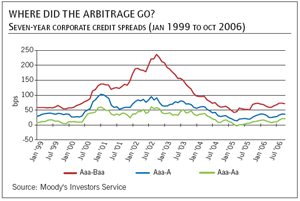
The bond insurance business grew out of the arbitrage that could be had between triple-B and triple-A credit spreads – an arbitrage that has all but disappeared in recent years. US municipal business was the foundation of the industry and has historically accounted for the largest share of gross par written. But while wrapping muni bonds was still a great source of business in 2005 (57% of the $408 billion-worth of bonds issued were wrapped), 2006 was far less productive with issuance dropping 14.7% in the first 11 months (year on year) and insured penetration down to 51%. The insurers loaded up on this kind of exposure when the municipal credits were less than stellar in a symbiotic relationship that suited both sides very well. But two things have happened: the creditworthiness of many municipal issuers has improved (the State of California and the City of New York to name two of the largest), making wrapping their bonds a far less remunerative proposition; and more and more insurers are chasing the business. The market has traditionally been dominated by the big-four firms: MBIA (with a 26.4% market share), Ambac (23%), FSA (16.4%) and FGIC (13.2%). But several newer players are building a presence too. These include XLCA (5%), CIFG (2.9%) and Assured Guaranty (2.7%). The net result is obvious: the price per unit of exposure (calculated by comparing adjusted gross premiums with gross par written) in the US fell from 99 basis points in 2003 to 73bp in 2006.
There is still a significant amount of low-risk, tax-exempt business for monolines to write, and it is nice work when you can get it. “In the muni market monolines still get well paid for taking a minuscule amount of risk,” says a banker. “They just don’t get paid as much as much as they did before.” There are 15 to 20 large US municipal credits that the insurers take capacity on, together with a block of other, more granular business (such as school districts), which drive a significant portion of the municipal business. It is therefore no surprise that the newer entrants to the sector are trying to break in. High-quality municipal business provides steady cashflow where structured finance and international business is less predictable.
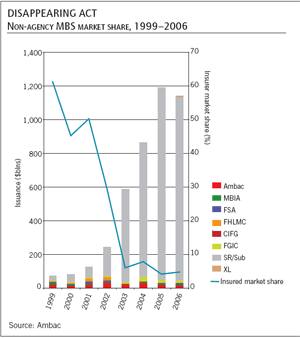
For a while it looked as if the structured finance market was going to be a similarly long-term lucrative proposition. But as the ABS market in the US has undergone spectacular growth, monoline penetration rates have plummeted (see chart). “At the beginning of the US home equity ABS market, supply grew much faster than demand,” recalls Doug Renfield-Miller, chairman and CEO at Ambac UK. “There were huge volumes of home equity issuance and investors did not understand it, which was a great opportunity for the monolines.” Volumes of ABS insurance written have not slumped (total US structured finance gross par underwritten by the big four underwriters has grown from $113.6 billion in 2000 to $129.5 billion in the first nine months of 2006), the fall in penetration is purely because of the sheer growth in the structured finance market. Unlike in Europe, large sub-prime issuers in the US have been through the cycle before and will therefore keep the monolines on their side, maintaining a rotation (probably not a bad plan given the current flow of negative headlines being generated by the US sub-prime mortgage market). But it is a very different risk profile to the municipal trades.
“Writing a wrap on, for example, the City of Pittsburgh, is an actuarial assessment,” explains Sean McCarthy, president and chief operating officer at FSA and chairman of the Association of Financial Guarantee Insurers. “But writing a wrap on structured finance can be like writing aggressive hurricane insurance – you can be sure that every hurricane will find you. It is a structural assessment.” It is essentially the difference between assessing the binary risk of a municipal credit and the risk of rapid contagion between different structured finance transaction pools when credit or sector goes sour. FSA has 35% of its portfolio in asset-backeds.
The big four monoline insurers wrote $129.5 billion-worth of structured finance business in the US for the first nine months of 2006. But the figure masks the extent to which the growth in CDO business has offset weakness in other asset classes and the increasing preparedness of investors to take ABS risk on a senior/subordinated basis rather than a wrapped basis. And even in the CDO space the firms are getting squeezed. “There is relatively little subordination required to get to triple-A,” says one UK-based monoline executive. “Triple-A CLOs are coming at 22bp – you just cannot squeeze a wrap into that. You would need a funder that would buy at 12bp.” Monoline activity in the CDO market is focused on wrapping senior and super-senior tranches – something that the new credit derivative product companies are also focusing on. However, while the CDPCs might take some monoline business, they tend to focus on single-tranche senior and mezzanine CDS, below the monolines in the capital structure.
Wrapping the super-senior tranches of CDOs might keep the monolines busy but it doesn’t pay them very much. Attaching at triple-A or super triple-A means a premium of maybe 5bp to 7bp. The more traditional business of attaching to mezzanine ABS yields more like 10bp to 12bp – much less than it used to but still more than the CDO business.
But Chris Weeks, head of international operations at MBIA, argues that the shift to CDO business should be viewed in terms of risk and reward. “The CDO business is a volume business with high risk-adjusted returns given the high underlying ratings and high levels of subordination underpinning a monoline insurer’s attachment point. There is a relatively higher percentage of CDO activity given the explosive growth of this sector within the broader structured finance market. Absolute premium rates are lower than many other lines of business due to the high underlying ratings and low capital usage,” he concedes.
 |
 |
 |
Squeezed in Europe too The international ambitions of many of the monolines were based on their ability to replicate their early success in structured finance outside the US. But the same dynamics have been at work in Europe – exacerbated by the strong CDO bid, which simply wasn’t there when the US home equity market began in the early 1990s. There has not been a wrapped sub-prime mortgage deal in the region since June 2004 – the amount of enhancement needed for a single-A attachment point is just so thin. “The market has not developed as we expected,” says Renfield-Miller at Ambac. “The typical flow business of MBS and auto-backeds did not materialize for monolines – there is tremendous demand for these assets on an unwrapped basis.” Whole business securitization – particularly in the UK pub sector – proved very fruitful for a number of years. But the growing exploitation of real estate values in this market seems to have put paid to this as well. “There were asset classes that we thought would be there, such as sub-prime, pubs and whole business securitization, that haven’t been,” explains Tim Travers, senior managing director and head of FGIC’s international business. FGIC (under previous owner GE) withdrew from the European market in 1993. The firm was subsequently acquired by a private equity consortium led by Blackstone Group and re-entered the European space in 2004. “Given the evolution in the pub industry, and the way in which it is viewed by the rating agencies, this has eliminated opportunity for us. The monolines have been squeezed out for the time being.” The most recent pub deal, Globe, got done without a wrap at all [see Euromoney June 2006, Pub opco propco has to wait as Globe opts for unusual whole business structure]. The growth of opco/propco financing structures in sectors such as care homes is also eating away at another former monoline whole business securitization preserve, and the firms’ activities in, for example, the water sector have recently been focused on repackaging index-linked bonds (through, for example, the Freshwater Finance and Dali Capital vehicles) rather than the huge primary deals of old.
The monolines could be forgiven for thinking that the markets seem to be conspiring against them, but there are a couple of bright spots on the horizon: Basle II and Regulation XXX in the US. The regulatory capital benefits of applying a triple-A wrap to risk-weighty project finance debt are considerable and the wrappers can make a nice living in this way from banks with heavily risk weighted balance sheets to manage. Last year, for example, MBIA offset the risk of Limerick and Swindon PFI hospital financings for HSBC by wrapping its exposure.
Regulation XXX was introduced in the US in 2000 and enables insurance firms to fund statutory reserves for level-premium term life insurance policies in the securitization market – something that monolines have so far seen some business from.
Plan B
The weakening in the traditional flow markets in both the US and Europe has left the monolines reaching for Plan B. This seems to entail a mixture of focusing on larger, one-off deals that can yield a large, one-off premium, and praying for the credit markets to turn.
 |
“This a very long-term business and patience is the name of the game. We cannot be an anxious group of people – we really have to wait” Frank Bivona, FGIC |
The first part of this plan seems timely, given recent advances in PPP/PFI-style financing techniques in the US infrastructure financing market and the number of large private equity-backed LBOs that have reached their threshold leverage and are looking for a lower cost of debt. Deals such as the 2005 Chicago Skyway financing – which along with bank debt involved a two-tranche $1.4 billion 144A bond issue wrapped by FSA – signalled the potential of this sector for the wrappers. “Growth of UK-style PPP is a big opportunity in the US, Canada and Latin America,” says McCarthy at FSA. “A lot of [Federal P3 – the legislation passed by a number of US states that facilitates private sector funding of infrastructure assets] initiatives were passed in November last year that indicate a strong level of activity to come. If we take this as a benchmark then the scale of opportunity is immense.” Indeed, the New Jersey Turnpike and the Pennsylvania Turnpike are expected to be refinanced in the capital markets soon. In Europe the monolines have successfully penetrated the infrastructure finance market and indeed many had record years in the international sector in 2006. But the threat from the banks to this business is very real. “US infrastructure has traditionally been financed via the municipal bond markets,” says Weeks at MBIA, “although this is changing of late with the increased impetus towards privatisation and the use of private financing techniques. In Europe, due to the more entrenched nature of the banks as lending institutions this represents a more potent form of competition to the capital markets either on a wrapped or unwrapped basis. But we can still provide capital efficient execution.” [Online Extra: How banks are muscling in on the monolines’ infrastructure business.]
But getting the chance to prove that comes at a price. Premiums have plummeted – from more than 40bp to below 20bp in the PFI space and from the high 30bp to the mid-to-low teens for infrastructure. PFI business in the UK has slowed, and the export of the technique to continental Europe has been agonizingly slow: Ambac wrapped its first PFI deal in Austria last year but deal flow can best be described as sporadic.
Competitive pressure means that guarantors are increasingly competing on other aspects of coverage, which can be a dangerous game to play. Any concessions that increase their risk are exactly what they have built a great business by avoiding. “Some new entrants have waived the right to accelerate the bonds and given way on, for example, swap rights, and these are nasty things to be competing on,” observes one banker. For example, in the UK utilities sector more than £3 billion of paper was wrapped last year and most of those bonds were sold without any incremental covenants. “In the UK utility sector covenants were originally put in place to protect the monolines,” notes Michael Cox, property, corporate and infrastructure securitization analyst at RBS in London. “But when there are two or more insurers involved in the bidding process they get dragged along with the deal and are forced to play off against each other at the end of the process. This has had the effect of watering down their covenant protection.”
Some wrappers argue that the strength or otherwise of covenant protection should not be cited as an indication of increased risk for the monolines. “The UK regulatory structure, including ring-fencing and licence restrictions, provides significant protection to all investors,” says Travers at FGIC. “The fact that a borrower or utility guarantor must remain a regulated utility and must use its best endeavours to maintain an investment-grade rating, in my opinion gives UK utility investors, including the monolines, more protection than a leverage or ICR covenant.”
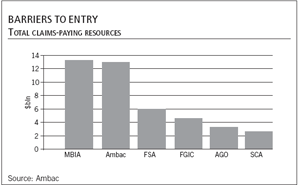
All the firms point the finger at each other on the weakened covenants issue but it is clear that the large, established firms have a strong advantage versus the newer players, and the latter’s options are therefore limited when it comes to trying to gain a foothold. “The good news for the big, established companies is that they have a sizeable back book of municipal business with a very long tail [this is 30-year business],” says Dorer at Moody’s. “This business will continue to provide revenue for these firms as upfront premiums amortize over time, and has enabled them to build up large investment portfolios. This means that they are in a better position to ride out a few lean years than companies without these large back books.”
Window of opportunity
But this does not change the fact that the price advantage of a wrap has all but disappeared and the banks are prepared to go longer on tenor. The window of opportunity for the guarantors – if not closing – appears at least to be narrowing. Not so, the insurers argue. “Monolines are still competitive when you are obliged to issue bonds because of the large size of the deal,” says Francisco Clemente Sánchez, chief financial officer at Spanish infrastructure specialist Cintra. “If you are a low investment grade corporate your capacity to tap the capital market will be reduced if you do not use a wrap. In these circumstances there is a window of opportunity for the monolines.”
But that isn’t much of a business plan. Rather than just relying on being cut in to the very big deals where a wrap is unavoidable, monolines should be repositioning their product to get into transactions earlier. By looking more closely at what the private equity buyers and the infrastructure funds want, for example, they should be able to exploit opportunities that would still be consistent with their risk profile.
The LBO market is clearly one that presents significant opportunity – as the $4.3 billion Hertz LBO refinancing in 2005 and the $2.43 billion buyout of Dunkin’ Donuts have shown. Both deals resulted in wrapped securitizations; the former wrapped by MBIA and Ambac, the latter by Ambac.
Insurers are looking to exploit this. “Is the structured and project finance business as safe as the municipal business? No,” says Stanlislas Rouyer at Moody’s in New York. “But is it consistent with the role of a monoline? Yes.”
By getting themselves involved early on in the LBO bidding process, the monolines could prove themselves as committed as any bank and this might give them more control over the takeout process. But it is hard to see where they could carve a new niche while the credit markets remain this liquid. There has been one instance of a monoline getting involved in a bridge deal – the €1 billion Toll Road Funding transaction in 2003, through which MBIA wrapped acquisition financing for the sale of Italian motorway operator Autostrade. In that situation the bonds were callable after six months but the deal had a final legal maturity of 2014. So MBIA was taking the risk the deal would not be refinanced – and its worst-case scenario was that the transaction turned into a long-term loan (a monoline’s traditional stock in trade).
“Banks can always beat us on short-term bridge financing,” says Renfield-Miller at Ambac. But by effectively taking away refinancing risk, the monolines might have a role to play earlier on in the LBO process. There are, however, a couple of problems with this: first, the number of institutions now piling into infrastructure [see Infrastructure assets: Behind infrastructure’s gold rush, Euromoney December 2006] make refinancing risk something of a moot point as long as liquidity in the market does not deteriorate. Secondly, bridge debt tends to be corporate debt and is only spun down to the operating company level when it is refinanced, and monolines do not tend to wrap single-name corporate exposures (except via CDOs).
A change in risk profile?
Monolines could also change their risk profile. If they have done the due diligence and are happy to invest in a credit at single-A, why not go down to triple-B and get a better return for their trouble? Yes, they would be taking on greater risk but in a relative spectrum. The rating agencies will always act as a check on their activities.
But it is hard to overstate how risk-averse these companies are. “We could be accused of being too conservative,” agrees McCarthy at FSA. “But that is a choice, not a consequence.” Frank Bivona, chief executive officer at FGIC, compares the monoline business to the investment management business in this regard: “Just because spreads are tight you do not go out along the curve, simply because that is where the risk is.” But some of the firms have expanded their geographical limits and ventured into new territories – indeed, FGIC itself has recently underwritten transactions in both Mexico and Kazakhstan.
Another plan of (in)action is for the monolines to bide their time and wait for the cycle to turn. “Someone will take a loss somewhere,” predicts Travers at FGIC. “Something will cause the market to turn. Banks seem to have forgotten that there is risk in credit.” Certainly the larger firms can sit out a few lean years, relying on the core back book of business to tide them over. But for such risk-averse companies this could be a high-risk strategy for one simple reason: what if – even when the cycle turns – the business doesn’t come back?
There are clearly many reasons why issuers wrap – not all of them financial – which will provide comfort to the guarantors that certain volumes of business will always be there. Some portfolio managers want wrapped triple-A paper for ALM matching purposes and will buy it for that reason alone. There is also substantial and growing demand from banks for wrapped paper for negative basis trades. On the issuer side, the monolines have always had a stronghold in the US municipal bond market and that is unlikely to go away. The fact that there is only one counterparty to deal with in a wrapped deal can also be attractive. “As soon as you have a ‘story’ credit it is much easier to deal with one counterparty which will be the case if the bonds are wrapped,” says Ambac’s Renfield-Miller. But those stories do not necessarily have a happy ending [see Investors rap MBIA over Eurotunnel payout].
Monoline managers therefore insist that the game is not up. “There is a composite of structural and cyclical change in the credit market,” admits Weeks at MBIA. But he claims that this is good, not bad, news for the industry. “This means that there is a greater spectrum of opportunity. It presents obstacles and opportunities for us.” He makes the point that the growth in the CDO market is a by-product of this structural change and it is also something that the monolines have benefited from. The CDS market has presented them with a new area of business writing negative basis trades, which (while being more of an accounting arbitrage than a spread arbitrage) certainly ticks the box as being a good, lucrative business on a risk-adjusted basis.
Deals that make a difference
But the structured finance and infrastructure markets are far more uncertain propositions for future business and the difference for these firms between having a good year and a bad year is now increasingly on the margin. There are maybe 10 to 20 key deals a year that will make the difference and it is these deals that will take up a disproportionate amount of management focus.
It is not hard to see why – the fees on offer from one Dunkin’ Donuts or Arsenal Stadium-type transaction will go a long way towards making up the shortfall from evaporating home equity or credit card business. The stakes are therefore incredibly high for the wrappers, which means that the temptation to give way on price and covenant protection will be even greater.
“This is a very long-term business and patience is the name of the game,” warns Bivona at FGIC. “We cannot be an anxious group of people – we really have to wait.”
Only time will tell whether the future for monolines rests on chasing big, key infrastructure and buyout deals (while relying on their back books to see them through) or whether a turn in the credit cycle prompts a flight to safety across all asset classes. But simply relying on the latter will likely prove to be a fool’s game.