Change is coming – but not in a rush
HOSTILE TAKEOVERS ARE hardly life-changing events for investment bankers but Oji Paper’s aggressive bid for rival Hokuetsu Paper Mills in July 2006, arguably Japan’s first ever hostile takeover attempt, was different.
“It was one of the most exciting days of my life,” says the head of M&A at a US bulge-bracket bank, “I really thought it would be the start of hostile bids in Japan.”
Alas for bankers in the Tokyo M&A departments of other global investment banks, it was not to be. Within weeks, Hokuetsu had outmanoeuvred Oji Paper simply by selling blocking stakes to Mitsubishi Corporation and Nippon Paper: deals that had no industrial logic but effectively scuppered the Oji Paper deal.
“It’s very hard to orchestrate a successful hostile bid in Japan,” says John Ozeki, head of M&A at JPMorgan in Japan. “It’s very unfortunate: hostile takeovers can really open up the equity market.”
Few bankers are predicting a flood of hostile bids in Japan despite the seminal move by Oji Paper. However, the deal was no less important for that, say bankers.
“While I don’t expect a flow of overtly hostile bids any time soon,” says Steven Thomas, managing director and co-head of Japan M&A at UBS, “where people put logical and sensible ideas to companies that are rebuffed by management, they may seek to put their proposals directly to shareholders.”
There is little disagreement among bankers that what Japan is beginning to see is an increasing flow of friendly mergers and takeovers as M&A ceases to be the dirty foreign idea that it once was.
The centrality of growth
“The key word today is growth,” says Masaru Shibata, head of Japan M&A at Lehman Brothers. “Where should it come from? There’s a consensus that management styles need to change. That’s part generational as management transfers to a younger generation. Another factor is the presence of increasing private equity money. More CEOs of blue-chip manufacturers are willing to meet heads of private equity to discuss working together.”

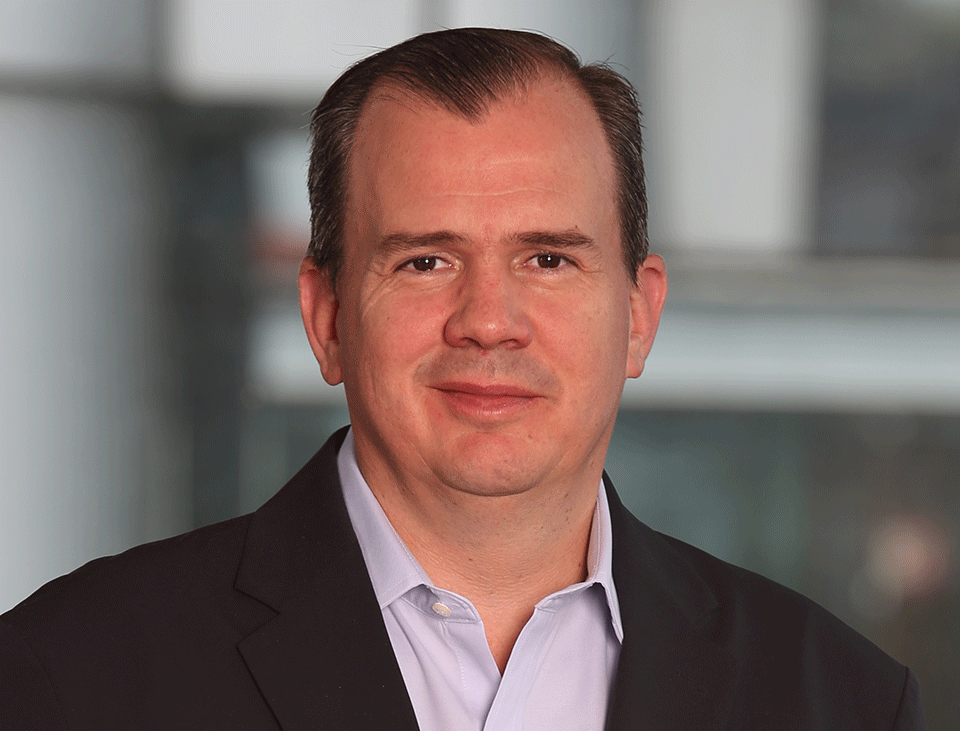
“More CEOs of blue-chip manufacturers are willing to meet heads of private equity to discuss working together” |
|
The product of those discussions, say bankers, is increasingly the sale of non-core assets and/or mergers between divisions of large conglomerates as corporate Japan continues to rationalize and streamline. Distressed deals, however, are conspicuously absent: Japan’s economy has moved decidedly from restructuring to growth and, along with that shift, prices have increased markedly. That change is already beginning to restrict opportunities for foreign companies seeking to buy assets in Japan, says UBS’s Thomas.
“Foreign strategic investors entering Japan have been on the wane,” he says. “In fact, we’ve seen a number of withdrawals already from Japan by foreign firms that decided to deploy resources and capital elsewhere. We’ll probably see more deals like that.”
Despite asset price increases, foreign private equity continues to seek deals, flush with fresh capital raised from limited partners and attracted by the abundance of cheap leverage finance from Japanese banks eager to grow assets. Now bankers are beginning to caution that asset prices might be getting ahead of themselves.
“Private equity guys can’t buy a dollar of assets at 60 cents any more,” says Lehman Brothers’ Shibata. “Now they need to pay a premium. Even if fair value is a dollar they need to pay $1.20. Deals are a growth play now.”
That worries some seasoned private equity players.
“Deals are being done in Japan at double-digit multiples of ebitda,” says Ankur Sahu, managing director, principal investment area, at Goldman Sachs. “You can’t justify deals based on the availability of cheap leverage alone. If you take on a lot of leverage, you’re setting yourself up for a lot of risk over the long term.”
Add to that the fact that private equity deals in Japan rarely come with control, and deals are becoming harder to do, says Sahu.
“Governance is still different here,” he says. “In Japan, management typically has a majority of the board , and as an investor you have to work in cooperation with management to effect change and cannot expect to do western-style restructuring.”
That has not stopped Goldman Sachs from putting its money to work, however. Early to the Japan private equity markets, the firm has already fully invested the $2.5 billion allocated to Japan from its $28.5 billion of global private equity funds.
“We feel pretty good about it,” says Sahu. “We’ve been disciplined and have invested at good value into companies where we believe we can add value. We’ve learned a lot and feel quite confident about our ability to partner with management and help build good businesses: you can’t hope for dramatic improvement over a short period of time. It takes a long time and you have to be patient and have a long-term view.”
Corporate change catalysts
One group of investors still hoping to speed up change in corporate Japan is the activist funds increasingly descending on Japan, unearthing valuation anomalies and testing the issue of control. Thus far, they have proved adept at the task and might yet prove to be a key factor in hastening the arrival of hostile takeovers.
“There’s a lot of shaking up that’s justified,” says Thomas at UBS. “And there are situations where activist intervention is indeed helping to iron out inefficiencies.”
He points to the investment by activist fund Dalton Investments into Sun Telephone, which ultimately elicited a management buyout of the company. In fact, says Thomas, MBOs are on the increase, encouraged by the ubiquity of private equity finance and as management teams become more comfortable with the process. Softbank acquired Vodafone’s Japanese business in 2006 in a $17.6 billion leveraged buyout – Japan’s largest.
Some bankers worry that MBOs, especially when sponsored by private equity finance, are still misunderstood by Japanese companies.
“There are certainly a lot of discussions in the market for MBOs,” says a senior banker, “but I’m not sure that the sellers understand that they’ll have to sell again later. I see more scope for what I call owner buyouts.”
UBS’s Thomas also sees signs of this trend.
|
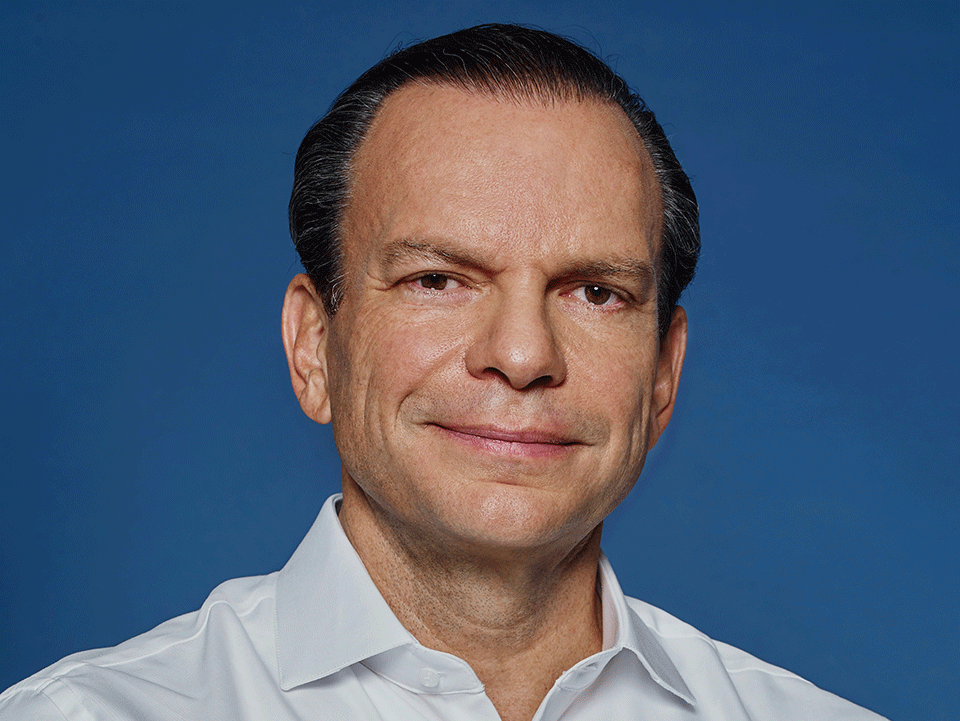
“There are situations where activist intervention is indeed helping to iron out inefficiencies” Steven Thomas, UBS Steven Thomas, UBS |
 |
“Five years ago, if we’d gone to a public company and suggested delisting, we’d have got zero traction,” says Thomas. “But Japan likes to pick up trends and executives are impressed by the successful examples of companies being returned to the control of original founding families or taken over by visionary management.” An example of this trend is Skylark, a listed major restaurant chain, which completed a $3.1 billion buyout by its founding family in June 2006 with funding form CVC Asia Pacific and Nomura Principal Finance.
So although foreign activist funds are playing an important role in unearthing undervalued companies and pushing management teams to improve returns to shareholders, their activities are still often resisted.
“I think these funds are increasingly being listened to as key stakeholders, rather than merely feared,” says Thomas. “It’s still very rare that they would launch a tender offer. It’s only happened four times so far and all by a couple of funds.”
Nevertheless the number of activist funds is growing, attracted by the strong returns made by early market entrants. Even local activist funds are gaining in popularity. Priveé Investment, a locally listed investment company, is launching a $2 billion fund following an activist investment strategy.
“Large Japanese companies with many subsidiaries often have very inefficient management,” says Kenzo Matsumura, CEO of Priveé Investment, the fund sponsor. “We’ll talk to management and change their strategy, help them reorganize.”
Heading hostile
Despite the lack of success of aggressive approaches, few doubt that hostile takeovers are on their way to Japan. It is merely a matter of time. Lehman Brothers’ Masaru Shibata says that his firm talks to companies all the time about hostile takeovers, on both sides of the deal.
“When we talk to management teams now, many have accepted that a company can’t be defended just with poison pills and lawyers any more,” he says. “There’s a reason why these companies are being targeted. Japan hasn’t seen a proxy fight yet. But people are already talking that way.”
Privee Investment’s Matsumura agrees. “The timing isn’t right yet for hostile TOBs [takeover bids] in Japan,” he says, “but we’re expecting to see some aggressive TOBs later this year.”
That is good news for investment banking departments, and especially foreign bulge-bracket firms, all of which are gearing up for a busy 2007 in M&A.
“M&A flows are looking very positive for 2007 and there’s a lot for us to get involved with,” says UBS’s Thomas. “Especially the outward flows: Japanese are now seen as entirely credible buyers, even in competitive auctions. The private equity activity will surely continue and we’ll see more domestic consolidation – much of it large-scale.”
Thomas claims that Japanese firms are increasingly mandating foreign firms for purely domestic deals that a few years ago would have gone exclusively to Japanese investment banks. He cites the $922-million merger between Hoya and Pentax in December 2006 as a case in point. It is a trend echoed by Masaru Shibata of Lehman Brothers.
“There are many situations where we get calls from Japanese companies before they’d even talk to a domestic house,” he says. “That’s very good news for us. And the local banks aren’t ready to compete for cross-border business.”
Japan’s M&A market might be opening up, particularly to the prospect of more aggressive tactics, yet it is difficult to escape the conclusion that it is the foreign investment banks that will ultimately control the market. As Junichi Nakamura, head of syndication at Mizuho Securities, concedes:
“Japan is increasingly part of a global market.”
Like many things in Japan, the outcome might take many years to evolve but the trend towards a normalized investment banking market is already discernible.