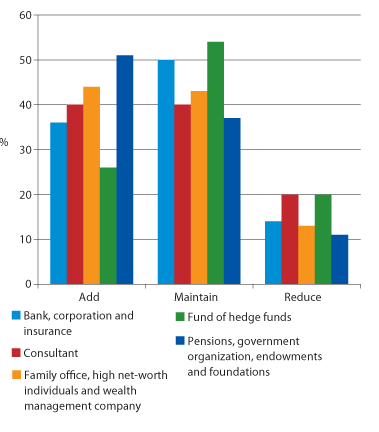
Multi-strategy hedge funds constitute the third-largest holding in investors’ portfolios, next to equity long/short and event-driven strategies. However, the strategy might be losing its shine. According to the Deutsche Bank 2006 Alternative Investment Survey released in January, investors are beginning to consider reducing exposure to multi-strategy funds. More than 1,000 investors in hedge funds responded to the survey from across the investment spectrum. Investors were asked how they would be rebalancing their portfolios in 2007 in order to estimate the movement of assets from one strategy to another. The predicted change in assets for multi-strategy funds was minus 6%.
John Dyment, global head of the hedge fund capital group at Deutsche Bank, believes these assets are being redeployed to single-strategy hedge funds. “Many investors, and particularly funds of hedge funds, have embraced multi-strategy hedge funds for their ability to reallocate assets, and actively manage portfolios on a real-time basis,” he says. “But now that multi-strategy funds are well represented in portfolios, some funds of hedge funds want to differentiate themselves from their peers, and one way is to find unique managers that trade single strategies and shift some assets to them.”
For endowments, pension funds and foundations looking for higher returns, single-strategy funds with their concentration can offer greater opportunity for higher performance. Eleven percent of this investor base said it would be reducing exposure to multi-strategy funds in 2007.
That is not to say that money will not remain with multi-strategy managers. Dyment says: “We’ve seen many investors who are comfortable with their multi-strategy manager requesting them to run sub-sector single-strategy hedge funds. So we’ll see big multi-strategy houses adding more single-strategy funds under their umbrellas to meet client demand.”
One for all
It is perhaps unsurprising that some investors are looking to reduce allocations to multi-strategy funds. The collapse last September of Amaranth, a multi-strategy fund, highlighted flaws in the strategy, and onlookers predicted a fall in demand. Many investors have been drawn to multi-strategy funds because of their ability to switch in and out of strategies quickly. In addition, multi-strategy funds invest in several strategies, ostensibly implying the possibility of less risk. The case of Amaranth, however, indicates that this is not the case. Leverage is used across the whole firm, and the assets of all the strategies in a multi-strategy fund are used to offset the risk. This means, as in the case of Amaranth, that if one strategy fails, the whole hedge fund can collapse.
Dyment says assets are expected to move, for the most part, into merger arbitrage funds. “It was one of the least interesting strategies a couple of years ago but there is now a real opportunity for investors to capitalize in that sector. And I don’t think this is too late. In my opinion, merger arbitrage enjoys a multi-year cycle, and I would expect opportunities to even improve on last year.”
|
Multi-strategy hedge funds |
|
Do you as an investor plan to add, maintain or reduce assets allocated to multi-strategy funds? |
 |
|
Source: Deutsche Bank 2006 Alternative Investment Survey |



