Every quarter, when HSBC announces its interim results, it also declares the size of the dividend in dollars it will pay its shareholders. At the same time, the global banking group details when it will set the exchange rate to convert these dollars into the sterling and Hong Kong dollars that the majority of its shareholders require.
HSBC announced on March 6 that its fourth interim dividend for 2005 would total $0.31 per share. The bank also stated: “The dividend will be payable in cash, in US dollars, sterling or Hong Kong dollars, or a combination of these currencies, at the exchange rates quoted by HSBC Bank plc in London at or about 11 am on May 2, and with a scrip dividend alternative.”
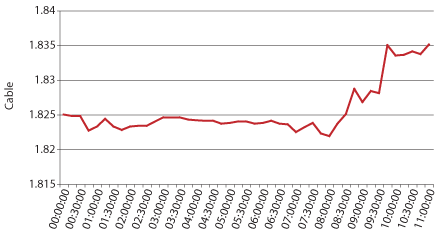
With close to 11.5 billion shares in circulation, the size of the dividend payout was about $3.5 billion. How much of this was earmarked to be paid out in cash to UK shareholders in sterling is unknown – despite its desire to be transparent, HSBC will not tell. What is clear is that cable caught a very strong bid on the morning of May 2.
Of course, this might have been caused by the fact that the dollar seemed to have started its much anticipated free fall against other currencies. However, the anecdotal evidence is very much that sterling always strengthens, even if temporarily, on the morning that HSBC sets the exchange rate to pay dividends.
Penalized
This suggests that HSBC’s shareholders are penalized to some extent by the bank’s well-intentioned transparency. Being transparent appears to result in the market being pushed against HSBC’s shareholders on the day the bank converts their dividend into sterling.
Noises emanating from HSBC point out that in the greater scheme of things the market impact of announcing the transaction in advance is not relevant. Also, even if HSBC exchanged the full $3.5 billion of the last dividend, the effect on the cable rate should prove only temporary given the vast size of the FX market. Even in cable, which is not the most liquid of the major currency pairs, daily spot turnover is likely to be considerably in excess of $100 billion.
Whether or not HSBC is right to be so transparent about how it does the dividend-related FX trade is opinion. However, certain other institutions that also account in dollars handle the way they pay their UK-based shareholders differently. Standard Chartered ostensibly does it in a similar manner to HSBC, announcing in advance when it will set the rate. But a spokesman notes there might or might not be an FX transaction depending on the bank’s overall cash management. In other words, it might well have generated sufficient sterling to make the payment to its shareholders, so setting the rate is more of a book-keeping exercise. HSBC might well do the same, although well-placed sources are adamant that it does buy a chunk of cable every quarter to cover the dividend.
| An obvious effect |
| Closing 15-minute rates, May 2 |
 |
| Source: Reuters |
AstraZeneca also accounts in dollars, pays an attractive dividend and has a large UK shareholder base. Noticeably, it does not announce in advance when it will carry out the FX transaction.“We set the forex rate on the day before the dividend is announced,” says a company spokesman. “This enables us to declare the dividend in the three currencies (GBP, USD and SEK) and provides shareholders and AstraZeneca with certainty over how much is actually paid out.” Market impact aside, what should really be of concern to HSBC’s shareholders is the bank’s reluctance to be transparent on how it set the rate for the fourth and final interim dividend of 2005. According to HSBC, the rate was set at “the forward exchange rates to May 11 quoted by HSBC Bank plc in London at 11.00 am on May 2 ($1 = HK$7.7521 and £1 = $1.83685)”.
The actual spot rate at 11am was 1.8351. Rolling this forward by a week only added a couple of ticks at the most. The rate set by HSBC (1.83685) not only looks too high for the time of day but is also higher than cable had traded at any point on May 2 until after the order was executed. Although the bank will not say how much cable it bought, if indeed any, market sources suggest it shipped in about £500 million. In such an amount, the discrepancy between the rate posted by HSBC and the actual rate in the market amounts to around $750,000. Perhaps not much in the greater scheme of things, but a tidy amount nonetheless.
Best not good enough
One market source pointed out, in HSBC’s defence, that it is not uncommon for clients to accept a spread over or under a fixing rate when placing large orders. However, as HSBC’s client was its own shareholders, one would assume that the trade was meant to have been carried out at best. HSBC may actually have filled the order at its best. But its best appears not to have been very good.
Unless HSBC suddenly changes the way it pays its UK shareholders their dividend, cable traders might want to mark June 26 2006 in their diaries. HSBC has announced that it will set the rate for its first interim dividend of 2006 at or about 11.00 am on that day.