 |
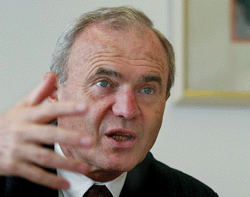
| Issing: faced down criticisms |
On May 31, Otmar Issing, the European Central Bank’s first chief economist and the sole remaining founding member of its executive board, left his office in Frankfurt’s Eurotower for the last time. Architect and overseer of the ECB’s monetary policy strategy, he had come to the end of his fixed, non-renewable, eight-year term. A strong proponent of central bank openness and communication, some three weeks earlier Issing had submitted himself for the eighth time to an annual inquisition – unique among central banks – by outside observers: The ECB and its Watchers series of conferences, which he himself had initiated in 1979. All day he listens to and responds to presentations by academic and market economists and by central bankers from outside the euro zone, who challenge and probe aspects of the ECB’s monetary policy performance and its twin-pillar strategy – in which analysis of the monetary data is used as a cross-check on its analysis of economic data – and also debate related topics such as the implications of fiscal policy and EU enlargement.
Each year Issing has faced down, with eloquent but rigorous argument, criticisms that he likens to those of Goldilocks: some say the role of money in the ECB’s policy strategy is too large, others that it is too small, that the price stability objective in terms of inflation is set too low or that it is set too high, that policy has been too tight or too lax, while he concludes that it is “just right”. Although the same criticisms were heard this time as at the very first conference, they have become less strident and more thoughtfully presented as the ECB watchers have come to understand better the internal logic of the ECB’s policy strategy and have observed the results of its implementation over the past seven-and-a-half years.
But this is not just an intellectual ping-pong match. Issing and his staff take back to the ECB fresh ideas and new arguments which they then debate and research further. His closing words this time were: “It was our decision to meet our watchers, our critics from all camps… For me it has always been a great challenge. I have learnt a lot from these conferences – I would not have liked to miss the experience.”
It fell to Bundesbank president Axel Weber, co-founder of the conference series when he was director of Frankfurt’s Centre for Financial Studies, to make the valedictory speech. Describing Issing as the “implicit third pillar” of the monetary policy strategy he had created, Weber concluded that the strategy’s focus on medium-term rather than short-term objectives made the ECB’s monetary policy largely independent of the influence of individual policy makers, providing it with steadiness and predictability that would continue beyond Issing’s own departure regardless of the consequent change in the composition of the executive board. Cue Jürgen Stark, who twice during the day slipped discreetly in and out of the penumbra covering the rear seats of the auditorium. The Bundesbank’s vice-president had already had his appointment to Issing’s place on the ECB’s executive board formally recommended by the Ecofin council of finance ministers and endorsed by the ECB’s governing council but he was still awaiting the formal opinion of the European Parliament and his predictable subsequent appointment by eurozone heads of state and government.
Word within the ECB, however, was that Stark was unlikely to inherit Issing’s mantle as chief economist. Indeed, gaining ascendancy was the idea that that role should be split up, with responsibility for the analysis of current economic developments and prospects, and the monetary policy recommendations flowing from this, being allotted to one board member and responsibility for research being allocated to another. There is certainly plenty of talent – and no doubt competition – in the six-strong executive board to take on these roles. All but president Jean-Claude Trichet have economics doctorates, three of them from prestigious American universities – vice-president Lucas Papademos and José Manuel González-Páramo (both Columbia) and Lorenzo Bini-Smaghi (Chicago) – and two – Gertrude Tumpel-Gugerell and Jürgen Stark – from universities in their own countries (Austria and Germany). The smart money was on Papademos for the crucial economics slot and on González-Páramo or Bini-Smaghi for research. President Trichet has insisted that the decision would be a collegial one but there will probably have been some arm-twisting before everybody accepted the anointing of the new guardian of the monetary policy strategy and the consequent reshuffling of job portfolios.
John Arrowsmith is a senior partner of Eurozone Advisors, an independent research company. He was formerly senior adviser on western European and EU affairs at the Bank of England, played a key role in drafting the Maastricht Treaty and advised the UK Treasury and Foreign Office on the policies of the European Central Bank. (www.eurozoneadvisors.com)