 |
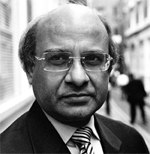
Ashfaque Khan, Pakistan debt office: does not envisage further problems with privatizations |
Pakistan’s privatization agenda will go ahead as planned, despite the botched sale of its leading steel asset earlier in the summer, according to a senior official in Pakistan’s finance ministry. Foreign investors might think twice about tendering offers in any future privatizations in Pakistan, following a decision by the country’s supreme court to overturn the sale of Pakistan Steel Mills in July. But Ashfaque Khan, director general of the debt office and an economic adviser in the finance ministry, says that the failed transaction will not have an impact on future state sales, adding that the country has a good track record of reform.
“I don’t envisage any further problems with Pakistan Steel Mills or future privatizations,” the official told Euromoney in London. The steel concern, he adds, was a very specific case and the government is committed to reform.
The controversy over Pakistan Steel Mills erupted in July when the supreme court decided that the $362 million sale of a 75% stake to a three-way consortium led by Russia’s Magnitogorsk Iron & Steel (MMK) had procedural flaws. The deal had already provoked outrage from labour unions and local nationalists.
In a short statement, the court ruled that the price was too low and criticized the non-implementation of certain rules and regulations during the privatization process. Specifically, it stated that the sale should have been first ratified by the council of common interests (CCI), a constitutional body. To complicate matters, however, the CCI has not met since 1997. The government has now reconvened the CCI, on which sit representatives from all four provincial governments. The body has agreed to a fresh sale of Pakistan Steel Mills and given the green light to other privatizations in the pipeline. What made the Pakistan Steel Mills’ process even more bewildering is that 24 hours after MMK’s official bid, the government received an unsolicited bid from a real estate broker offering PRe8 billion ($132.5 million) more. With the transaction referred to the supreme court, everyone’s case had to be heard, including that of the unsolicited bidder.
Despite the CCI’s clarifications, uncertainty still surrounds the situation. Why, for example, didn’t the privatization commission, and ultimately the government, realize that the Pakistan Steel Mills’ sale and all other upcoming privatizations needed the approval of the CCI first? In that event, why hasn’t the CCI sat since 1997? And what further shocks might foreign investors encounter?
Zahid Hamid, Pakistan’s minister for privatization, has tried to reassure investors, and says the “government is taking steps to implement [the] privatization process according to the supreme court’s observations.”