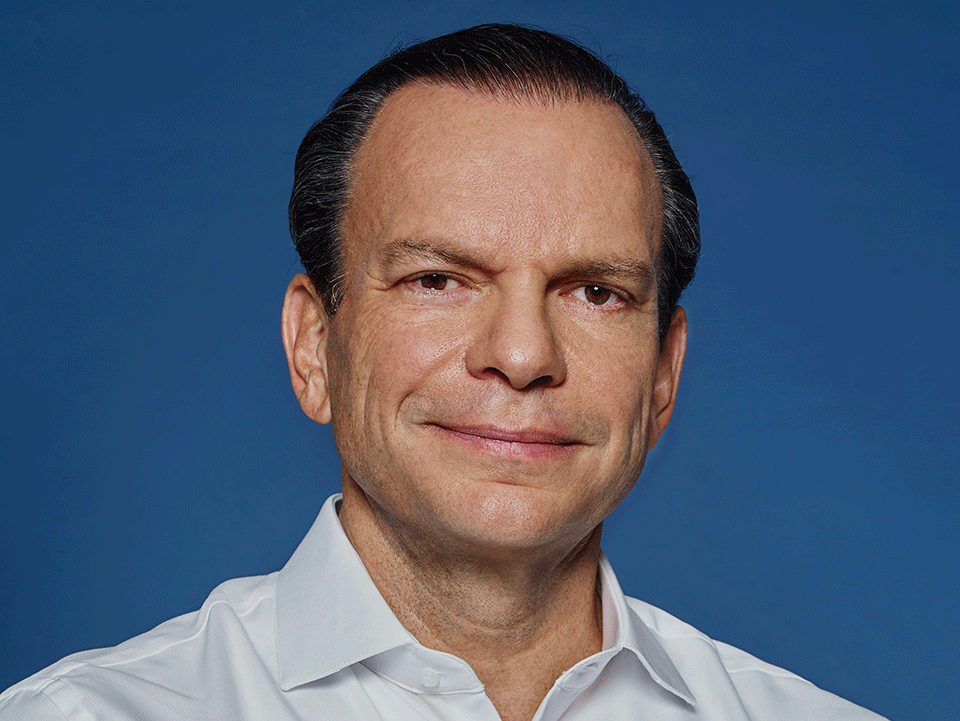
According to Derek Halpenny, senior currency economist at Bank of Tokyo-Mitsubishi UFJ, there is strong evidence to suggest that the importance of reserve diversification by the world’s central banks has been overstated.
Halpenny feels that the end of the cycle of interest rate increases in the US has caused market participants to search for what will be the next driver of the dollar’s value. “The market is starting to look at how the US will fund its current account deficit,” he says. “The perception that emerged at the end of the fourth quarter of 2004 was that the US would look to weaken the dollar to do this and that would fuel diversification.” The Bank of Italy’s move at the start of August to decrease its dollar holdings in favour of sterling seems to provide evidence that this perception is correct.
However, although past data are clearly no predictor of future patterns, Halpenny says they show that there has only been limited diversification away from the dollar. And as this has occurred over a period when the dollar has weakened, he questions whether there is any reason to believe it will now pick up when some of the strong dollar negatives appear to be waning in power.
“Looking back at published reverse data, there’s no evidence to suggest this [diversification] has occurred,” says Halpenny. He points out that data from the IMF show that, as at the end of 2005, dollar reserves as a percentage of the total held by central banks stood at 66.6%. This was actually an increase from the 65.8% figure reported in 2004.
The data shows that there has been only one notable year when diversification was evident – 2002. “The decline in the dollar composition in global foreign exchange reserves in 2002 reflected a shift into the euro,” says Halpenny.
However, the IMF data do not account for the reserves held by 70 developing countries. These “unallocated” reserves, including probably China’s and several oil-producing nations, account for around a third of the total held by central banks. Halpenny says there is no way of knowing if these countries have already diversified.
“We may well know in the future if the dollar was to drop sharply. That would, I suppose, indicate that it didn’t happen in the past,” he says.
Halpenny clearly feels that there has been plenty of time for the central banks to have already reduced their dollar holdings. “Given that the largest shift away from the dollar was in 2002, in the first year of the dollar bear market, it suggests that central banks have become more reluctant to sell dollars at lower levels,” he says. With evidence that the US trade deficit has stabilized, a major reason to sell dollars has been removed.
Furthermore, even though the end of the US rate cycle has probably been reached, it does not necessarily mean the greenback will come under pressure. “The focus will remain on the interest rate story and the dollar still has a relatively attractive yield pick-up. I think the market has already largely positioned itself for a dollar fall and that will limit it. Also, at the end of other rate-hiking cycles, such as in 1995, dollar weakness only proved temporary,” says Halpenny. Not surprisingly, Bank of Tokyo-Mitsubishi UFJ is predicting that the dollar will strengthen before the end of 2006. It is forecasting that the euro/dollar rate will fall to 1.24, while dollar/yen will rise to 120.