|
Digicel factbox Chief executive: Colm Delves |
You are a single-B rated company based in Jamaica. Your business is mobile telephony, an industry more vulnerable to swings in investor sentiment than most. The capital markets have been effectively shut for well over a month and are only just showing signs of life. You’re the chief financial officer and you need to raise money to fund your aggressive regional expansion. But do you take the risk and issue at a time when it seems that only the blue-chip names can borrow? Or do you sit on the sidelines and wait?
For Lawrence Hickey, the CFO at Digicel, the decision was straightforward. In July, the company reopened its 2012 bond for $150 million and in the process became the first true high-yield corporate in the Latin America and Caribbean region to issue since the big market wobble began in May.
Roadshow
“We did a non-deal roadshow in London, New York and Boston in March and I think investors appreciated that,” says Hickey. “The feedback we got is that there is clearly demand for this type of instrument [emerging market corporate high yield].”
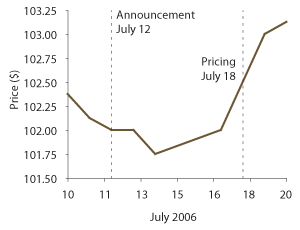
The eventual transaction, he adds, “was a vote of confidence from the market.” The deal, which also helped refinance the company’s existing debt, was more than four times oversubscribed, confirming Digicel’s status as one of the emerging markets’ most sought-after borrowers. The offering generated interest from both new and existing investors. The bond, which carried a coupon of 9.25%, was priced at 102.50, above the 102 bid price in the secondary market. “The pricing was very attractive,” says Hickey, who adds that the decision to reopen its 2012 bond rather than structure a new note proved the right one.
“The structure we had from the original bond was fine and, because demand for it was so strong, and investors were familiar with it, the best decision was to reopen.”
That original bond was Digicel’s debut transaction and was issued exactly 12 months earlier. The market environment for that deal could not have been more different, with liquidity at record levels. Indeed, the transaction caused quite a stir in the market as the seven non-call four-year bond generated an incredible $3 billion of orders that left some bankers scratching their heads in amazement.
Maybe they should not have been so surprised as there were signs in the weeks leading up to the deal that something special was afoot. The planned three-week roadshow was stopped after five days, such was the level of interest being shown. The strong demand, especially from high-yield corporate investors, meant that the eventual $300 million offering was priced barely wider than the sovereign, at 513 basis points over US treasuries.
“Generally, it was a good time in the market,” says Hickey, an Irishman who joined the company in 2002. “A lot of investors had money and were seeking opportunities.” Moreover, few mobile operators in the emerging markets, he adds, were generating the level of revenue and subscriber growth that Digicel was. “Investors were excited,” admits Hickey. About 75% of the bond was placed with high-yield accounts, which preferred to compare the company with wireless operators in the US high-yield market rather than focus on the fact that it’s a Caribbean credit. Investors simply discounted the country risk. “There isn’t a single entity that we can be easily benchmarked against,” says Hickey.
Despite the level of demand, he says the company was happy to increase the bond’s size from its originally planned $250 million by only another $50 million. “We looked at our overall debt structure. There might have been an opportunity to raise more than an additional $50 million but we didn’t feel it was appropriate,” he says.
“We’re quite good at getting finance in a relatively short period of time so we didn’t see the reason to raise cash just for the sake of it.”
Track record
Part of the reason why investors feel so comfortable with Digicel, which is sponsor of the West Indies cricket team, is that it’s part of Irish entrepreneur Denis O’Brien’s empire. O’Brien is one of the world’s most successful businessmen in the telecoms industry. In 1991, he established Esat Telecom in Ireland, which was sold 10 years later to British Telecom for $2.5 billion after a hostile takeover attempt by Telenor. “A lot of bondholders would be familiar with his history and track record,” says Hickey. That, he adds, helps to convince investors that Digicel will deliver on its promises.
|
“When we go to the market we look for a sizeable chunk of money. The capacity of the local market to raise funds is limited” Lawrence Hickey, Digicel |
 |
O’Brien founded Digicel in 2001. The company is now the fastest-growing wireless carrier in the largely underserved Caribbean and operates in 20 countries. Its initial success came in Jamaica, where it launched the country’s first GSM mobile service. At the time, borrowing from local banks or receiving capital injections from existing shareholders was sufficient to fuel its growth. The aim, though, was always to become a region-wide player. As Digicel began to spread its wings, Hickey says the firm continued to borrow aggressively from banks. But by March 2005, the process was becoming unwieldy so the company amalgamated its loans, worth over $400 million, into one structure. “We put in place common agreements with all the lenders.” These included, among other things, common covenants, interest rates and repayment structures.
As Digicel expanded, partly through acquisitions, partly organically, the company decided to venture into the debt capital markets. The decision to re-enter the markets this year was inspired by the company launching in Haiti and Trinidad & Tobago in April and May.
Unprecedented demand
Hickey says the company was always confident of success in those two countries. “We’ve been met with unprecedented demand,” he says. “In Haiti, the biggest challenge has to been to get the handsets on the island quickly enough.”
One benefit of this expansion is that it has helped diversify the company’s revenue streams and so reduce its credit risk. “Early on in our development, Jamaica represented the largest part of our revenues. But on the [non-deal] roadshow we said that, over time as the Trinidad & Tobago business comes on, the level of Jamaican dollars will fall as a percentage of our overall revenues,” says Hickey. “Now we have a good mix of revenues. Our reliance on Jamaica has diminished.”
The company will continue to grow aggressively as the Caribbean and central American telecom industries liberalize further. “We will seek opportunities both organically and through acquisitions and then decide what the next financing step is,” says Hickey.
One area the company will not explore in the immediate future is the local capital market. The company did issue a $30 million-equivalent bond in the Jamaican market in 2003 as part of its revenue/debt hedging strategy at that time. But that need is no longer as great. “The local markets tend to be expensive and lack maturity,” says Hickey. In any case, he adds: “When we go to the market we look for a sizeable chunk of money. The capacity of the local market to raise funds is limited.”
| Investors lap up Digicel’s bond |
| Digicel 9.25% notes due 2012 |
 |
| Source: Citigroup |