EMERGING MARKET INVESTMENT is evolving rapidly as an asset class, and one London firm – Ashmore Investment Management – has managed to position itself at the forefront of change.
Ashmore is no giant of the buy side: with barely more than $20 billion in assets under management, it’s little more than a rounding error when compared with trillion-dollar investors like Fidelity or Barclays. But that $20 billion is invested exclusively in emerging markets, making Ashmore the second-biggest player in the asset class, after Pimco. And if you subtract Pimco’s tactical allocations and look only at the money that it has mandated to emerging markets, the two are neck and neck: Ashmore has slightly more in total emerging market mandates; Pimco still has a couple of billion more in fixed-income mandates.
Ashmore, however, is taking the lead in selling the story of the asset class to institutional investors worldwide, especially after the departure from Pimco of high-profile fund manager Mohamed El-Erian. And no one does that better than Ashmore’s co-founder and head of research, Jerome Booth.
The meat of Booth’s pitch is simple: he points to $4.3 trillion in tradeable debt in emerging markets, up by $1 trillion in just one year. In 15 years’ time, he says, emerging market debt will make up one-third of the global bond market. Emerging markets is no longer a Wild West backwater whose riskiness makes high yield look safe; it’s now an asset class in its own right, deserving of a large, permanent, strategic allocation from anybody running long-term assets.
But while the asset class is growing fast, only a very few fund managers can demonstrate the kind of experience and expertise that large institutional investors require before they’ll start handing out their billions, and Ashmore is foremost among them.
| The sudden rise of Ashmore’s funds |
| Ashmore’s assets under management |
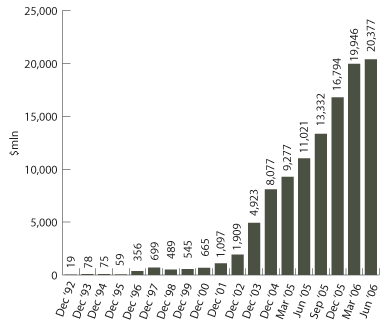 |
| Source: Ashmore |
Veteran emerging markets investor Simon Treacher, for instance, runs BlueBay Asset Management in London, one of the few large dedicated emerging market shops other than Ashmore. He says that he is finding it difficult to find four or five more people to help manage his $6 billion in funds under management, and that in general the human capital barriers to entry in the business are enormous. For the time being, it’s easy to believe Booth when he says that he’s not worried about competition. Booth says: “In the US, it’s us, Pimco, GMO, and Citi/Legg Mason. Between us we got 95% of the institutional mandates in the last 10 years in dollar debt. In local currency and special situations, there’s no competition at all: we have nearly 10 years’ track record with a separate local-currency portfolio.”
It should be noted that for these purposes Booth is ignoring the fact that there are very large fund managers like Fidelity with enormous reach in the retail market. Taken en masse, says Michael Gomez, the new emerging-markets head at Pimco, retail investors are the single-largest investor group in emerging market debt, and will be for some time to come. For the time being, though, Ashmore does not seem interested in selling to individual investors, although such a move seems inevitable sooner or later.
Maybe a move into retail would force Ashmore to grow too much; the entire company fits comfortably on two floors of a backstreet office building in London’s Covent Garden. It has 17 investment professionals, seven lawyers and a marketing staff of just four people globally.
The biggest salesman of them all is Booth, and he is squarely focused on institutions: northern European pension funds, mainly, and, increasingly, central banks as well. Ashmore counts several central banks or other repositories of government savings among its investors – something that makes sense in the context of the enormous reserves that many central banks, especially in Asia, are accumulating. China alone now has $1 trillion in reserves, so even a modest 1% allocation to emerging markets would still be $10 billion, in an asset class where half that sum puts you squarely in the league of big-money investors.
Central banks could be the perfect emerging market investors. The ones with the most reserves generally have vastly more than they “need” by any measure of prudence, which means they can afford to take a bit more risk with the rest. And their own assets are growing extremely fast: according to Brad Setser, head of research at Roubini Global Economics, central banks globally have been accumulating reserves at a rate of more than $150 billion per quarter over the past couple of years, adding up to $2.25 trillion in total just between 2002 and 2005. If inflows into Middle Eastern oil investment funds are added to that, the total increase in official assets between 2000 and 2006 comes to more than $3.7 trillion. And it is being run by investors many of whom are emerging markets themselves, and all of whom are financially sophisticated. What’s more, the economists at central banks, who aren’t as profit-minded as their private-sector counterparts, might well be more inclined to diversify their portfolios for long-term strategic reasons, even if – perhaps especially if – emerging market debt is going through a rocky patch.
“All Asian and Middle Eastern central banks have local currency in their portfolios now,” says Booth, adding that “central banks are more fleet of foot than pension funds: they can move faster and tend to top up much faster in a bear market.”
China, in particular, is widely believed to have placed money with such buy-side firms as Ashmore and Pimco, as well as investing directly through its state-owned banks. The Chinese are understood to be particularly interested in the safer end of the emerging market spectrum, especially the dollar bonds of Mexico and South Africa.
But the really big money – and potential growth for Ashmore – remains in the hands of pension funds. Booth likes to say that there’s $24 trillion in total pension fund money, of which zero is in emerging-market debt (to the nearest trillion dollars). Meanwhile, he says, emerging markets is “the most attractive 25% to 30% of the global debt market, and provides much better diversification.”
A lot of that diversification can come on the foreign exchange side, from moving into local currencies, rather than just on the credit side. Booth is particularly bullish on the prospects for local markets. He sees his dollar bond portfolio topping out at between $20 billion and $25 billion but says the local-currency portfolio could get much bigger.
Booth views local-currency debt as more labour-intensive than dollar debt (“You need different risk controls, and a hefty team of lawyers,” he says), but not necessarily riskier. “Sovereign debt is sovereign risk,” he says. “Changing the currency just changes the payoff matrix.”
Indeed, Booth doesn’t buy the idea that when you buy local-currency debt you’re buying not only credit volatility but also foreign-exchange volatility. “The local currency index is less volatile than US treasuries since 1998,” he says. “The volatility in FX markets is G3 volatility, so a Bund or a gilt will be more volatile than emerging market debt.”
 |
|
“The 1990s’ investor base, which was highly levered, came out of the market and they went and played the Nasdaq. Good riddance” Jerome Booth, Ashmore |
Indeed, JPMorgan’s Elmi local-currency index, made up mainly of one-month, two-month and three-month forwards, has been significantly less volatile than the Embi Global dollar bond index since the emerging markets shakeout of 1998. On the other hand, if you look at a diversified basket of local bonds rather than local currencies, volatility increases: JPMorgan’s GBI-EM Broad index has had higher volatility than the Embi Global since the beginning of 2005, although it had much lower volatility beforehand. During the emerging markets sell-off in May and June this year, local markets in such places as Turkey and Mexico were hit much harder than the dollar bonds of those same countries – and so far, local markets haven’t been stress-tested in remotely the way that dollar markets were in 1998. Booth considers the 1997-98 crises as a turning point in the asset class, when it moved from being a plaything for traders and hedge funds and started becoming a long-term strategic investment for long-only players. “The 1990s’ investor base, which was highly levered, came out of the market and they went and played the Nasdaq,” he says. “Good riddance.”
Booth doesn’t mind hedge funds being in the market (“they’re a source of volatility and we like that: we can make money off them,” he says), but he is clearly reassured by the fact that they no longer have the ability to drive the market off a cliff as they did in 1998.
In fact, the market is deep enough now to ensure that not only are hedge funds relatively unimportant but that even the biggest players like Pimco and Ashmore don’t have the kind of power over issuers and syndicate desks that they used to have.
In local markets, which are much younger and less developed, investors have even less power: bonds are generally sold to set timetables and at auction, since governments don’t tend to issue opportunistically in their own currency.
Although local markets are clearly the future of emerging markets, investors will equally clearly have to be very fleet of foot if they’re to avoid crushing losses in the event of another emerging market crisis.
They’ll also have to have the size and confidence to rush straight back in before the crisis is even over. That’s what Ashmore did in Russia in 1998: it was pretty much the last man standing as far as bond funds were concerned, after its Russian Debt Portfolio fund crashed by 75% over the course of the year yet somehow stayed extant. Indeed, far from disappearing, in 1999 it returned 276%; in 2000 it returned 180%; and overall, since its launch in 1996, it has returned 1,692 basis points per year more than the Russian Embi.
Not all Ashmore’s funds are quite that successful, but the firm does have an impressive track record. Its flagship Emerging Markets Liquid Investment Portfolio (Emlip) has returned an annualized 25.35% gross of fees since launching in 1992, and more than 20% net of fees. That compares with 12.93% for the Embi. Emlip’s best year was 1996, when it returned 61.55%, and the Local Currency Debt Portfolio did even better than that in 1999. It’s all pretty impressive for a fixed-income shop.
Ashmore is majority owned by Mark Coombs, who has veto power over investment decisions but rarely if ever uses it; the best-known fund manager is Jules Green, who works on the Emlip full-time and is known to have very good relations with issuers, even if he does sometimes get aggressive with their investment banks.
Green sits on Ashmore’s investment committee with the company’s nine other portfolio managers; the rest of Ashmore’s 17 investment professionals are devoted to what Ashmore calls “special situations”; most other people would probably call it private equity. Neither Green nor Coombs nor anybody else at Ashmore ever makes investment decisions single-handed. All decisions are made collectively, by the committee, which meets every week and on an extemporaneous basis as necessary. “We have a reaction time in minutes,” says Booth. “We can move very fast.”
Interestingly, Ashmore, in stark contrast to Pimco, has no traders; it doesn’t even follow the BlueBay model of having people whose job it is to execute trades but who have no P&L of their own and aren’t allowed to take any initiative or try to time or trade the markets. Rather, the investment professionals simply execute their own trades, after, of course, the investment committee has signed off on them.
The other big difference between Ashmore and Pimco is that Ashmore doesn’t confine itself to fixed income. It has a small top-down public equity fund, but it’s much more excited about its special situations fund, and devotes two full-time professionals to special situations in China alone.
Ashmore might sometimes be interested in distressed debt, but never with a view to litigation. Much more likely would be some kind of debt-for-equity swap in full cooperation with the owners. The Ashmore team has been doing special situations deals since they were at Grindlays bank in London in 1983; the first dedicated special situations portfolio was launched in 1998, and the rate of return on exited deals is more than 35%.
And while the huge US private equity funds have more money than they know what to do with, Ashmore has the opposite problem. “We’re turning down a lot of deals, or having to bring in partners, for lack of capital,” says Booth. “We’ve got much more dealflow than capital, and in special situations a $1.5 billion fund would be drawn down in a year.”
Booth is coy about the deals that Ashmore has done: the company likes to keep them quiet, especially since many of them involve co-investing with foreign governments in third countries. But one recent deal (not Ashmore’s largest, Booth says) was the acquisition of 15 emerging-market utility and power assets formerly owned by Enron for $2.2 billion. As yields on emerging market debt stay low, Ashmore is going to have to find many more such deals to keep its total returns anywhere near their historical levels.