Market sentiment: Who cares who wins?
Sterling’s recent fall back below 1.90 against the dollar was attributed by some to the apparent near outbreak of civil war in the UK’s ruling Labour Party. However, since there was little lasting weakness shown against other currencies, most market participants played down the impact that Labour’s shenanigans to oust its leader and UK prime minister Tony Blair had on the pound. Instead, cable’s fall was seen more as a product of unexpected dollar strength.
In fact, whether prime minister Blair was going to become the victim of a modern-day night of the long knives and be replaced by his one-time sidekick and next-door neighbour Gordon Brown really warranted little concern in the market. Similarly, the possibility of a challenge emerging to threaten Brown’s long wait for the top job in British politics has also elicited little more than a yawn. Even the possibility that Labour’s potential implosion was increasing the likelihood of the opposition Conservative Party returning to power after a decade in the political wilderness seemed totally irrelevant.
This is all in huge contrast to the way currencies and other assets used to react. Once, it was not only an issue about which party was in power, but also who was in charge of that party.
Older hands, especially those involved in sterling markets, will remember how UK assets moved during the 1992 UK general election. After more than a decade in power, the ruling Conservatives were perceived as a fading force. A bout of infighting had seen the replacement of an apparently once strong, authoritarian leader with an altogether greyer and more woolly figure. A Labour victory was widely predicted.
Abrupt mood swings
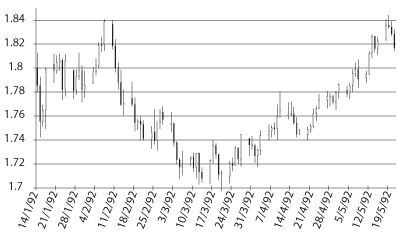
Back then, Labour was seen as distinctly business-unfriendly. The thought of the impact its policies would have on the UK economy spooked the markets, and both sterling and gilts came under considerable pressure. Cable fell from around 1.8400 to 1.7000 in the run-up to the election. On April 9, it closed at 1.7405. However, sentiment abruptly changed as the Conservatives managed to stage a surprise victory and cable traded up to 1.7800 the following day, a modest move in that environment.
| Sell the rumour, buy the fact |
| Cable before and after the 1992 UK general election |
 |
| Source: Reuters |
The short-term impact was arguably greater in the gilt market. As the Bank of England wrote in its May 1992 Quarterly Bulletin: “The market stayed open on election night as did the Bank’s Gilt-edged dealing room, principally to monitor developments and ensure an orderly market. In the event, as the election result became clear, there was substantial demand for Gilts, which the Bank met, exceptionally during the night; two packages each of £800 million of tranchettes were announced at 2.30 am and 8.15 am, both of which sold out very quickly.” The Bank added: “Including sales on 10 April, gross official sales of some £4 billion were made in the first 10 days of April, a substantial contribution to the funding requirement for this year.” In today’s landscape, with both politicians and their parties increasingly appearing homogenous, it is hard to imagine that a debt manager would even remotely consider staying up all night to take advantage of any such sudden demand for bonds.
Muted reactions
Even though few analysts and strategists are prepared to venture the opinion that it really makes little difference now who is in power, they will point out reasons why the market reaction to changes in the political environment are muted.
“Basically, a lot of the central banks, including obviously the Bank of England, are now independent,” says Tony Norfield, former global head of FX strategy at ABN Amro. “Unless a change in the political landscape threatens their independence or a significant change in monetary policy, such as a major altering of an inflation target, the issue of political interference has largely been removed.”
He adds: “The second factor is that fiscal policy has become far more tightly controlled. There’s more political consensus on fiscal policy and less likelihood of governments trying to spend their way out of trouble. There is also more liquidity. In the past, a market might have had to move 10% before it stopped. People are more likely to step in and take profit a lot sooner these days.”
Matt Sharratt, economist at Bank of America, broadly agrees. “The question to ask is how much is macro-policy likely to change under a new Labour leader or even the Tories, if they win the 2009 general election as polls currently suggest. The answer is simply not much,” he says.
“Brown has been intimately tied to the heart of macro policy under Labour. There is no question about changing the current arrangements for the Bank’s independence. On the fiscal side, the market already knows where Brown is coming from. Tightening is already in the pipeline after years of very strong real-term spending growth. Brown has also come out strongly on keeping a lid on public sector wages. Given his pride in his ‘prudent’ reputation, it really does not seem as if the broad parameters of fiscal policy would change for the worse and become significantly looser,” he adds.
Unexcited
“The more interesting question is whether the Tories would offer a more market friendly alternative. Here too, the differences in policy appear slight after Cameron’s move to the centre. Tax cuts are not yet being loudly touted and commitments are being made to preserve current spending levels in the public sector. Fiscal gains are apparently to be made via greater efficiency. All in all, there’s not much for the markets to get excited about,” Sharratt concludes.




