YOU WANT HIGH returns with little to no risk? It’s easy. Just buy Brazilian reais. Overnight interest rates are north of 17% and the currency only ever seems to get stronger. If you’re a dollar investor, you’re making high nominal returns from Brazilian domestic rates; what’s more you are getting capital gains from currency appreciation. No wonder local markets in general and Brazil’s in particular are the new hot asset class.
In emerging market trade body EMTA’s quarterly volume surveys, local-market treasury instruments consistently account for roughly half of the total volume in emerging market debt. That’s up from 19% in 1994 and 35% in 2000, and means that every year banks trade more than $2.5 trillion in Brazilian reais, Mexican pesos, Polish zlotys and other formerly exotic currencies, much of it being sold to US and European investors who have never owned such securities before.
“Latin America has been invaded by a new flow of money in the last year and a half,” says Jorge Alonso, head of Latin America local markets at JPMorgan. Alonso estimates that foreign holdings of Latin governments’ treasury securities have doubled in that time.
And in the equity markets, between 60% and 70% of the free float in the Brazilian market is in the hands of foreigners, according to estimates from Dario Lizzano, head of Latin American equities at Santander in New York.
The investors buying this paper are not just hedge funds desperate for return. Every major emerging market fixed-income investor nowadays has a significant exposure to local-currency debt, because there are no attractive dollar-denominated assets any more. Increasingly, the insurance companies and endowments that mandate emerging market investors are either asking that as much as 40% of total exposure be in local currency, or asking to be able to put their money into dedicated local-currency funds.
Buy-side firms are beginning to respond to the demand. “There are now dedicated funds looking for all types of assets,” says Alonso, and more are being created every month. Aegon is putting together a fund that will invest in single-A rated securities or higher, and Union Investment, in Frankfurt, will launch a A200 million fund in April aimed at retail and institutional investors.
“From an asset-management point of view, there’s a limit to how far external spreads can go,” says Daniel Moreno, who’s setting up the Union Investment fund. “After three years of spread compression, investors are looking for higher returns elsewhere, and it’s quite logical to look to the local markets.”
Moreno expects that in a year or two other asset-management companies will have set up enough funds similar to his to mean that local-market debt will become an established asset class in its own right. “Mexico and South Africa are the most developed markets,” he says, but he’s optimistic about the development of markets in higher-yielding countries too. In countries from Peru to Botswana, investors who are comfortable with currency and convertibility risk can find yields vastly higher than anything available by taking just credit risk alone.
Investing domestically actually decreases credit risk: Mexico’s foreign currency credit rating is triple-B, while its domestic bonds carry a single-A rating. After all, sovereigns can always choose to print more money rather than default on their domestic debts.
Towards normality
In Latin America, countries are moving their foreign investors from dollar debt to local debt. “It’s a sign of maturation: it is the normal way for issuers to issue and investors to invest,” says Moctar Fall, head of Latin debt capital markets at JPMorgan. “In the past, we used the hard currencies as a safety net. But once an investor is comfortable with the economy, there is no reason to limit your investment to a dollar asset.”
Brazil is the prime example. With no risk of immediate default, short-dated dollar paper trades at close to risk-free rates, even as the central bank has set its benchmark interest rate at 17.25% in service of its inflation-targeting mandate. With inflation near 4%, that means real Brazilian interest rates are well into double digits – a state of affairs few foreign investors can resist.
Brazil’s yield curve is steeply inverted, but even at the long end the country yields much more in reais than in dollars. The government’s recently issued 2016 real-denominated global bond, for instance, yields about 12% in reais, while dollar bonds of the same maturity trade at a yield of 6.6%. If you believe in the Brazil story – and most emerging market investors are firm believers – you think long-term rates are coming down, while a large and structural current account surplus will help the currency continue to stay strong or even appreciate further. On top of your 12% yield, then, you also get capital gains from bond prices rising in reais, and even more potential gains from the currency play.
It’s a story that has played out well in the past. “We’ve seen the convergence play work in Mexico in 2002-03,” says Alonso. “Now we’re seeing it in Brazil.”
And even when you don’t like the underlying macroeconomic story, local markets can be highly attractive. Inflation-linked bonds in Argentina, for instance, were originally designed so that domestic investors could protect the value of their money. Increasingly, however, foreign investors are buying them as a bet that inflation in that country is going to rise. If it does, the bonds pay out more – and because of the link between a depreciating currency and inflation, the investors are even somewhat protected against devaluation as well.
Outside Argentina, inflation-linked bonds are becoming more popular among foreign investors not because they’re bearish about inflation but just because of the arbitrage against the nominal debt. “I don’t think people are looking into inflation-linked instruments because of the protection vis-à-vis the currency,” says Alonso. “They’re looking at the yield pick-up.”
Local bonds are also a fantastic source of diversification. For the past few years, bankers such as Citigroup vice-chairman Bill Rhodes have regularly warned of a lack of differentiation between emerging market credits: the rising tide of the EMBI has lifted all boats, even those whose fundamentals don’t warrant the kind of spread tightening they have seen. The corollary is that if and when there is a sell-off in dollar-spread product, every country and every bond is likely to be hit.
Correlation plays
That’s not the case in domestic markets, however. Although most global bonds have a roughly 80% correlation with the US treasury market, even the domestic debt of Mexico is only 50% correlated with treasuries. Most other domestic markets have lower correlations still. And when it comes to correlations between domestic markets – Colombian bonds versus South Korean ones, for example – the correlation is essentially zero. Since many fund managers, especially at hedge funds, are compensated on the basis of their risk-adjusted returns, an asset class that can so greatly decrease risk while at the same time increasing absolute returns is something of a holy grail.
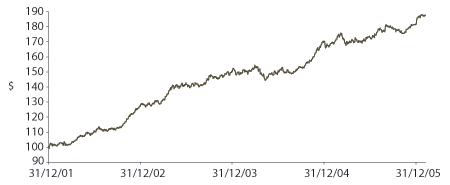
| Local currencies offer strong returns GBI-EM broad local market index: total returns |
 |
| Source: JPMorgan |
Interest from foreign investors is not always a good thing for the countries involved, however. When debt is rolled over by domestic investors, any profits made by domestic banks and pension funds ultimately benefit the economy as a whole. That’s not the case if the government’s interest payments leave the country entirely. Brazil is a good example. Like many other countries, it has historically been wary of foreign investors coming into its domestic markets looking for outsize returns. After all, it was only four years ago that a massive bout of risk aversion had those very investors dumping their Brazilian debt at as little as 40 cents on the dollar.
Had those foreign investors been holding domestic treasury bonds, the government and foreigners would have been selling the same securities at the same time to the same relatively small group of domestic investors, and the consequences could have been far worse.
Policy dilemmas
Even if there’s no crisis and no panic, foreign investment in domestic securities is hardly an unqualified boon for the Brazilian economy. It does help to bring interest rates down. But the flow of funds into the country also bids the exchange rate up, decreasing exporters’ competitiveness. “The most immediate impact is in the currencies,” says Mark Dow, a former IMF economist who has now moved to Pharo, a hedge fund. “It may produce pressures for the local currency to appreciate above and beyond fair value, which could create policy dilemmas for local authorities.”
So the markets understood completely when Brazil issued the 2016s in New York: there were good reasons not to want the buyers of that bond to be sending their money to Brazil. “If you open the door too much, god knows who comes in – and you can’t control them,” says a source close to the deal. “You have to ensure that you have a system that’s mature enough. The risk is that two or three big hedge funds come in and make a mess.”
And yet Brazil looks very much as though it is minded to follow Mexico’s lead and open its domestic capital markets to foreign investors. In addition, the government’s emphasis on buying back foreign debt means that the local markets will become more important. To all intents and purposes foreign investors are already in the market.
Very few foreign institutional investors have their money directly invested in Brazilian fixed-income instruments: there are far too many taxes standing in the way. Instead, they buy a structured product from their local financial supermarket that offers the same exposure without the hassle or the taxes.
Deutsche Bank or Citigroup or Santander will buy whatever exposure their clients want in the Brazilian domestic market, and then sell that same exposure in Frankfurt or New York or Madrid through a pass-through note or any number of much more complex instruments. Investors can even embed any option they want, giving themselves leverage or hedge depending on their risk appetite.
One of the most popular products is the total-return swap, where an investor simply picks a currency and a duration to fund in – often overnight dollar Libor – and another currency and duration to invest in, such as long-dated Brazilian real bonds. So long as the investor is happy with the currency risk, all he then need do is to sit back and earn the carry. Local Brazilian investors can’t do that, because their overnight cost of funds is higher than the yield on the long-dated paper. As a result, international players dominate the long end of the Brazilian curve.
The synthetics business is highly profitable for the banks but probably won’t last. “We don’t pay any of the taxes that the investors would have to pay, and charge a small fee for letting them participate in the market,” says one foreign banker. “Going forward, that’s bound to disappear.”
If foreigners are going to be loading up on Brazil exposure anyway, it makes sense that they do so directly rather than through costly middlemen. The government is expected to announce a series of measures to cut taxes on foreign investments in locally issued public debt.
As soon as the taxes are lifted and investors can buy underlying bonds rather than structured products, foreign flows into Brazil are likely to surge. But Brazil isn’t sure that it wants such a surge. Already, says Pharo’s Dow, there’s a risk of too much money chasing too little in the way of emerging market assets. Some of the money is crossover investors wanting tactical, out-of-index exposure, but most is institutional strategic investors allocating capital to the asset class for the first time. “This money is oil tanker money,” he says. “It took them three years to make the decision to invest, and it would take them just as long to decide to leave. But the size of the inflows may end up being mismatched with the size of the opportunity set.” Pharo sees a situation akin to the Thai equities market in the early 1990s, where the market simply wasn’t big enough to absorb the amount of money that foreigners wanted to invest.
But a look at the Mexican market shows what the upside could be for Brazil if it does dismantle its barriers to entry.
Mexico’s smooth curve
At the moment, the domestic Brazilian yield curve is unimpressive: it’s short and yields are very high. In Mexico, by contrast, the yield curve is smooth and liquid all the way out to 30 years. Dozens of corporates price easily off the sovereign, and there’s even a fast-growing market in mortgage-backed securities. Most impressively, the markets don’t seem to be fazed when foreigners leave, even at the long end of the curve. Consider what happened in the three months between two large peso-denominated 10-year bond issues by Carlos Slim’s telecommunications companies.
First, in November, was wireless firm América Móvil. It issued at a yield of 9.13%, 55 basis points over the Mexican bono, with the Mexican peso trading at 10.85 to the dollar. Nearly all of the interest came from European and US accounts.
Then, in January, it was the turn of fixed-line operator Telmex. By that point, the peso had strengthened to 10.50 against the dollar, meaning that international investors saw much less scope for currency appreciation. Yields had also fallen on 10-year Mexican domestic government debt, from 8.58% to just 8.05%. International investors were therefore that much more reluctant to join the party.
In the end, the Telmex bond came at 8.75%: 38bp inside where the América Móvil bond had priced, yet 15bp wider to the sovereign. Sixty per cent of the bonds were allocated to local investors, who stepped in when the foreigners were no longer interested.
In effect, Mexican corporates now get two bites at the cherry. When spreads over dollar rates are high, they can take a leaf out of América Móvil’s book and sell to foreign investors at 440bp over equivalent US treasuries. When interest rates converge, they can behave more like Telmex. That bond’s yield was just 360bp over treasuries, but no one minded because the domestic investors were happy with the 70bp pick-up over Mexican government bonds.
The Mexican markets are still developing, of course. So far, only América Móvil and Telmex have issued bonds with simultaneous listings in New York and Mexico. The local certificado bursatil (corporate bond) market is still very much dominated by local investors. What’s more, the Mexican markets don’t seem to do a great job yet at pricing credit risk: issuers such as the Inter-American Development Bank or the Province of Quebec still end up paying a premium over the Mexican sovereign.
But there’s no doubt that the development of the domestic capital markets is one of the signal achievements of the administration of Vicente Fox. Now that the market institutions are in place, demographics can do the rest of the work: Mexican pension funds, just like pension funds in Brazil, Chile, Colombia and Peru, are growing at 10% to 15% a year, with no redemptions in sight for at least a decade.
Ultimately, those pension funds will dwarf whatever hot money comes into the region. Today they have $450 billion under management, albeit conservatively invested. Total domestic investment funds in Latin America, including money in mutual funds and insurance companies, is roughly $1 trillion.
“What we are betting on here at Citigroup is the growth of the domestic markets,” says Luis Nunez, head of Latin American local markets at the US firm. “Money internationally is invested in emerging markets as a diversification. Money domestically is invested in the local markets because the liabilities are in that currency.” Nunez points out that already Colombian pension funds, running out of securities to buy domestically, own one-third of that country’s dollar-denominated global bonds.
Indeed, domestic pension funds can sometimes now provide funding at more competitive rates than the international capital markets. Caribbean development bank Cabei recently issued a $200 million 10-year bond in the domestic Colombian capital markets. Desperate for diversification, Colombian investors snapped up the deal at 65bp inside the sovereign curve, a level that swapped back to dollars at just 15bp over Libor. That’s not bad for a triple-B rated issuer.
Local markets are flavour of the month for international investors, and are likely to remain so as long as dollar yields remain at all-time lows. But the real hope for the asset class lies at home.