
“EVERY HEDGE FUND manager I speak to has at least one ‘hot money’ fund of hedge funds horror story,” says a fund of hedge funds executive. Horror stories are indeed plentiful. “We’ve all heard the story of the hedge fund that went from $100 million to $1 billion in a year, and then back to $100 million a year later due to funds of hedge funds inflows and outflows,” says Adam Sussman, senior research analyst at Tabb Group. This short-term view of parking money and pulling out is becoming a bugbear among hedge funds, which are increasingly turning away fund of hedge funds money.
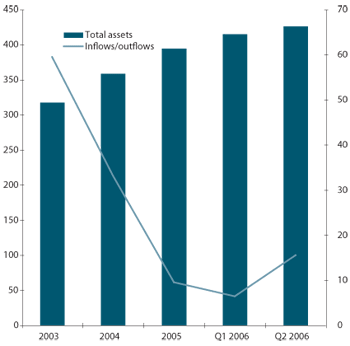
There are 2,071 funds of hedge funds in HFR’s database alone. Three years ago there were 1,232. Their combined assets under management total $426 billion – one-third of the estimated $1.2 trillion in hedge funds, and market participants suggest these figures are conservative. It’s a huge industry, founded on the principle that funds of hedge funds can do a better job of picking hedge fund managers, diversifying returns and gaining access to high-quality funds than an individual investor can. But recent events indicate that this is not always the case. Once the lifeblood of hedge fund managers, an increasing number of funds of hedge funds are being rejected as hot money. At the same time, investors in funds of hedge funds are voicing their dissatisfaction with investment performance and operational due diligence. Some of these middlemen need to clean up their act before the entire industry is tarnished.
Hot high-net-worths
Certain funds of hedge funds have developed a reputation as being fast money. One such type is the Swiss fund of hedge funds. As one high-net-worth investor with a long-term investment horizon explains: “Swiss funds of hedge funds are just about the worst money you can take in. They are the fastest money on the street, coming in and going out. And every hedge fund manager is aware of that.”
This is held to be because the end investors in such funds are wealthy individuals that are chasing the highest returns possible, forcing the funds of hedge funds to change underlying managers more frequently than normal. The high-net-worth individual says: “One hedge fund manager I know started his first year with $250 million and was up 25%. In his second year, the fund reached $900 million but was down 14%. Funds of hedge funds pulled out $300 million and said he wouldn’t be in business for much longer. But the following year he was up 80% and now he has several billion in assets under management.” According to the high-net-worth individual, this manager refuses to let those funds of hedge funds back in.
Other managers have similar views on funds of hedge funds that exit at the first sign of performance concerns. “It is a small industry, and if you develop that reputation, you will have trouble getting into the medium-size good-quality funds,” says one manager.
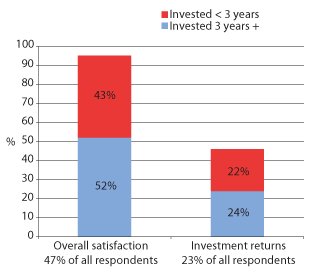
| Institutional investors grow more wary |
| Percent highly satisfied by funds of hedge funds |
 |
| Source: Mercer IC |
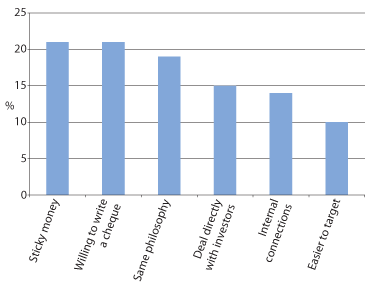
Sadly for funds of hedge funds that do take a longer-term view, this hot money reputation is a challenge to the future of their industry. In a Tabb survey of hedge fund managers earlier this year, respondents predicted that funds of hedge funds’ share in hedge funds’ investor base would fall by 11% a year to 2008. They will be replaced by direct investments from pension plans, endowments and institutions. The same Tabb survey indicated that 21% of hedge funds cited “sticky money” as a characteristic they preferred in their investors.
| Hedge funds want stickier money |
| Preferred investor characteristics |
 |
| Source: TABB Group |
Endowments and institutional investors fit that bill, taking a much longer-term view when investing. John Moehling is the co-head of hedge fund investments for the University of Chicago’s $5 billion endowment. He admits that hedge fund managers appear much more excited about receiving capital from endowments than from funds of hedge funds. “Endowments and institutional investors are much less quarter-to-quarter performance-oriented,” he says. “Funds of hedge funds look at performance more closely on a quarterly basis because of their underlying clients, whereas we invest for longer periods of time and allow money managers’ strategies to play out.” Some funds of hedge funds say their investments have been returned and replaced with this perceived sticky money. “It is really beginning to irritate those funds of hedge funds that approach their investments sensibly,” says one fund of hedge funds manager. If funds of hedge funds are to be considered by high-quality hedge funds as suitable investors, it is clear that they will have to be act more like the favoured endowments. William Maslovsky is senior vice-president of hedge fund strategies at fund of hedge funds manager Lion Cao Asset Management (LCAM), which has adopted the approach of an endowment portfolio in constructing its hedge funds portfolio. “Endowments often have higher returns with lower volatility and take a long-term approach in selecting their underlying managers,” he says. “One key point of emphasis is the compounding effect of positive returns from their hedge fund portfolio. Like an endowment, we spend a large amount of time selecting a relatively small number of hedge funds which we view as partners and then devote the resources to understand fundamental organizational, portfolio and risk management changes.” Furthermore, endowment management offices benefit from access to highly regarded professionals in the hedge fund industry through their alumni and faculty network and collegial relationships with other endowment offices. These can provide added insight and enable access to funds that are otherwise closed to many investors. LCAM has an investment advisory council composed of current and former CIOs and investment officers of leading endowments.
Conflicts about liquidity
As institutional clients take preference as end investors, high-net-worth clients are having to be reconsidered by funds of hedge funds that want to be regarded as long-term money.
Girish Reddy, former co-head of equity derivatives at Goldman Sachs, is managing partner of $1.5 billion fund of hedge funds Prisma Capital Partners, which he set up in 2005 with Gavyn Davies and Thomas Healey. His fund’s liquidity schedule varies but portfolios typically have a one-year lock-up. “I think hedge funds are much more nervous about funds of hedge funds that represent high-net-worth clients as they are focused on short-term performance,” Reddy says. “They want stability of capital. Ninety-five percent of our assets are institutional, and performance is one of the lower-ranked reasons for us when deciding to leave a fund. Style drift and organizational changes are deemed more important.”
This issue of liquidity is becoming increasingly complicated in the relationship between hedge funds and funds of hedge funds. Some hedge funds that have highly liquid strategies, which would, in theory, be more enticing to funds of hedge funds, are being turned down by players in the industry that want to be seen as long-term strategic investors. One hedge fund manager says: “We were refused by one fund of hedge funds as they were concerned that our quarterly liquidity would mean they would be co-investing with hot money.” Hedge funds with quarterly liquidity can often suffer at the hands of funds of hedge funds. “For example, if an end investor wants to get their money out, a fund of hedge funds is forced to redeem from the most liquid strategy,” says another fund of hedge funds manager. “This could be the best-performing underlying hedge fund. The frustration for hedge fund managers offering this liquidity is that they can’t even judge what redemptions will be based on performance.”
Mismatches in liquidity requirements of funds of hedge funds and those of institutional clients are causing chaos. Some funds of hedge funds need to offer quarterly liquidity to meet high-net-worth individuals’ needs, while endowments and pension plans are happier to take on longer lock-ups and don’t want to invest alongside funds of hedge funds that might pull out because of poor performance. “You have to find out what the liquidity requirements of the other investors in a hedge fund are or else you risk being damaged,” says Julien Sevaux of family office Stanhope Capital.
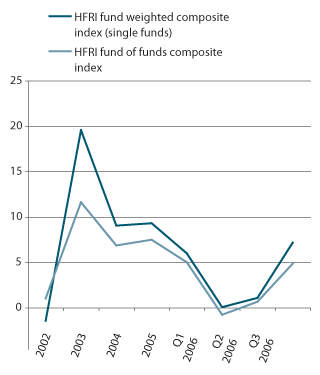
| Fund of hedge funds performance falls |
| HFRI Monthly Indices – performance 2002 to Q3 2006 |
 |
| Source: HFRI |
David Ben-Ur, portfolio manager and director of research at $2 billion fund of hedge funds Corbin Capital Partners agrees on the importance of considering other investors. Corbin’s end investors are predominantly institutional and so the firm looks for like-minded underlying investors. “We look for hedge funds with end investors such as endowments, family office and foundations, and there is also a selection of funds of hedge funds that we would invest alongside,” says Ben-Ur. That is not to say that long lock-ups equate to better investing. Philippe Bonnefoy of fund of hedge funds Cedar Partners says: “There is a place for long lock-ups in certain strategies, but for some hedge funds it leaves room for abuse. It’s not black and white.” An alternative to having institutional investors as underlying clients in order to deter frequent redemptions is to offer less liquidity to end investors. Seattle-based Quellos is the seventh-largest fund of hedge funds globally, with about $15 billion in assets under management. It has been running for more than 11 years. Eighty percent of its end investors are institutional clients. Its CIO, Bryan White, says it has altered its liquidity levels to end investors over that period the better to suit them and the hedge funds in which it invests. “When we started, the world worked on a quarterly redemption cycle,” he says. “Nearly all hedge fund managers had a quarterly redemption schedule. But today you could be facing semi-annual liquidity after a two-year lock-up. So we have altered our structure accordingly so that our funds better match our assets and liabilities. We have emphasized the growth of long-term committed clients and largely avoided the ‘fast money’ that stems from structured products. Our core funds offer quarterly, annual and three-year liquidity buckets, enabling clients to pull a portion of their money for rebalancing purposes while allowing us to commit to hedge funds with less frequent redemption cycles.”
Too big, too quick
It is not just the small to medium-size Swiss funds of hedge funds that are being branded as hot money. Some of the largest independent funds of hedge funds managers are being singled out as being destructive for hedge funds because of their short-term approach to investing.
Mr X used to work in the due diligence department for one of the top-10 funds of hedge funds. His job entailed researching the operational quality of hedge funds to put before the final manager selection committee. “It was purely for show,” he says. “I would report back to the committee on a hedge fund, and, before even starting my presentation, would be told: ‘We’ve already allocated $50 million to the fund. Unless there is a huge problem here, then let’s leave it. We can pull it out next quarter when we find something better’.” The root of such thinking is fundamentally greed. Some funds of hedge funds are taking on so much money that they need to park it as quickly as possible and are not considering hedge funds as long-term investments. One hedge fund manager says he was recently approached by a fund of hedge funds that claimed to be taking as much as $200 million from investors each month. With a 1% management fee, it is easy to understand why it is difficult for funds of hedge funds to say no to new money. However, taking on so much money puts firms in an awkward position. One manager says: “Large funds of hedge funds are forced to put money to work immediately. So they’ll allocate money where they can. For some funds of hedge funds this can be at the expense of proper operational due diligence. The theory is: pick a fund with short-term liquidity, dump it there and then pull it out when you’ve found somewhere better to put it. Just make sure it is invested in something. And who cares if the fund does badly? A $25 million investment for a $20 billion fund of hedge funds is not a significant risk.” Some funds of hedge funds are more sensible when it comes to capacity. Andrew Gibson, executive director of fund of hedge funds IAM, says: “The risk of raising assets too quickly is that you either start selecting tier-two or tier-three managers or you add so many managers that you diversify away all manager risk. All investment managers operating in a capacity-restricted business need to stay focused and disciplined on their research and avoid short cuts or becoming too marketing driven. We always say if we are not finding the quality, then we won’t take on new business. Indeed, the first four months of 2004 we didn’t take any money in.”
| Fund of hedge funds assets continue to grow |
| Industry assets ($bln) up to Q2 2006 |
 |
| Source: HFRI |
The hedge fund managers that suffer most from this depositing of short-term cash are those that are just starting up. They are of course, not blameless. Start-up hedge funds are desperate themselves for sources of capital (as are most hedge fund managers) and manage their investor base poorly. The Tabb survey showed that, alongside sticky money, “those willing to write a cheque” were the preferred investor types. But accepting large sums of money from funds of hedge funds unwilling to stay the course has led to several disaster and near-disaster stories. Many small hedge funds see half their assets walk out of the door when a fund of hedge funds leaves. In addition to having merely to park money to gain the 1% management fee, funds of hedge funds know that they need to be investing in high-performing funds to compete with their peers, earn a performance fee and attract yet more assets. So they pull money out of hedge funds as soon as performance dips.
Another operational due diligence executive with a different top 10 fund of hedge funds reportedly left in disgust when it became clear that investment performance was the only measurement by which underlying hedge funds were judged in the allocation process.
One Asia-based hedge fund manager says he had a close call as a result of GAM, the $25 billion fund of hedge funds, pulling out after a drawdown. “They told us they were a long-term investor and put a large sum of money with us. We had almost two years of positive performance, and then, one drawdown and they were gone. It could have destroyed us,” he says. This manager has since gone on to produce positive performance and raise assets elsewhere. Another market source says he speaks to investors, and some refuse to invest alongside GAM because of its reputation for being quick to pull the trigger. GAM has the added disadvantage of having a client base dominated by private clients. It also has leveraged funds of hedge funds, which some market observers say exacerbates the problem. One fund of hedge funds manager with a five-year investment time horizon says: “Systematic funds of hedge funds (such as some of the leveraged ones) will tend to have much shorter holding periods by design, as their model cannot afford to patiently wait out long drawdowns. I’ve heard that certain of these funds automatically redeem anything that has a losing quarter.”
A spokeswoman for GAM said the firm declined to comment. GAM is not the only large independent fund of hedge funds to have attracted such criticism.
And the end investor?
Funds of hedge funds that are upsetting hedge funds risk tarnishing the entire industry and could drive end investors away. If funds of hedge funds are increasingly disregarded as viable clients of hedge funds, the value they offer to end investors also comes into question. Investors in funds of hedge funds rely on the vehicle to access hedge funds. If this route is blocked or narrowed, institutional investors in particular will do better to access hedge funds directly and save on the double layer of fees. A survey of 181 institutional investors by Mercer Investment Consulting revealed a fairly chilly attitude towards the supposed added value that funds of hedge funds offer. Fewer than half of those surveyed said they were satisfied with the overall performance of their funds of hedge funds.
Furthermore, investors in funds of hedge funds are relying on them for manager selection and due diligence expertise. If it is true that large funds of hedge funds are allocating money to managers regardless of operational due diligence findings, serious doubts as to the value of funds of hedge funds start to creep in. One fund of hedge funds manager admits that while his firm’s operational due diligence is among the best in the industry, some investments are based on the identity of other investors in the room. “Basically, if we see that seeding firm Cap Z is getting involved, it’s a stamp of approval for us,” he says. Such stories make some fund of hedge funds managers wince. “The operational due diligence is one of the most important parts of our manager selection,” says Quellos’s White.
Some investors are tricked into thinking that operational due diligence is a size game, and that those funds of hedge funds with the most assets under management will be better equipped to implement it. However, those caught out by the September blow-up of energy hedge fund Amaranth throw doubt on this theory.
Man Group, UBP (Union Bancaire Privée), and Goldman Sachs Hedge Fund Strategies are among the 10 largest funds of hedge funds. They had exposure to Amaranth when many other funds of hedge funds had declined to invest, or, reportedly in the case of Blackstone, redeemed earlier in the year. (UBP did reportedly reduce its holdings in Amaranth before the fund’s demise.)
To top it all, the performance of funds of hedge funds has come down substantially. The HFRI fund of funds composite index has returned just 4.85% year to date. At the end of 2003 it returned 11.61%, at the end of 2004 6.86%, and at the end of 2005 7.49%. Only 23% of institutional investors surveyed by Mercer IC said they were satisfied with investment returns of funds of hedge funds. Twenty-eight percent said they were dissatisfied.
Although returns have come down for all hedge fund managers, whether as a result of a growing, more risk-averse institutional investment base, or because of lack of opportunities, funds of hedge funds will need to be able to convince investors that if they are not offering enhanced performance, they are at least bringing other skills to the table. Those funds of hedge funds that are diversifying returns, performing operational due diligence and selecting appropriate managers do offer value to end investors. However, if those that are not doing their jobs properly do not change their ways, the fund of hedge funds industry might be in for a rough ride.
| Funds of hedge funds to lose dominant position as hedge fund clients |
| Weighted asset demographics predicted by hedge funds % of assets |
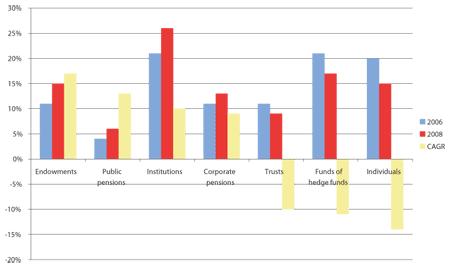 |
| Source: TABB Group |



