Timing your entry into a new market is tricky. But when the number of potential competitors has doubled over the previous 12 months, things probably get a lot trickier. This is what has happened in the red-hot CLO market: there were 35 managers in the European CLO market in mid-2006 whereas little more than a year ago there were only 16. And although CLOs accounted for roughly 75% of the European cash CDO market in 2005, so far this year they account for a full 92%.
This rapid growth has largely resulted from the many US CLO managers that have set up shop in Europe. Several of these are US CLO managers with a private equity sponsor parent: Bain Capital, Carlyle Group and Blackstone Group are the obvious examples. But hedge funds have been moving into this space as well: London-based CQS brought its debut CLO in June via Morgan Stanley; another hedge fund, Elgin Capital, brought its first deal earlier this year via Citigroup.
Their ranks could be further swollen by several European private equity sponsors that are now understood to be looking closely at the merits of setting up debt management businesses themselves.
They would not be the first to do so. Babson Capital acquired CLO manager Duke Street Capital Management in May 2004 and Alchemy Partners set up CLO manager Alcentra in 2003 (but exited the investment earlier this year, selling to Bank of New York). But news that CVC is now in the process of setting up a new debt management shop, CVC Cordatus – and several other private equity houses might follow suit – shows how closely the sponsors have been watching the institutionalization of their own lending market (see How CLO managers muscled in on the LBO market, Euromoney June 2006).
| Attractive assets |
| European leveraged loan pipeline |
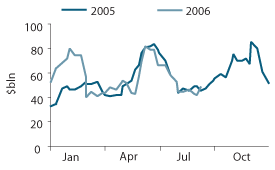 |
| Source: S&P/LCD |
“A number of financial sponsors are looking very closely at the debt management side,” reveals one commentator close to the deals. “We would expect to see a couple setting up new debt management businesses very soon.” He says that the interest boils down to three main factors: the quality of earning streams, the frontloaded nature of returns, and the nature of default probabilities. “Sponsors are attracted by the stability of CLO cashflows versus private equity returns,” maintains the banker. “They like the fact that CLO returns are front-loaded while private equity returns are backloaded. I haven’t seen so much focus on this for a number of years.”
The exact focus of CVC’s new business is not clear but the firm hired Deutsche Bank’s co-head of European leveraged finance, David Wood, in April this year to run it. It will be entering a crowded field and one in which competition for experienced staff is very tough. Managing a CLO or a credit opportunity fund involves a different set of skills to being a private equity sponsor and any new manager will have to build up a whole new credit team. Wood has already poached Ben Edgar from Alcentra and Jonathan Bowers from Deutsche Bank for the operation, which will be entirely separate from CVC’s private equity business, and even housed in a separate building.
But the benefits of being a subsidiary of a private equity sponsor should not be underestimated when it comes to experience and access to collateral.
A key risk in the European CLO market is manager reinvestment risk – will the manager be able to source enough collateral? Prepayment levels currently run at around 30% so keeping a 10-year deal fully ramped throughout its life is quite a commitment. But for private equity-owned managers this can be a benefit and a concern.
One concern that investors might have is whether managers are incentivized to put every deal that the sponsor does into the CLOs. The managers need to give investors comfort that this is not the case.
But while they might have a natural advantage as regards access to collateral, the question of timing remains. The CLO market has had an astonishing run but as recent JPMorgan research states: “the fundamental CLO arbitrage (exploit risk and illiquidity premia) has become less attractive.” But with their access to loans, any new sponsor-owned CLO managers will certainly have the upper hand over other new entrants. And one observer reckons that as the credit cycle turns, private equity sponsors will increasingly look to diversify their business. “In a bull market sponsors should load up on private equity but in a more mature market they will be better off playing in the debt space,” he reckons. One structured credit analyst is not so sure: “They may set up debt management businesses as part of a general diversification of their business philosophy but this will never be more than a fraction of what they do.”