Why are global bond yields so low, despite the fact that central banks everywhere are increasing interest rates? Why does the dollar stay stable when the US is running a huge external payments deficit?
I have argued in previous columns that the main reason why global bond yields have not risen in parallel with interest rate increases is because there has been a glut of new sources of liquidity outside traditional monetary aggregates: namely securitized debt and the huge derivatives market. This liquidity has absorbed much of the impact of rising short-term interest rates. Thus the cost of long-term capital has remained low.
It is a key phenomenon of the past decade that the quantity and price of money are no longer controlled by central banks. Central bank-dictated reserve ratios no longer set the credit multiplier. So increases in policy rates have not affected the cost of capital.
| The currency accelerator |
 |
| Source: IMF, WTO, Independent Strategy |
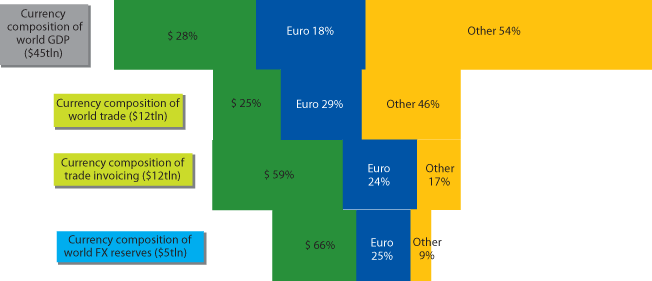
This new form of liquidity has sustained financial markets but it also brings increased risk. As long as the cost of capital remains low, liquidity can expand. But once capital becomes more costly, the new liquidity will contract much more sharply than monetary aggregates did in the past. So the resultant impact on asset prices could be severe and the deflationary pressure enough to pitch the global economy into a deep recession. The new liquidity has also been sustained by an international currency accelerator that has concentrated global trade and capital flows into just two or three major currencies. As currency flows from financing GDP into international trade and then into paying for imports, it becomes increasingly concentrated in dollars and euros (and to a lesser degree in yen) and away from the smaller currencies.
At the level of GDP, the euro and the dollar account for 46% of the value of global currency. The US dollar and euro account for 54% of the value of international trade but for 83% of the currencies used to pay for it. Finally, central banks in the current account surplus world receive and keep their international reserves heavily in dollars and euros – 91% is in these currencies.
Currency concentration
Thus, the real economy flows of global GDP and international trade cascade like water through a series of weirs that increasingly focus currency use in two or three of the world’s main currencies. Minor currencies of countries accounting for roughly half of global output and trade are filtered out in the process. To a degree, so is the yen.
When this stream of currencies reaches the central banks – the point at which the water stops flowing and is stored in a reservoir – the domination of the main currencies is further concentrated by central bankers in the structure of their international reserves. This is one big reason why dollar liquidity stays stable even though the US runs a trade and capital flow deficit with the rest of the world of more than 8% of GDP.
The real economy progressively channels currency demand into the major currencies that drive global liquidity, and central banks act to ensure that this pattern is preserved in the store of assets they control.
This points to two outcomes. Global liquidity is pumped up by the mechanism of world trade. But that also means global liquidity could be significantly reduced overnight if central bankers were to dump the dollar.
The credit party can go on longer because real economic demand for the cornucopia of currencies that form global liquidity lends stability to the whole structure. But when the party ends, currency turmoil could be a cause of the ensuing liquidity contraction, as the twin systems of trade and asset markets start to reject the weakest dominant currency – the dollar.
Global trade and the heads of many an Asian central banker could be the victims of a violent adjustment. Gold and non-dollar currencies would be the winners.
David Roche is president of Independent Strategy Ltd, a London-based research firm. www.instrategy.com.


