Morgan Stanley recently announced that it had bought parts of hedge fund managers Avenue Capital Group and Lansdowne Partners, and all of FrontPoint Partners. Fortis Investments is the latest to join the M&A train, taking a 70% stake in fund of hedge funds Cadogan Partners.
“Lots of conversations started in 2005 and this year, and there are tremendous negotiations going on right now [regarding acquisitions of hedge funds and funds of hedge funds],” says Gooden. In 2005, there were four acquisitions of hedge funds, and this year to date there have already been 13 according to Berkshire Capital’s research. Including acquisitions of funds of hedge funds, there were 10 deals in 2005, and 24 this year.
Gooden says it is a natural progression in the industry: “While the hedge fund industry has been expanding rapidly, there really hasn’t been a need for managers to partner with larger financial institutions. If they were good, they could raise capital. But we are no longer seeing such rapid growth in assets being raised, and performance is becoming more difficult to achieve. Hedge funds are now more responsive to buyers.”
Funds of funds
It is a similar story with funds of hedge funds. Stuart Leaf, CEO of Cadogan, believes there are many funds of hedge funds like his that are looking to form a partnership with a large institution or cash out entirely. “We started the firm in 1994 with just $3 million in assets,” he says. “Now we are more than $2 billion in size, and we must have turned down a similar amount in new money over time as size was not our goal. But then you have to think, how should a firm best evolve to service its clients and retain its talent? With smart people we generate a lot of new ideas. However, without the ability to fund these new ideas, a number have had to be put on the shelf, and we realized we needed access to a balance sheet and/or captive distribution. We have had a lot of enquiries over the last two years from buyers, but it was essential for us to find a partner that would allow us to retain equity in the firm, and remain autonomous and that would be complementary to our products and distribution.”
| M&A in hedge fund sector is rising |
| Deals involving hedge funds and FOHFs |
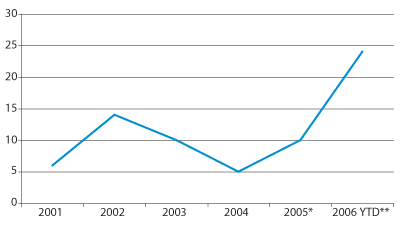 |
| * of which 4 single hedge fund transactions ** of which 13 single hedge fund transactions |
| Source: Berkshire Capital Securities |
Gooden says the pick-up in M&A activity by larger institutions signals that they are becoming more comfortable with the hedge fund industry, and are realizing its value. “Bigger institutions, which once didn’t want the risk involved with putting significant capital into what essentially was a cottage industry, realize that, with the continued demand for hedge fund products, and the talent on offer, partnering or acquiring hedge funds is a necessary move. On a revenue basis, hedge funds are as important as running institutional investments and mutual funds.” He points to the success of the JPMorgan/Highbridge deal last year as adding further comfort to large institutions. “There was scepticism about whether that deal would work out but it has been very profitable and successful.” Overcoming barriers to entry
A further reason for the projected increase in M&A activity is the inherent difficulty of entering the hedge fund sector organically. Leaf says: “You can see why the acquisition route is becoming popular for large financial firms. They need short-duration assets like hedge funds but attracting whole teams to come in house is very difficult. Plus, starting a team in house means no track record, which deters investors. Over the next two to three years I think we will see great demand from those institutions without short-term duration alternative asset capabilities in house.”
Gooden says that when making acquisitions in the hedge fund sector it is essential to pick a management team that can create products. “You either go with a series of boutique acquisitions that are excellent in their own expertise or make a cornerstone acquisition such as the Legg Mason deal with Permal, which had a lot of strategies. If you go with just one acquisition, you need to make sure that more products can be created.”
Fortis’s deal with Cadogan exemplifies this point. Historically, Cadogan’s greatest research strengths have been in the US, Japan and, more recently, other parts of Asia, and its focus has been on smaller and often more idiosyncratic managers. Fortis, being based in Europe, has a natural advantage in this area, and overall has been focused on larger, diversified managers. In the short run, Leaf expects that the Cadogan and Fortis portfolios will continue to run as they have historically but that there is interest in further exploring geographically designated funds and also funds incorporating traditional managers that generate alpha.



