 |
|
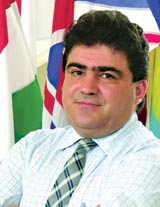
Neacsu: aiming for transformation in less than a year |
ASK ANYONE FAMILIAR with Romania’s debt markets about the state treasury’s reputation, and a picture swiftly emerges of an arbitrary issuer that could not be relied on to access the market predictably, let alone encourage its development.
It failed to communicate with the market; what’s more, its creaky and inward-looking set-up meant it had little focus on preparing for the challenges of imminent membership of the EU.
“The ministry of finance used to be rather erratic about coming to market, and came with irregular maturities,” says Dan Pascariu, chief executive of HVB Bank Romania in Bucharest. “There is a need to develop a yield curve and establish benchmark issues.”
Romania’s last foray into the international debt markets in 2003 only compounded its borrowing reputation internationally – the outcome was a €700 million seven-year Eurobond that, thanks to a decision to appoint four investment banks as lead managers and then make them split paltry fees for the privilege of arranging the deal, sank like a stone immediately after launch in the secondary markets.
That bond has since traded in around 200 basis points from its spread at launch, thanks to renewed confidence in Romania’s economy and its position as a convergence trade. Nevertheless, the sovereign’s reputation as an issuer remains fragile.
For Romania to repair its reputation both domestically and abroad, actions rather than words are needed. And that is where Dragos Neacsu, a former civil engineer and latterly president and chief executive officer of Raiffeisen Capital and Investment Romania, comes in.
At the beginning of the year, Neacsu accepted an offer from then Romanian public finance minister Ionut Popescu to join him in creating a modern borrowing entity ready for EU accession as early as 2007.
Previously best known for his vocal criticism of the shortcomings of the finance ministry’s activities, he switched sides with alacrity after seven years in the private sector. Today, as secretary of state, he is responsible for debt strategy in the ministry he so often criticized. Part of his remit is to set up a separate debt management agency in line with the growing trend for these across Europe.
The fact that Popescu gave him only a matter of days to make his decision did not faze him. “I saw it as a major personal and professional challenge, and as something one should not say no to,” Neacsu explains. “You should not sit on the sidelines, being vocal, but instead be in the game.”
His task, as he sees it, is clear. “To make an opportunistic and non-transparent issuer like the treasury become market friendly, and carry out permanent and substantive dialogue with market participants; to create a borrower able to communicate its intentions in advance, leading to a predictable environment; and to move towards a medium-term public debt strategy – this is what we hope to achieve by the end of 2005,” he says. “If we can bring about this transformation in less than one year, we can be proud.”
Becoming market friendly means communicating with dealers and investors. Neacsu began by engaging market participants in dialogue through a questionnaire designed to find out what they wanted to see on the debt markets. He has also made sure that he meets local bankers and investors face to face.
Yield curve inadequacy At the end of 2004, Romania’s domestic yield curve extended only as far as 24 months. “This was a major barrier in the development of a medium-term and long-term market,” Neacsu says. “One had to rely – and this is also the case for corporate and municipal borrowers – on reference points from the interbank markets. This was a temporary, hybrid structure that you could not build much on.”
Maturities therefore formed an obvious starting point in Neacsu’s discussions with market participants. HVB’s Pascariu explains: “The banking community held several discussions with Dragos Neacsu and suggested that the government should begin by issuing bonds with shorter maturities and then increase them.”
Their advice has so far been heeded. Having begun the second quarter of the year with multiple maturities of two, three, five, seven, 10 and 12 years, Neacsu’s team have scaled back the range of maturities to be issued in the third quarter to three, five and 10 years.
A 15-year bond is also under consideration for the fourth quarter, once these shorter maturities have been established. “We do not want to stop at 15 years, but even this length was pure science fiction as recently as this January,” Neacsu recalls. “When I mentioned it earlier this year I was told by many people that I must have been joking.”
As a result of scaling back the range of maturities being sold, the treasury is able to focus on bringing benchmark-sized bonds. Average issue sizes have increased from €5 million to €10 million in 2004, to €30 million to €50 million this quarter, leading to fewer overall issues. “We will continue to develop this process of increasing our issue sizes,” Neacsu says. “We are also contemplating reopenings, and we should see these beginning either later this year or in 2006.”
Reliable information
In addition, Neacsu is determined that the treasury will issue exactly what it announces. “At our first auction of the third quarter, we sold 100% of what we said we would,” he says. This strategy is made harder by legislation that requires that the exact issuance timing, maturity and size is announced well in advance, removing the flexibility that many other countries enjoy. “At the moment we have to be good at predicting what the market wants,” Neacsu says. “This is important in developing our relationship with it.” Changes to this are planned as part of a wider revamp of public debt law.
Under Neacsu, the treasury has moved from a monthly issuance calendar to a quarterly one, designed to give investors a better understanding of its intentions. By the end of the year he also plans a yearly calendar of issuance for 2006, and a defined medium-term debt strategy.
Bankers and investors have reacted positively to Romania’s decision to set up a dedicated debt management facility. “At present there are only two specialized sovereign debt entities in central Europe, the AKK in Hungary and Ardal in Slovakia,” says Vince Purton, managing director of debt capital markets at Daiwa SMBC Europe in London. “By looking to adopt a similar strategy, Romania is sending out a positive message of intention and commitment to the market.”
Central and eastern Europe has seen its fair share of changing governments over the past 15 years since breaking free from its communist past.
Romania is no exception. Prime minister Calin Popescu-Tariceanu announced his resignation in early July, only to reverse his decision later in the month to provide continuity after heavy floods killed more than 20 people.
The introduction of a separate debt management facility places it outside the political sphere. “It centralizes debt management in one place, and the involvement of debt specialists with both public and private sector backgrounds serves to create a coherent unit of experience, expertise and efficiency,” says Purton. “This in turn helps optimize cost savings and minimize the problems caused by personnel change.”
On January 1 2006 direct investment in Romanian securities will be opened for the first time to non-resident investors. Foreigners have already been active on the market through special purpose vehicles, but the full lifting of restrictions is expected to increase significantly the level of international capital flowing into Romania’s debt markets.
Although a number of Romania’s central and east European neighbours, notably Hungary, have suffered from volatile currency and bond markets as a result of hedge fund activity, Neacsu professes not to be concerned about the upcoming broadening of the market.
“At the moment, non-residents already invest billions of euros in our domestic bond markets via SPVs,” he says. “We look forward to their introduction in 2006. We are not concerned at this stage about their presence. It is a win–win situation and there is no conflict of interests.”
He also wants to redress the balance between the sovereign’s domestic and external issuance. At present, only about a quarter is raised domestically, with international financial institutions playing a big role in the remainder. “In order to find a balance,” Neacsu says, “we have challenged these IFIs to work with us in our efforts to develop a local-currency yield curve and issue mid-term to long-term bonds to finance their projects in Romania.”
He has received what he terms a positive response from these international financial institutions, including the World Bank, European Bank for Reconstruction and Development, and European Investment Bank. “I hope that by the end of this year the precedent will have been set,” he says.
Romania hopes to have collected a full set of investment-grade ratings before the arrival of new foreign capital in January. The sovereign had just one investment-grade rating, a BBB– from Fitch, as of mid-August. It is one notch off investment grade in its ratings from both Moody’s and Standard & Poor’s. However, both of these ratings are on positive outlook, so the country should not have long to wait.
“We still see a lot of interest at speculative grade, but would very much like to see a wider spectrum of investors, especially longer-term ones,” Neacsu says.
Knowledge pool One bonus of deciding to set up a debt management agency relatively late is that it allows scrutiny of the efforts of those who have gone before.
It gives Romania the relative luxury of picking and choosing between different models. “We do not believe in cloning, so are looking at several models,” Neacsu says. “The fact that we have been late in making the transformation gives us the potential to use the best existing experiences from old and new Europe.”
He cites the Swedish, Austrian and Irish examples as ones that Romania has looked at, as well as the more recent initiatives closer to home in Slovakia.
Slovak debt management agency Ardal, founded in February 2003, hosted a visit from a Romanian delegation at the end of August to discuss its own foundation in more detail and pass on advice.
Romanian policy-makers will be pleased to hear one tangible benefit from better debt management practices. Ardal’s liquidity management techniques are calculated to have saved the Slovak state budget €100 million in 2004.
The decision to set up Ardal came about as part of a wider reform of the economy, encompassing structural reforms such as healthcare and tax, as well as public finance reform. Within this, the focus was turned to public finance cashflows, with the aim of combining them into one system and increasing their transparency.
Slovakia’s approach was to establish Ardal as a greenfield development, without any help from the finance ministry. The rationale was that this would allow the agency to set up its own, independent, system of management.
Ardal was created in cooperation with the treasury to centralize and make more effective the cashflows of state and public finances, and to manage state and public debt, liquidity and risks more effectively. Better liquidity management lowers the state’s need for debt financing.
“The most important decision for countries like Romania that are setting up debt management agencies is about where the agency will sit,” says Ardal director Daniel Bytcanek. “This depends very much on local conditions. In our case, it was impossible to establish the agency as part of the ministry because no-one from the commercial sector was willing to come to the ministry. For us, the only way was to establish an independent institution, and to be small and flexible.” Ardal employs just 17 staff, all of whom are professionals.
Ultimately, the debt management agency’s position comes down to a question of local legislation. In Belgium, for example, the agency is part of the ministry but the legislation provides for it to have a separate budget.
As in the case of the Romanian agency, the majority of Ardal’s employees had previously worked for commercial banks, giving them a clear understanding of what the market wanted. On a practical level, it also meant that most Ardal staff spoke English and were able to communicate with international investment banks and investors far more easily than many finance ministry employees.
The spotlight in Slovakia also fell on the auction process. “Previously auctions were conducted via fax, which led to poor transparency,” says Bytcanek. “We brought in a new electronic system that is very quick and comparable to those used in any western European country.”
As a result, technology is another vital area to consider. “The other aspect I would recommend looking at is IT support,” he says. “You need good systems for front-, middle- and back-office operations. Reporting requirements are high and will become even higher. Today our position is good, with all our data held in one system.”
This is something that Neacsu and his team have already taken to heart – a tender for an electronic trading platform will be launched in the next couple of months.
Strong foundations For all the talk of completing the transformation of the treasury’s debt management strategy by the end of the year, much still remains to be done.
To a large extent, this cannot be completed until the fledgling debt management agency is enshrined in a new public debt management law. It is hoped that this will happen either later this year or early in 2006.
Running in parallel with the revamped issuance strategy is the need to restructure existing debt. Neacsu expects to appoint several banks to advise on this, and will send out requests for proposals later this year. “The major outcome will be a significant reduction of the debt service, which will make our case for setting up the debt management office more consistent,” he says.
For a man trained as a civil engineer, building stability is clearly a priority. As he admits: “If one day when I leave, the whole thing continues to function [then that will be my greatest achievement]. I was lucky enough to see this happen in my previous career, and I know what it is when something works.”


