
IN THE NEXT three months, the Russian government will finally liberalize Gazprom’s share structure, allowing foreign investors unfettered access to the equity of Russia’s biggest company. It is a watershed event for Russian equities. “It’s the best thing to happen to the Russian stockmarket since president Putin was elected,” says Vadim Kleiner, head of research at Russian hedge fund Hermitage Capital.
Up to now, foreign investors have had severely restricted access to Gazprom equity. The previous management of the gas concern, perhaps to protect their own control of the company, put in place a law limiting foreign investors’ Gazprom holdings to American depositary receipts. Only investors registered in Russia could buy the company’s Moscow-listed stock.
This restricted foreign access to about 3% of the company. However, foreign investors were able to buy the local shares through so-called grey trading schemes, using brokerages in Moscow to set up special investment vehicles.
Such schemes enjoyed quite a lot of credibility – Germany’s Ruhrgas, for example, has a stake in Gazprom that it acquired through such a vehicle. But the risk of an attack by Russian bureaucrats on grey trading schemes was sufficient to put off some of the larger, more conservative institutional investors.
When the Russian government tears down the ring fence around Gazprom shares, its Moscow-listed shares and its ADRs will become fully fungible. The main obstacle to this was that the government wanted to obtain a 50% plus one share stake in the company before it allowed foreign investors access to the rest of the shares. It achieved this in July, when it bought 10.74% of the company, so the ring fence could come down as early as this month.
One consequence will be a convergence of the ADR price and the Moscow share price. At one point last year, local shares were as much as 30% cheaper than the ADRs, which tempted many hedge funds into entering what could be called the Gazprom liberalization play.
“Some hedge funds made a lot of money on that play,” says Pavel Kolouche, emerging Europe fund manager at hedge fund RAB Capital. However, the spread between ADRs and local shares is now tight, as the market expects liberalization to take place soon.
The longer-term effect of the liberalization will be to make up to 49% of the company’s shares available on international exchanges. At long last, big institutional investors will have access to the world’s largest hydrocarbon company.
Gazprom will immediately become one of the biggest emerging-market stocks, second only to Samsung in market capitalization. If the company performs well and its stock price rises, it will soon become the biggest.
Gazprom share liberalization will also have a big impact on emerging-market indices. The company’s share of the MSCI Russia Index will go up from 3.4% to about 39%, and Russia’s share of the total MSCI index will also rise.
This means that as much as $6 billion in new funds from index trackers will flow into Russian equity. “After the ring fence comes down, Gazprom will be a very attractive investment, simply because of all the index money it will attract,” says Kolouche.
But will the share price rise?
Although there are strong technical reasons for buying Gazprom shares, it still needs to be assessed as a long-term investment.
There are clear arguments for buying. As Gazprom director Sergei Kuprianov says: “Gazprom is the world leader in the provision of natural resources. Its gas reserves account for 16% of world supply, and 60% of Russian supply. These resources are inexhaustible from any reasonable historical perspective.”
At present valuations investors can get exposure to these enormous reserves remarkably cheaply. “It is the largest hydrocarbon company in the world by reserves. But by barrel of oil its stock is five times cheaper than the next biggest super-major, Exxon,” says Alex Metherell, director of mergers and acquisitions at Dresdner Kleinwort Wasserstein.
These reserves put the company in an extremely favourable position as world gas demand rapidly increases. The International Energy Agency predicts that the world gas market will double in size by 2030, as countries such as the US and UK become net importers of gas in the next few years.
Gazprom’s overseas markets are crucial to its continuing success. As Alexei Miller, chief executive, said at the company’s AGM in June: “Gas exports to Europe are practically the only source of profits for us today.” In Russia, Gazprom has a monopoly over domestic gas transport and sales but will struggle to make big profits because the government obliges it to sell gas to local retail and industrial customers at a heavy discount.
Gazprom is also an attractive investment because of the way the present management has turned around some of the mistakes of the previous regime. That regime was led by former chief executive Rem Vyakhirev from 1992 until 2001, when president Vladimir Putin fired him.
“It was run like a family business, in the interests of the management,” says one Gazprom source of that time.
The company lost about $5 billion through asset stripping, often to companies owned by relatives of the senior management. It lost $1 billion a year simply by giving 50% of its market share in former Soviet Union countries to Itera, a gas company based in Florida.
A further $3 billion was drained off in three years through construction write-offs to a company called StroiTransGas, whose vice-president was the son of Viktor Chernomyrdin, chairman of Gazprom and prime minister of Russia.
Gazprom’s finances were in a mess. Production started falling in 2000, and the company had built up what Charles Ryan, chief executive at Deutsche Bank UFG, calls “a little Gazprom version of the GKO pyramid”. The GKO reference is to Russia’s disastrous late 1990s’ treasury bill issuance strategy – as with that, billions of roubles in short-term debt were borrowed at ruinous interest rates. “The company”, says Ryan, “was in danger of disappearing altogether.”
Much to the market’s surprise, chief executive Miller has succeeded in turning around many of these problems. “[Under the previous management] the company lost assets and markets, and the volume of production fell,” says Kuprianov. “Now the situation is altogether different.”
He continues: “We have returned to the markets of the former Soviet Union, production is growing again, and we have begun to realize our strategic diversification into other markets, products and business spheres.” In other words, the company is gradually being run like a normal, functional business rather than a Soviet ministry on its last legs.
Take the company’s debt profile. In 2002, 43% of the company’s debt had a maturity of under a year, while just 6% was longer than five years. In 2004, the trend had reversed so that only 27% of its debt had a maturity of under a year, while 33% was longer than five years.
The company has built up a good name for itself in the international debt markets. “Through the offerings of a wide range of marketable debt instruments, Gazprom tries to attract new high-grade accounts from all over the world,” says a source in Gazprom’s analytics department.
“We have seen them coming and buying our Eurobonds and we are quite happy to become an attractive credit for that type of investor,” he adds. One concern, though, is that the company is twice as leveraged as LUKoil, the next most highly geared Russian oil and gas company.
A final attraction is that Gazprom has the blessing of the Kremlin, which raises the possibility that it might elbow its way into any Russian energy consortium, or acquire any other energy company. “President Putin wants the company to be very financially strong, and to play a key role in establishing and maintaining Russia’s position as a great power,” says Deutsche’s Ryan.
Given these advantages and improvements, and given the excellent performance of the Russian stockmarket over the summer, foreign investors might be expected to be champing at the bit to gain more Gazprom exposure. But many are guarded in their interest and others are explicitly suspicious of the company.
“To invest in Gazprom, you have to believe that the management is acting in shareholders’ best interests. I don’t believe that,” says Glen Finegan, a senior analyst at First State Investments, which has more than $4 billion invested in emerging-market equities.
Chuck Tennes, portfolio manager of Alfa Capital’s Russia mutual fund, says: “I own it, but I don’t love it. There are too many things going on there that aren’t to do with shareholder value, too many factors at play that have nothing to do with market forces.”
Social responsibilities
Gazprom is obviously different to other super-majors such as Exxon or BP. As Kuprianov says: “The company creates 5% to 8% of GDP and 8% of foreign currency revenues for Russia, as well as about 20% of budget revenues. It provides gas to 80,000 towns and villages, to 22.8 million apartments, and to 122,000 companies. It has a huge influence on international trade, on the budget of the government, and on its energy security.
“On its shoulders rest the responsibility for payments and wages to the budget, for warmth and light to houses and flats, and for the continuation of industrial development and the creation of jobs. The socio-economic stability of the entire country depends on the actions of the company.”
These social responsibilities, understandable perhaps in a country as big and as subject to extreme climatic conditions as Russia, is an obvious impediment to any drive to maximize shareholder value. The company also has enormous investment needs. “There was a huge lack of investment in the 1990s, and we have had to close those gaps,” says Kuprianov.
The company has to spend hundreds of billions of roubles in upgrading its ageing pipeline system, of which about 60% is more than 21 years old; developing new markets such as liquified natural gas; and drilling new fields, such as the Shtokman field in the Barents Sea. It is also building new pipeline projects such as the planned north European pipeline. That alone will cost about $10 billion, say observers.
Still, analysts say Gazprom’s biggest failure is in keeping costs under control. Jeffrey Woodruff, analyst at Fitch Ratings in Moscow, says the sovereign was recently upgraded but that Gazprom wasn’t because it had failed to take control of spiralling costs. “While Gazprom revenues grew by 14.9% last year, operating costs grew by 19%,” he says. Production volume, meanwhile, went up by just 1%.
Poor cost control
Investors make the same point. “I don’t get any sense that any efficiencies are appearing,” says Finegan. Alfa Capital’s Tennes agrees: “The company doesn’t have a good management history. It’s not improving efficiency or profit margins, and you have to question its internal performance.”
The biggest critic is Hermitage Capital’s Kleiner. He paints a depressing picture of a management unable to control costs. Unpaid debt receivables, for example, grew by almost $5 billion in 2004. Raw materials costs rose by 85% last year. Capital expenditure increased by $2 billion in two years.
The company has had success in reclaiming business from pointless intermediary companies in the former Soviet Union but there are still a few examples of such wasteful practices. For example, exports from Turkmenistan through Russia to Ukraine and beyond are handled by a company called RosUkrEnergo.
This is half-owned by Gazprom, with the rest owned by Raiffeisen Investment, which says it holds the shares for private Ukrainian business interests. Because it has only a 50% share in the profits of this company, Gazprom loses out on over $400 million annually.
When asked why Gazprom needs to use such an expensive intermediary, Wolfgang Putschek, a member of the board of Raiffeisen Investment, says: “It’s a good question. I guess they saw a benefit in not having to deal with NaftoGaz [Ukraine’s gas monopoly] directly.”
Those familiar with Gazprom say that it has yet to tackle an incredibly wasteful corporate culture, which seems to be proliferating. One head of research at a Moscow brokerage says: “It’s a remarkable animal. Domestic gas prices grow by 20% per annum, yet somehow administrative costs keep pace.”
Other sources paint an idyllic picture of working for Gazprom. “It’s another country”, says one Russian businessman. “The headquarters in south-east Moscow has its own restaurants, its own hairdressers, its own hotel, its own medical clinic. A friend of mine works at the clinic. They say it’s far better paid than other clinics in Moscow.”
Staff costs grew by 47% in 2004. The average monthly salary in the Russian gas industry is almost double that in banking, and three times that in telecoms. And 38% of the 390,000 employees of Gazprom are employed in non-core assets.
These include Gazprom-Media and the NTV TV station, the Black Sea resort of Lazurnaya, the Izvestia newspaper, the home furnishings company Karat Plus, the Beloyarski and Sovetski airports, the Rigas porcelain company, an ice rink in St Petersburg, and a chicken farm in Morevskaya.
“Gazprom does own assets that are unrelated to its main business,” admits Kuprianov. Such assets, he says, were mainly amassed in the late 1990s, when Russian consumers paid for gas with barter deals. “As a result, Gazprom has accumulated quite a lot of irrelevant assets that it is looking to get rid of.” It sold R7 billion ($245 million) of such assets in 2004.
However, investors hoping to see Gazprom concentrate on its core business of gas will probably be disappointed in the coming years. On the contrary, Miller has made it clear he wants to turn the company into a global energy company. That means he wants it to expand rapidly into the oil and electricity markets.
It has been frustrated this year in its attempt to become the Russian state’s oil and gas super-major by its rivalry with Rosneft. At one point last year, it looked as if Gazprom and Rosneft could merge, with the latter playing the role of junior partner. Not surprisingly, Rosneft’s executives were not keen on that proposition.
But then came the auction of Yukos’s main asset, Yuganksneftegaz (YNG), in December. The Kremlin’s original plan was for Gazprom to buy YNG, but after Yukos filed for bankruptcy in a Houston court, a different buyer emerged – Baikal Finance Group.
Baikal then sold the asset on to Rosneft. Although the move caused lots of behind-the-scenes discussions between the Kremlin and Rosneft, the upshot was that Rosneft held on to YNG. Miller decided to ditch the merger and argued that the Kremlin should buy its stake with cash.
Hungry and on the prowl
So the Russian energy sector now has two hungry corporations stalking the land – an already very powerful Gazprom and an increasingly powerful Rosneft. They have their own preferred methods and partners.
 |
|
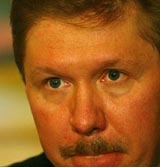
Miller: exports are the main source of Gazprom’s profits |
Gazprom is chaired by Dmitri Medvedev, Putin’s chief of staff, a lawyer by training. He and Miller represent the St Petersburg liberal school, which sees Russia returning to greatness via an embrace of western legal norms and strategic partnerships with western banks and western super-majors such as Shell, BP and Statoil. Rosneft has a more opaque financing structure, is happier to look to other Russian state structures rather than the west for support, and has a track record of teaming up with Asian partners such as CNPC or India’s ONGC.
Both have an obvious appetite for oil assets – Rosneft’s president, Sergei Bogdanchikov, recently said he wanted to see the company overtake LUKoil as the biggest oil company in Russia. Both are thought to be bidding for Sibneft, which London-based oligarch Roman Abramovich is planning to sell. Gazprom is raising what is rumoured to be the biggest emerging-market loan ever from western banks to buy Sibneft. It will be interesting to see who is victorious, in this and future battles.
Western investors trying to work out the direction Gazprom will take could actually take heart from the YNG incident, because it shows that Gazprom’s management was not going to let a juicy but legally dubious asset tempt them from their long-term goal of building a global super-major. This is the Kremlin’s goal for the company, as much as it is Putin’s goal to make Russia a firm and reliable member of the G8 club of top nations.
That ambition is good news for equity investors, because if Gazprom is going to compete with such companies as BP, it will have to raise huge amounts of financing. Its export business is already facing strong pressure from LNG producers such as Qatar and Algeria, which recently managed to reduce the cost of their product and make it genuinely competitive with Gazprom’s pipeline deliveries to Europe.
Share price pressures
Gazprom has shown an increased desire to enter into joint ventures with foreign super-majors, to help it develop its own nascent LNG facilities and reserves. But to do that it will need valuable equity, to pay for its stake in consortia. Therefore, its market capitalization becomes all important.
“The senior management is beginning to understand, as they hit this very tough period of investment, the role that equity financing is going to play in Gazprom’s future,” says Deutsche’s Ryan. “So they’re starting to see a direct link in the value of Gazprom shares and their ability to do these projects.” One Gazprom source says: “How does the government evaluate the job the management is doing? One way is the market capitalization. The top management understand that they depend on the market capitalization, and it’s a reflection of the overall efficiency of the company.”
When the company’s ring fence comes down, Gazprom will finally be able to attract the world’s biggest long-term investors, such as Fidelity or Capital Research. “After the ring fence comes down, the management will finally be talking to the appropriate people,” says Ryan. “Their idea of investors is still these little hedge funds running around banging the drum.”
He adds: “But the likes of Hermitage aren’t going to change the company, with its $1 billion in funds. Think of a company like Exxon. The people who influence such companies are the large pools of capital, like UBS or Fidelity, with their $900 billion in capital. They’re the owners Gazprom needs, the ones with the deep pockets.”
These new investors will exert pressure on the company in a different way to the likes of Hermitage. Rather than taking out an advert in a paper criticizing the management, they will get UK prime minister Tony Blair, for example, to mention a concern at a meeting with Putin. Gazprom will have become part of the global energy and finance establishment.
It is not there yet. One thinks of the ice rinks, the chicken farms, the newspapers, the worsening situation with costs. What will the global pools of capital make of these?


