UniCredit advances – but must stay on its toes

Central and eastern Europe's leading institutions have been quick to praise UniCredit's acquisition of HVB, which creates the region's biggest bank. But, they warn, it had better stay on its toes, as rivals will look to profit from any loss of focus that the alliance brings.

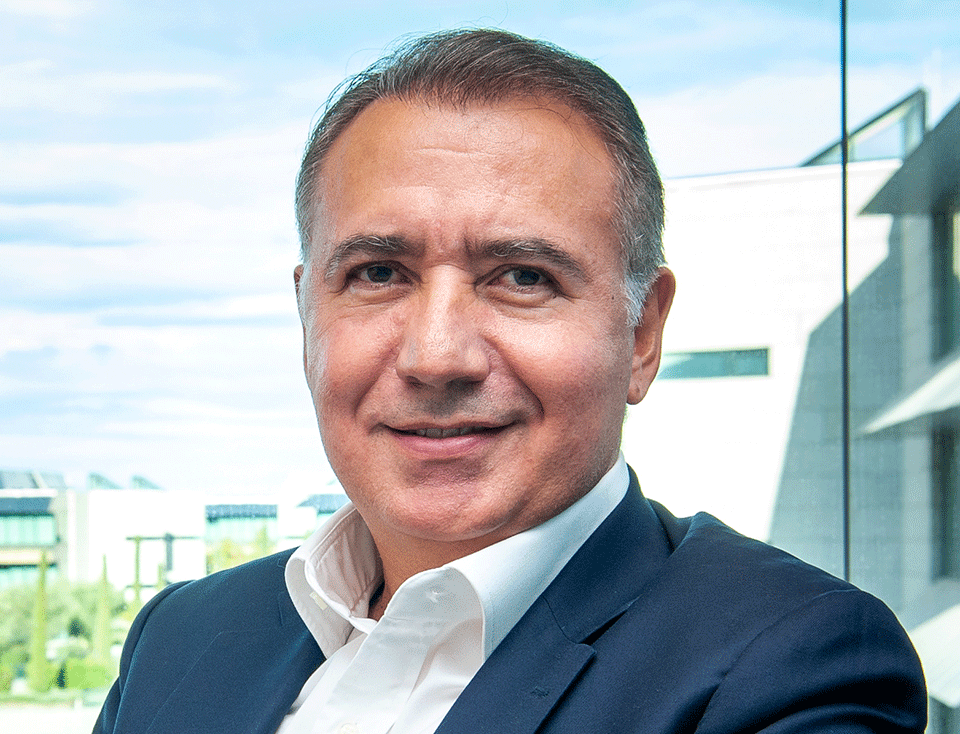
Bergen: an opportunity
to gain market share?

WHEN DOES IT make sense to pay more than €15 billion for a bank principally to get access to its subsidiary, which operates outside its home market? For Italian bank UniCredit, the answer is when the subsidiary in question operates in central and eastern Europe, where banks have reported profits in the first half of 2005 up as much as 60% on the same period in 2004.

Although UniCredit has not bought Germany’s HVB solely for its central European assets – since the acquisition also gives it access to the bank’s German client base – it is HVB’s ownership of Bank Austria Creditanstalt that has excited most interest.

With assets of €733 billion, the new bank will have more than double the total assets of its nearest competitors, and will enjoy a customer base of more than 28 million and more than 7,000 branches across 19 countries.

“The new group’s CEE business will be run separately,” says Dirk Albersmeier, head of M&A for Germany at JPMorgan, one of the banks advising HVB on the transaction. “Outside of CEE, operations will be organized on a divisional basis in four groups – retail, corporates and SME, multinational and investment banking, and private and asset management.”

UniCredit’s chief executive, Alessandro Profumo, will become CEO of the combined group, with HVB chief executive Dieter Rampl taking over as group chairman.

“As far as central and eastern Europe is concerned, the deal is essentially a UniCredit/Bank Austria combination,” says Andre Bergen, chief executive of KBC Bank in Brussels.

Bergen has a mixed view of the effect the merger of the two groups’ central and east European assets will have on the market as a whole and KBC in particular. “Its impact will be significant in Poland, but less of a threat in other countries,” he says. “In most of the countries that KBC operates in, the merged bank will not have a substantial market presence. Beyond that, the teaming up of the two banks will increase Bank Austria’s investment firepower in the longer term.”

But with UniCredit and HVB likely to be preoccupied in the coming months and years digesting what the deal means for their core and subsidiary holdings, will the path become clear for central and eastern Europe’s other players to take advantage of the combined group’s new focus?

Although few suggest that UniCredit’s Profumo is likely to take his eye off the ball, there is a growing feeling among competitors that the two banks’ coupling might not prove to be bad news for their own interests.

Consolidation, after all, has been a key theme for all financial institutions that have been operating in central and eastern Europe over the past 10 years, as groups such as Erste Bank, RZB International, Bank Austria, KBC and UniCredit itself swallowed up banks across the region during the privatization process.

None of these, however, has been on the scale of the UniCredit-HVB deal, which as well as creating the largest operator in central and eastern Europe, also forms the ninth-largest banking group in the whole of Europe.

“The combined Polish banks will be a major player, but as we have all experienced, consolidation takes time,” says Bergen. “In the first few years you have to address a number of issues internally, which may enable other parties to gain market share.”

As well as being time-consuming, the merger of Poland’s second-largest and third-largest banks will also create personnel opportunities for competitors. “The merger will create some opportunities,” says Bergen. “It is probable that, for example in Poland, some employees will be unhappy and expertise will become available.”

Andreas Treichl, chairman of the management board at Erste Bank in Vienna, agrees that there could be some positive side benefits for other banks. “The fact that the two financial institutions will as a result of the activities connected with their merger be busy for several months or even years with their own internal affairs, means an enormous market opportunity for the other banks, as they will be able to persuade clients who are unsatisfied with this situation to try their services,” he argues. “Apart from this, there will be many chances to acquire top people from central Europe for other positions, as there is certain to be some overstaffing.”

Although the Polish regulators are not expected to oppose the merger of the two groups’ banks, the situation is not so clear elsewhere. In Croatia, for example, where UniCredit owns Zagrebacka banka and HVB owns Splitska banka, the combined group is likely to have to sell at least some of its assets before looking to complete its merger. Croatian regulators forced UniCredit to sell Splitska to Bank Austria in 2002 before it could buy Zagrebacka.

It is easy to see why western European banks, and in particular central European ones, are so keen to grab an increasingly large slice of the pie. “All three major central European consumer markets of Poland (with a population of 40 million), Hungary (10 million) and Czech Republic (10 million) are showing excellent growth rates, and while there has been strong growth in retail deposits and lending over the last three or four years, there is plenty more room to grow,” says Sanjeeb Chaudhuri, a managing director at Citigroup in London. “Retail deposits in Poland as a percentage of GDP are only 26%, compared with 71% in the UK.”

Dual exposure A recent Citigroup equity strategy handbook, Investing in Emerging Europe, revealed that the region’s banks are now among its top stock picks. Its lead authors, Andrew Howell and Geoffrey Dennis, are so keen on the returns available in the region’s banking sector that they recommend exposure to it both through western European financial groups with operations in the region, such as Swedbank, Bank Austria, Erste Bank, HVB and UniCredit, and, for those investors willing to invest directly in the countries themselves, by buying positions in the local banks.

Citigroup’s report positions the banking sector as an aggressive buy in the region, and a good alternative to stocks that are highly geared to the strong run in commodity prices. “Our investment rationale is that loan penetration, especially in mortgage and other consumer products, can still grow substantially over time; combined with the remaining interest rate convergence, this supports the outlook,” it says.

Top picks in individual countries, it advises, include Hungary’s OTP Bank, Poland’s Bank Pekao, Turkey’s Isbank and Russia’s Sberbank. “Although there is less fundamental value in the Polish banks,” the report continues, “these could benefit from restructuring brought about by the recent UniCredit/HVB merger that resulted in the combination of two of Poland’s larger banks.”

The traditional way for banks to gain assets across central and eastern Europe – privatization – has today virtually been exhausted. Few countries have many banks still to sell.

One exception is Romania. The government’s auction of Banca Comerciala Romana, a state-owned institution, has a list of no less than 11 recognized bidders engaged in due diligence. A sale is possible as early as the fourth quarter of this year. BCR is Romania’s largest bank, with assets in excess of €6 billion.

All of the bidders are western European banks — an indication of how highly they now value the region’s assets. It also shows the extent of renewed interest in Romania itself, in the country’s run-up to EU membership in either 2007 or 2008. Two years ago the government unsuccessfully tried to sell BCR.

UniCredit and Bank Austria have not been listed among the bidders for BCR because, analysts say, they need to concentrate on the mechanics of their merger.

A second Romanian asset is likely to be up for grabs when the government finalizes the timing of the sale of a majority stake in the country’s fourth-largest bank, CEC.

This relative dearth of new assets coming to the market in the medium term explains the ferocity of bidders in the privatization process.

But bankers say that all is not lost for those who still crave growth through acquisition – they will just need to be patient. “In the next couple of years, assets will begin to change hands again,” says Bergen. “Poland, for example, is still very fragmented, with more than 50 banks. This situation will change one day, and we will see investors with market shares of 2% to 3% becoming sellers.”

UniCredit is not the only Italian bank to show an interest in the surrounding region. Banca Intesa’s management has often stated its plans to expand its emerging Europe exposure further.

Farther north, Swedbank and SEB are the two Nordic banks with the largest emerging Europe exposure, both having significant assets in the Baltic republics. Both banks are said to be keen to expand into Russia. “Among other banks, Société Générale management have said they would like to expand in Turkey, the Greek banks are looking for acquisitions in the Balkans, and DNB Nor is hoping to expand in the Baltics,” the Citigroup report says.

Farther afield In the absence of available new central European assets, another way to maintain momentum is for banks to widen their focus away from the first wave of new EU members and the upcoming second wave. This is a tactic that RZB International, among others, has applied.

“Our growth strategy is focused on exploiting the potential of retail banking in the entire region,” says Martin Grüll, chief financial officer at RZB International in Vienna. “The CIS and southeastern Europe are fast-growing sub-regions. We have one transaction which will make us market leader in Ukraine. We already have a leading position in southeastern Europe, partly as a result of early-mover advantage, and will continue to strengthen our branch network and brand awareness, which are the key drivers in retail banking.”

The transaction is the acquisition of Aval Bank, Ukraine’s second-largest bank, which was agreed last month.

BNP Paribas and SG are also said to be considering Ukrainian acquisitions.

In RZB International’s first-half results, reported in mid-August, southeastern Europe provided the institution’s biggest pre-tax profit increase, up 90.9% to €88.1 million on the same period in 2004.

By comparison, the CIS segment of its business generated profits up 76.3% to €62.4 million, and its core central Europe business came in with a profit of €122.7 million, up 34.5%. The improved performance of southeastern Europe and the CIS means that the bank’s pre-tax profits are becoming more evenly spread, with central Europe now contributing 45%, southeastern Europe 32% and the CIS 23%.

The UniCredit-Bank Austria combination will have a strong presence outside the core central European markets too. “One excellent asset is UniCredit’s strong presence in Turkey, which could be key when talking about EU convergence in the future,” says Birney. “HVB also owns International Moscow Bank, which is a reasonable bank in a country that many institutions are keen to get access to.”

Acquiring acquirers The lack of assets for sale also makes the most successful international groups operating in central and eastern Europe acquisition targets themselves. Regional powerhouses such as KBC and Erste Bank, with their pan-regional network and strong existing operations in a majority of the region’s economies, are the obvious choices.

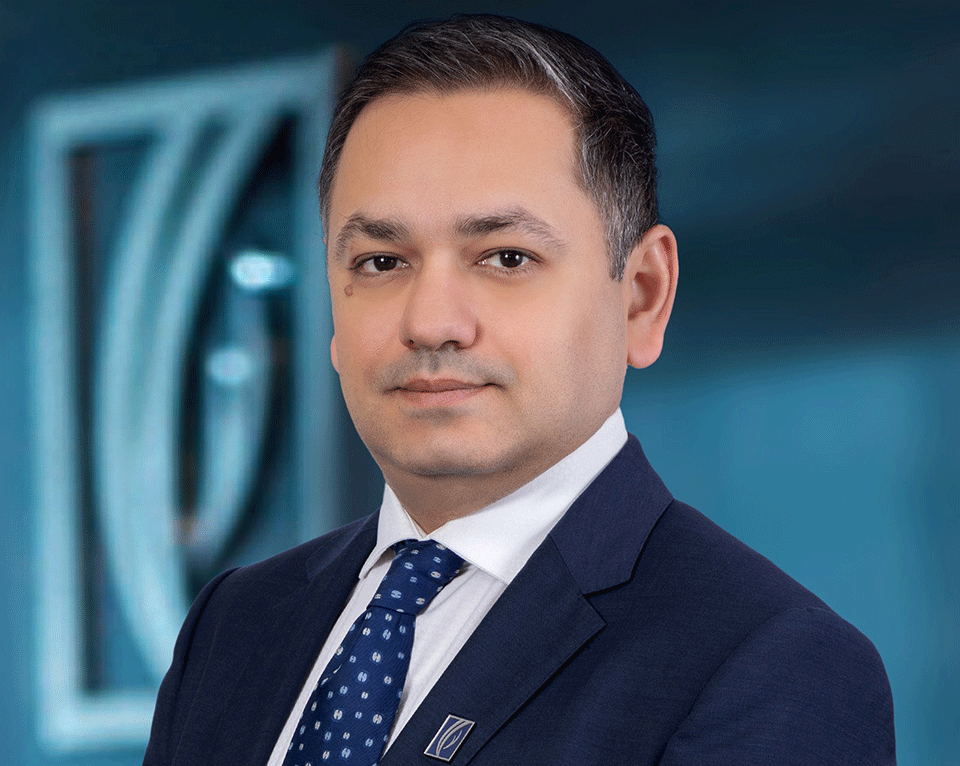
Profumo: integration
experience could be vital

But not everyone is convinced that the UniCredit/HVB deal will lead others to follow suit at parent-company level. “While this deal will lead to externally driven mergers in countries such as Poland, where Bank PBH, and Pekao are likely to be merged, we do not expect to see widescale cross-border M&A,” says Chris Birney, a ratings director at Fitch Ratings in London. “While there are a number of attractive targets for banks looking to increase their activities in CEE, such as Erste Bank or KBC, these would be far harder to buy, and far harder to swallow, than HVB.” What the merger move does do, however, is show the way for future cross-border transactions to be fully funded by share issues. “There are some unique ingredients in this deal that mean it will not necessarily form a blueprint for further cross-border banking acquisitions – such as the banks’ great fit in CEE as well as western Europe, and the similar mindsets of both CEOs,” says Albersmeier at JPMorgan. “However, the transaction has proven that you can do large share-for-share deals across Europe, which may open the way for more transforming transactions in Europe. In the past, such share-for-share deals would have been difficult, but today investors operate on a sector rather than country basis, and they are happy to exchange German shares for Italian ones.”

Those financial institutions that are seemingly the most obvious targets for predators loudly proclaim their self-sufficiency, although the only real way to guarantee their independence in many cases is to perform so well that they are too expensive to acquire.

KBC’s Bergen, is quick to scotch any talk that the group is open for purchase at the right price. “There has been a lot of talk about cross-border mergers over the last few years, and many institutions have been talking about possible deals,” he says. “We ourselves have been approached on a number of occasions. We have always made our position on this very clear. We have very stable shareholders, and want to remain independent.”

Erste Bank’s Treichl is similarly determined. “Erste Bank’s board of directors considers a company’s uniqueness to be a value that ought to be retained,” he says. “We want to prepare and implement our own decisions ourselves. We want not only part of the commercial activities to be managed from Vienna but the whole corporate strategy. Our aim is to operate so effectively and profitably that our valuation remains high and we are an attractive possible takeover target – but, in the last consequence, too expensive.”

Erste Bank has been one of the largest acquirers of emerging European assets in the past five years, according to Citigroup’s research report, spending more than $4 billion on acquisitions. As well as bidding for Romania’s BCR, it has also highlighted Serbia as a focus for its further growth.

Although corporate banking services do not require a large on-the-ground presence, this is far from the case for retail and consumer lending, meaning that even big international hitters such as Citigroup will have to spend time growing their presence.

Retail demands a presence “Big international players cannot simply rush in and build a regional banking operation,” says Fitch’s Birney. “For corporate banking purposes, they can lend to them from London or Frankfurt. But if a bank is determined to get into retail, it will have to do this by acquiring assets.”

The attractiveness of the region, though, ensures that banks are prepared to do this.

“The retail banking markets of central and eastern Europe are expected to grow very significantly, meaning that the pie will expand,” says Chaudhuri at Citigroup. “So while competitors may have changing capabilities, the overall market growth represents the most compelling opportunity that Citigroup sees.”

This means that those players not yet enjoying a significant slice of the cake can take heart that it only takes victory in one market to begin enjoying the spoils. “Growth in central and eastern Europe still comes down to a country-by-country process,” says Birney. “Players do not need to reach a critical mass regionally to be able to compete; it is more about whether they are big enough to survive in a country. It really is a story of banks waiting for each other to get out if they want access, but at the moment there are no sellers, only buyers.”

The other challenge for the region’s competitors is adapting to the speed of change in consumers’ demands. Central and eastern European clients are quickly catching up with the vogue in western Europe for telephone and online banking, for example.

“There is a constant evolution of the customer base, as customers move up the value chain and become more affluent,” says Chaudhuri. “The globalization of things such as the media mean that people’s aspirations are changing in respect of what they want from travel, holidays, wealth management and so on.”

As they become wealthier, so their needs change. “Consumers are ever busier and so are more willing to do their banking on the internet or by phone,” says Chaudhuri. “Banks must be ready to adapt to make themselves easy to reach.”

Most of the leading financial institutions in the region unsurprisingly agree that it is already too late for banks to enter the market and enjoy success purely through greenfield operations.

They also agree that new entrants, if they are to have a hope of building a presence, will have to be canny when it comes to offering new products. “As we have seen in other parts of the world, clearly banks that have had a head start will have an advantage,” says Chaudhuri. “But if institutions looking to break into the market come with new products, then they will also do well.”

Citigroup is well placed to assess the pros and cons of organic versus acquisitive growth. “The merger of Bank Handlowy and Citibank Poland gave us a significant footprint there, but having said that, organic growth is also important [for continuing to grow our franchise],” Chaudhuri explains. “One example is in Russia, where we have built a retail bank with 21 branches from scratch in under three years.”

Analysts point out that because the market still has some way to go before reaching the levels of sophistication of western Europe, late entrants need not despair. “Financial institutions do not have to be too specialized at this point, because the market is growing so rapidly that the main aim is to grab market share,” says Birney at Fitch.

Institutions with the financial clout to buy assets at inflated levels would also be able to succeed. “It is never too late for new entrants to the market, but it depends on the price they are prepared to pay,” says KBC’s Bergen. “When we began to invest, it was possible to buy financial assets at 1.5 times book value. Today, this has risen to easily three times book value in some of these countries for financial assets.”

Acquisition fever There has been a lot of talk about cross-border M&A in Europe’s banking sector, particularly spurred by the Santander-Abbey National transaction late last year, and by ABN Amro’s attempts to increase its stake in Italy’s Bank Antonveneta. “Everyone is talking to everyone at the moment,” one banker says.

All M&A activity so far in 2005 has involved the acquisition of German or Italian banks – highlighting the relatively slow consolidation in these markets compared with their western European peers.

However, UniCredit’s acquisition of HVB indicates that further consolidation in Italy cannot be the only driver of the bank’s growth.

As Fitch Ratings director Matthew Taylor explains: “UniCredit considers the scope for expansion by acquisition within Italy as limited, and sees greater potential for growth outside. But at the same time it wants to find a balance between achieving growth and the risk that this entails. This means that the bank is prepared to invest in central and eastern Europe, but only up to a certain limit of its equity.”

UniCredit CEO Profumo’s impressive track record in Italian consolidation suggests that the move abroad will prove fruitful.

And his Italian training ground should help him in the nuts-and-bolts business of bringing the two institutions, plus their regional subsidiaries, together. “To be successful, you need substantial integration experience and UniCredit’s Profumo has proven in Italy that he has this, where he has integrated seven savings banks, achieving substantial synergies on both the costs and revenues sides,” says Albersmeier at JPMorgan.

Persistent German risk Although Bank Austria is the jewel in HVB’s somewhat tarnished crown, UniCredit cannot afford to ignore the legacy of the German bank’s less than attractive loan portfolio. However, most market observers believe that UniCredit has as good a chance as any of tackling this successfully. “The only downside to the deal is that HVB itself has not been performing very well,” says Taylor. “The bank seems to be picking up somewhat, but there is still a degree of risk connected with the German economy and property markets.”

But the worst might now be over for HVB, analysts say. “HVB is now reasonably well managed, and although it faces some problems and the German market faces some problems, UniCredit is used to dealing with these sorts of issues,” Taylor continues. “The big question is what further losses could arise from HVB’s books, and how can UniCredit manage them?”

Assuming that the loan portfolio holds no nasty new surprises, attention will then turn to how the bank can implement the cost savings and revenue improvements it expects to deliver.

“The charm of the deal is that there is very little overlap between the two banks,” says Albersmeier. “They have very different client bases, and, if they operate in the same country, such as in Poland, they are strong in different product areas and in different regions. This means that the combined bank will not lose much revenue.”

The combined bank’s cost savings – UniCredit is planning to cut almost €1 billion of costs from HVB in Germany and central Europe by 2008 – will be important, given that it is predicted to be harder to increase revenues in the central European area.

“There is little scope for the new bank to increase revenues in central Europe, and it might even lose some,” says Birney. “HVB’s subsidiaries have been quite aggressive in some markets in the region, where UniCredit hasn’t been, and if they all operate along the same lines as UniCredit, then this may hit revenue targets.”

IT systems are also expected to provide new efficiencies. “It also helps to be strong on the IT side,” says Albersmeier at JPMorgan. “Given that UniCredit and HVB operate in similar regions in western Europe, such as southern Germany, Austria and northern Italy, there is a compelling argument in favour of a common IT platform.”

HVB had a similar wish list to its acquirer, the bank’s M&A adviser says. “HVB was not just looking for a partner that was interested in its central and eastern European business and who could help them become the market leader there, but also one that was attracted by its German operations,” says Albersmeier. “That is why UniCredit is a perfect fit.”