 |
|
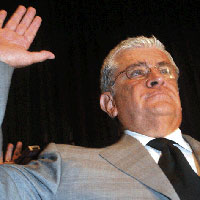
Palacio: “Immoral” amounts spent on debt service |
Ecuador has yet another new president. This time it is Alfredo Palacio who is playing the role of the unassuming vice-president thrust blinking into the presidential spotlight, following the April dismissal of Lucio Gutierrez by congress. Gutierrez is the third Ecuadorean president in eight years to be forced out of office before his term was up. As is usual in such circumstances, Palacio started in his new job by trying to placate the mobs on the streets of Quito. One way he did this was to denounce his predecessor’s economic policies, which, while far from by-the-book orthodoxy, were at least keeping Ecuador’s always fragile finances in reasonable shape.
Within a couple of weeks, it was clear that Palacio would remain president for long enough to be capable of seriously damaging the economy should he be so inclined. And his choice of finance minister – Rafael Correa, an academic formerly known mainly for his campaign against Ecuador’s dollarization – was not encouraging.
Between them, Palacio and Correa are long on leftist rhetoric and short on experience dealing with the international community, especially Wall Street. Palacio came to office saying it was “immoral” that Ecuador spent 40% of its budget on debt service, and immediately moved to spend less of the oil windfall on debt buybacks and much more on social projects.
Correa, meanwhile, was embarking on a series of conference calls with Wall Street analysts. He managed to impress none of them. In stark contrast to his well-respected predecessor, Mauricio Yépez, Correa has persuaded no-one that he even has control of the economy, let alone the ability to steer it in the right direction.
IMF attacked
Palacio has also stepped up rhetorical attacks on the IMF, which could prove to be extremely dangerous. At the moment, Ecuador operates under an IMF monitoring programme, allowing the World Bank and the Inter-American Development Bank to continue lending it development funds. If Palacio bans the IMF from the country, as he has threatened to do, multilateral inflows would come to a halt and Ecuador’s fiscal situation would deteriorate rapidly.
At the moment, Wall Street’s greatest hope is that the Organization of American States, which is unhappy about the dubious legality of Gutierrez’s dismissal, will press for elections sooner rather than later. But even if that were to happen, a market-friendly candidate would probably not be elected.
An actively pro-market candidate would probably be too much to hope for, in any case. Increasingly, the cleavage in Latin politics is not between right and left but between the market-friendly left (Lula in Brazil, Lagos in Chile) and the market-unfriendly left (Kirchner in Argentina, Chávez in Venezuela). Gutierrez was somewhere in the middle, edging towards the Lula end of the spectrum; Palacio seems to be placing himself squarely in the second camp.
The consensus on Wall Street is that even if Palacio stays in power until January 2007, when the next elections are due, the country will probably manage to avoid default. That, however, is pretty much the best that can be said. There’s certainly now no chance of Ecuador issuing a long-rumoured global bond. As far as the international capital markets are concerned, Ecuador is, once again, off the map for the foreseeable future.
When Ecuador’s president Lucio Gutierrez was sacked by congress in April the sovereign spread blew out to 840 basis points over US Treasuries as creditors dumped the bonds. Ecuador has only $4 billion-worth on the market, just 2% of the JP Morgan EMBI+, so the crisis was not enough to send the broader market crashing.


