With liabilities of nearly $80 billion at GM, capital has been diverted from the business of making cars at a time when Japanese companies Toyota and Honda are investing in new plants in the US South. Money has been flowing out of bonds in GM and GMAC, leaving credit spreads on paper maturing in 2009 as wide as 205 basis points over benchmark. This has pushed spreads on similarly dated Ford paper to 189bp.
Real-money investors fleeing US names have been looking to Germany, and VW, BMW and the global DaimlerChrysler.
Of these, BMW has the strongest credit profile, though it is such a small issuer that Standard and Poor’s does not rate it. As Christophe Boulanger, automotive credit analyst at Dresdner Kleinwort Wasserstein, says: “Real money investors have been increasing exposure to VW and DaimlerChrysler since the beginning of the year, which enabled their 2011 bonds to tighten by around 25p and 15bp respectively.”
Are investors making a good value bet? The 2005 outlook for GM is now stable at BBB– from S&P, which has the same rating and outlook for Ford and Ford Motor Credit. Also stable is the outlook on its BBB for DaimlerChrysler. In contrast, VW, albeit from a stronger position of A–, is now seen as having a negative outlook.
The automotive sector is now truly global. The key concerns for VW are a continuing decline in profits and market share in China, from a peak of over 50% share to a target of 20% in 2005. In addition, as with all the European manufacturers, the euro/dollar exchange rate is a continuing burden.
Wolfgang Wiehe, German auto analyst at Fitch, which gives VW a negative outlook, says: “Despite a strong local manufacturing presence in North America compared with other European carmakers, and after a sizable dollar-induced loss in 2003 and 2004, the exchange rate is still affecting margins.”
One positive for VW, which has the largest European market share at 18.1%, is that the western European market is seen as being at the bottom of the cycle. Despite this, Pierre Bergeron, automotive credit analyst at Société Générale, recommends that investors use the spread tightening to exit VW. “These results show that the group still has a problem on the cost side, as revenues increased by 5% in a challenging environment but, after special items, operating profit increased by only 1%,” he says. “We do not see the improvement in the net cashflow as positive news as it does not seem to be linked to an improvement in operations.”
At DaimlerChrysler the outlook is seen as stable by both Moody’s and S&P. Like VW, it suffers from currency concerns, and also the profitability of the Smart brand and the Mercedes Benz division. On the plus side, and this is a big advantage of the global nature of the business, Chrysler, which was a burden from 1998 to 2003 has now become a profit driver. As Maria Bissinger, automotive credit analyst at Standard & Poor’s says: “Though still a little vulnerable, Chrysler is much better than expected, commercial vehicles have turned around in 2004 and are expected to improve further through 2005.”
It remains to be seen whether bond investors will live to regret switching out of US autos into German names. One group seems particularly keen to invest. In the last month, over $2.6 billion has been directly invested in VW and Daimler Chrysler by the emirates of Abu Dhabi and Dubai.
Last year, Abu Dhabi pulled away from a deal to buy 9.8% of VW stock mainly because of a falling share price. Since then, VW, seeking to strengthen its financial division by purchasing the Leaseplan Corporation from ABN Amro, turned to co-investors Olayan Group of Saudi Arabia and the state owned Mubadala Development Company of Abu Dhabi. This meant taking a e500 million stake in the e2 billion deal.
Since that deal was signed, VW has announced plans to build an assembly line in Abu Dhabi for heavy trucks, which will come online in 2006 and have an initial annual target of 1,000 units. This fits into the current strategy at VW which has a similar size plant in Brazil and is about to build one in South Africa.
Crucial diversification
|
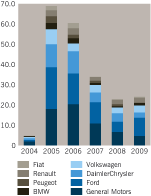
All currency bond redemptions Auto sector, 2004-2009 (emn) |
 |
Diversification is crucial for Abu Dhabi and is an even more pressing priority for Dubai, underlying its $1 billion equity investment in DaimlerChrysler earlier this year. This is the Gulf emirate’s largest foray into the equity markets and makes Dubai, with about 2.2% of the stock, the unofficial third largest stakeholder after Deutsche Bank, (10.4%) and the Kuwait Investment Authority (7.2%).
In general, analysts have reacted positively to the news. As Bergeron says: “This is a real opportunity to build a position in one of the top carmakers in the world, and one newly on a recovery trend, but we would not expect this recovery to appear in the figures until the second half of 2005.” Unlike the VW deal, this seems to be a straightforward investment, not immediately linked to any regional manufacturing plants.
As Leslie Dharmasena, fund manager at the National Bank of Dubai, explains, it is also about the cachet of the investment. “The UAE appears keen to invest in high-value-added industries such as premium automotives,” he says. “It is a similar strategy that attracts international private banks to the region focusing on high-net-worth customers and their preferred products.” This is despite 70% of the local auto market being taken by Japanese manufacturers.
The UAE has been investing heavily in its international air infrastructure, and its carrier, Emirates, has 45 of the new flagship Airbus 380 on order. In total, this is worth over $19 billion to Airbus. Airbus is 80% owned by EADS, a consortium 33% owned by the DaimlerChrysler. Not only is the UAE investing in the cars its citizens love to drive – sales of Mercedes went up by 14% last year in the region – so they are also investing in their aircraft.
So with VW and DCX receiving capital inflows from the Middle East, and GM and Ford remaining out of favour as far as the long-term investor is concerned, what is the primary market outlook for automotive bonds for the coming year? The chart indicates that the auto sector leads the way in redemptions in six months of 2005. The issuance and supply pipeline for autos looks likely to be in decline or flat with expected issuance of e60 billion to e80 billion in 2005, versus e80 billion in 2004. VW is seen by many to be a net redeemer this year, with DCX expected to be relatively flat.
Ford and GM, on the other hand, are expected to be strong redeemers, and this lack of new issuance could well once again work in the German companies’ favour. Less issuance, as we have seen across the wider market this year, could well reduce the spreads on the remaining auto issuers. With so much negative talk still in the market, GM and Ford, perhaps sensibly, have little in the new-issue pipeline at the moment.
Looking at Ford, which is expected to issue $12 billon to $17 billion this year, highlights the scale of the redemptions. As DrKW’s Boulanger explains: “We expect them to redeem $27 billion in total in 2005, and of that figure e6.5 billion will be redeemed by late February – about a third of the year’s total.” It is expected that after the travails of late 2004 and early 2005, GM will also look towards less volatile markets, in particular to the ABS and whole loan market, thus escaping some of the risk elements of the current bond market.