 |
|
Outspoken Opel: the Schmall car |
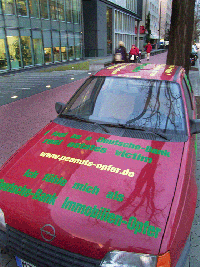
If you are passing the head office of the mighty Deutsche Bank in Frankfurt you might notice a red Opel Kadett parked outside. Scrawled along its sides in big bright letters is the slogan: “Never again, Deutsche Bank or its partners!”
Then again, you might not spot it. The owner of the car, Frank Schmall, returned on one occasion to discover it had been hidden between two large Deutsche Bank posters turned inwards.
The city of Frankfurt did nothing to remove the posters covering his car for two days until Schmall called and threatened to sue the city authorities for personal injury should one of the massive Deutsche billboards fall on a pedestrian. They were removed half an hour later.
If you have a keen eye and travel widely in the region around Frankfurt you might well spot more of these cars, parked outside local Deutsche branches, the offices of its affiliates and partners and even in the road in front of the houses of members of the bank’s board of directors.
Schmall has five similarly adorned cars, including his wife’s Renault Twingo, that he has been using to protest against a real estate deal that went bad in 1996 involving the bank.
Schmall is one of a group of 140 customers who are actively campaigning against the bank. They say they have a list of more than 3,000 people they claim are victims of the bank’s relentless pursuit of profit.
The problem began when Schmall bought an apartment in a development designed for old people.
“I am self-employed so I have to take care of my own old age,” says Schmall, who is an Apple Macintosh distributor in the state. “They sold 120 of 140 apartments, but Deutsche Bank was financing both the developer and buyers. It was only later that we discovered we had been badly overcharged. The bank should have realized this, yet they went ahead and financed our loans anyway.”
Schmall spent e125,000 on the apartment but claims it is worth half as much. Discovering he was not alone, the group has sued the bank four times in the local courts in Frankfurt and won, only to see the decision overturned four times in the higher regional court in Karlsruhe.
“We are not getting very far,” Schmall admits, “But I am not going to give up. The problem is that no-one in government wants to see us win. What really ticks me off is that the bank won’t even meet with me or the others to discuss the problem.”
When asked about the affair, a Deutsche Bank spokesman offered no comment.
The disgruntled customers were already hopping mad but things turned ugly when one of the alleged victims was unable to continue mortgage payments and committed suicide, although Schmall is careful not to make an explicit link between the incidents.
“I can cope and I am continuing to make my monthly payments, but some people are standing up to their necks in the water,” says Schmall.
So he hit on the idea of a parking protest. His work takes him all over the region and he always parks one of his slogan-clad cars near something linked to Deutsche Bank.
VIP parking
In the last week of January it was the turn of the villa belonging to Deutsche Bank board member Hermann-Josef Lamberti in Faltenstein. This time Schmall returned to find all four tyres on his car had been slashed by what the police report described as “persons unknown”. Deutsche Bank chairman Josef Ackermann’s house has also had a few visits from one of Schmall’s cars.
Although Schmall says he has not been harassed by Deutsche Bank, he has certainly incurred its ire and claims to have been followed by the bank’s security personnel.
On another occasion Schmall parked one of his cars outside the offices of Deutsche Bank’s fund management arm, DWS, strategically placing it next to the private entrance of the senior management and below an employees’ smoking room on the second floor. This time he returned to find the car surrounded by scooters that hid all but the messages on the roof.
“I don’t want anything more than an acknowledgement from the bank that there is a problem and for them to sit down with me and the others at a table to talk about what can be done,” says Schmall. “But they refuse. So I intend to keep this up for at least the next five years. It’s a goal I have set myself.”


