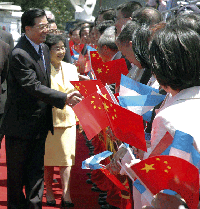
Traditionally the backyard of the US, Latin America is fast becoming China’s new best friend. Such is the apparent warmth of the relationship that Venezuela’s president, Hugo Chávez, recently declared that Mao Tse-tung and 19th-century independence leader Simon Bolivar would have been great friends had they met.
Ideologically, communist China and free-market Latin America have little in common. But resource-poor China is eager to gain control of gas, copper and oil production to fuel its red-hot economy, which was the world’s fastest-growing at 9% in 2004. Latin American leaders are only too happy to receive the promised billions of dollars in capital for tourism, mining and energy infrastructure and to have a guaranteed export market. Investors hope the new relationship will provide a platform for sustained economic growth from Mexico to Argentina, increasing creditworthiness in a region known for the volatility of its stop-start economies and unpredictable sovereign bonds.
As the Bush administration focuses on Iraq and its war on terror, China’s leaders have been on a whirlwind tour of Latin America in the past six months, visiting Argentina, Brazil, Chile, Cuba, Mexico, Peru, Venezuela and various countries in the Caribbean. The People’s Republic has signed a series of investment deals that could transform economies and add dynamism to the trade relationship worth $14 billion in Latin American exports to China last year. China promised Argentina $20 billion in capital for energy and infrastructure projects in what would be the first major investment in Latin America’s third-largest economy since its debt default at the end of 2001.
This year, Brazil’s state oil company, Petrobras, hopes to more than double its crude exports to China, the world’s second-largest oil consumer. China is poised to become a key trading partner for Brazil, and Beijing expects trade to increase fivefold by 2010 to $35 billion a year. In return, Brazil, along with much of the region, has recognized China as a market economy, waiving the right to raise anti-dumping barriers on Chinese goods.
Major investments
In gas-rich Bolivia, China hopes to invest $1.5 billion in the energy sector and it plans to put billions of dollars into Mexico’s copper mines. It has already agreed to make Peru one of a select group of official tourist destinations, which should mean thousands of extra visitors every year. Tour guides at Peru’s Inca citadel Machu Picchu are already polishing Chinese language skills. “Peru’s hearts and arms are open to receive Chinese tourists,” Peruvian president Alejandro Toledo said during a visit by Chinese vice-president Zeng Qinghong in January.
Venezuela, the world’s fifth-largest oil producer, has signed five contracts with China’s state-owned oil company to increase exports to Beijing for the promise of future Chinese investment in Venezuelan oilfields and has started talks with Panama to use a pipeline to pump Venezuelan oil across to the Pacific for shipment to China. “Venezuela is clearly trying to reorient its oil sector policy towards China and reduce its dependence on the US,” says Jan Dehn, an analyst at Credit Suisse First Boston in London.
The relationship appears to be bearing fruit for both sides. According to the World Bank, Latin American economic growth averaged almost 6% last year, its highest since the mid-1990s, thanks to high commodity prices pushed up by China’s appetite for raw materials. Latin American exports reached a record $445 billion in 2004, the best performance in decades. Such economic clout led the Group of Seven rich nations to invite Brazil and China to talks for the first time in February, a move Chinese central bank governor Zhou Xiaochuan says could lead to greater stabilization of the global economy as major developing nations have their say in economic policy-making.
But while China appears to have its chequebook at the ready for Latin America, the investments must still materialize and the capital injections, in the case of Bolivia, will be made over many years in industries still battling against corruption and inefficiency or popular resistance to foreign capital. Venezuela faces major logistical obstacles before it can export oil easily to China and would need to acquire supertankers to reach Chinese ports, while China lacks the refineries capable of processing Venezuela’s high-sulphur crude. Mexico and Brazil are traditional trade rivals with China and fight over access to the lucrative US market in exports ranging from textiles to manufactured goods.
But Chinese officials have called for cooperation and in a goodwill gesture have dropped plans to enforce stricter import standards on Latin America’s soybeans and beef. If the relationship is to work, Latin America will need to negotiate intelligently on sensitive agricultural issues and to take advantage of a Chinese market open to everything from Brazilian aircraft to Argentine shoes. China will also have to make good on its promises and only then will the US be forced to admit to its relative neglect of the region.