Issuers: France; Greece; Poland
Sizes: e6 billion; e5 billion; e500 million
Lead managers: Barclays Capital, BNP Paribas, Deutsche Bank, HSBC (France); Alpha Bank, EFG Eurobank, HSBC, Lehman Brothers, Merrill Lynch (Greece); ABN Amro (Poland)
Dates: January – February 2005
|
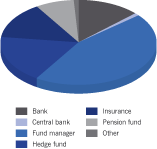
AFT’s 50-year bond Distribution by investor type |
 |
Old and new Europe have come to the markets this year as sovereign issuers continue their move well beyond 10-year bonds.
With Agence France Trésor (AFT) launching its 50-year OAT last month, it’s easy to forget that European sovereigns have a history of avoiding long-dated issues, particularly those secondary sovereigns that have managed their debt programmes to appeal to non-domestic investors. But following last year’s celebrated 2020 deal by the European Investment Bank, non-eurozone countries like Poland are issuing longer-dated paper.
It’s a good time to do this. Supply is down. Between mid-January and mid-February, the amount of seven-year to 30-year euro-denominated bonds outstanding fell by around euro20 billion. Supply is also down in US Treasuries longer than seven years.
Poland’s new record
On January 21, the Polish Ministry of Finance priced a 30-year e500 million bond at 29 basis points over mid-swaps, to yield 4.489%. The deal was launched under Poland’s existing EMTN programme, with ABN Amro as the sole lead manager.
It followed a e3 billion 15-year from Poland – at the time, the largest and longest single deal from any new EU member.
Now the 30-year is the longest ever deal by any sub-AA sovereign and looks like a cracking deal for investors. When Poland launched the 30-year bond, the 15-year was trading at Libor plus 23 bp, four points tighter than its issue price. “This time last year, not even Poland’s five-year was at this price level,” says Ciaran O’Hagan, sovereign strategist at Lehman Brothers. Poland’s rating could continue to move towards AAA because the country is cutting its debt. Both the 15 and 30-year deals are being used to finance foreign debt obligations, including a possible prepayment of Paris Club debt.
With investor appetite so huge, 30-year bonds have outperformed recently. Still, pricing in the mid-to-high 20s shows that Poland has some ground to make up. In February, Portugal priced its longest-ever deal, a e3 billion, 15-year syndicated deal, at 2.5 bps below mid-swaps.
“There’s still a big spread between Poland and southern Europe,” says one banker. “Even the most liquid and relevant CEE name is still evolving towards being accepted, while the spread between Portugal’s 15-year and its outstanding 2014 will be quite modest.”
Another southern European issuer, Greece, got a successful e5 billion 10-year deal away in February. This was the first large syndicated issue from Greece in a year. The delay in confirming a successor to Christopher Sardelis, who quit as head of Greece’s debt management agency, the PDMA, last year, stopped Greece issuing its usual early January benchmarks.
Immediately before launch, Lehman Brother’s head of European interest rate strategy, John Butler, recommended that investors sell or underweight GGBs generally, in particular at the short end where Greece’s curve is steeper than CEE sovereigns. While the Greek press used this as a stick to beat Lehman with, the bank helped deliver an exceptionally strong deal. The bond sold at 7.5 bps over Libor, 1.5 bps tighter than price guidance, and demand was strong. That’s a good sign for Greece, which still has over e10 billion of redemptions to pay off by April.
France took demand for long-dated bonds to its logical conclusion with its 50-year OAT. Launched on 23 February, it priced 3 bps over the OAT 2035. The order book for the e6 billion deal reached e19.5 billion. Despite AFT’s stress on attracting real money, it included 18% from hedge funds. There’s more to the success of the OAT 2055 than pension funds and insurance companies reallocating funds from equities to high credit-quality, long duration instruments.
Convexity and protection
Very long-dated bonds can protect portfolios from changing interest rates. The OAT 50’s duration is close to 22 years. “The convexity of the 30-year OAT is around four,” Benoît Coeuré, CEO of AFT, told investors in London on February 18. “For the 50-year it is over seven.”
Banks want long-dated bonds because volatility is low. “US mortgage duration is falling because the call option in US mortgages is worth less,” says O’Hagan. “So banks that apply a duration target to their holdings must extend along the curve.”
And because there is already a market for 50-year swaps in the eurozone, swap desks want 50-year bonds to stabilize their books.
What does the 50-year OAT mean for the rest of France’s issuance? “We don’t want special treatment for this deal,” said Coeuré. The bond is fully strippable and France’s 21 primary dealers will act as market makers. It will be listed on MTS as a benchmark and will be in all the major bond indices from March 1.
Although France’s budget deficit is falling, AFT faces redemptions of between e60 billion and e90 billion per year. “We have to remain a substantial issuer until 2009,” said Coeuré. “We will not scale back our 30-year or linker issuance.”