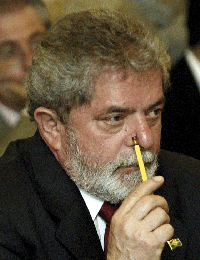
Since taking office in 2003, Brazil’s president Luiz Inacio Lula da Silva has been the man to watch in Latin America, bringing the region’s largest economy unprecedented stability and silencing fears that the former steel worker would be unable to handle the country’s huge foreign debt. This year, though, Lula faces one of the biggest challenges to his pro-market credentials: the task of pushing an initiative through congress to give the central bank autonomy.
The issue has been controversial for years in Brazil. Although Lula has the IMF on his side and finance minister Antonio Palocci knows the move would create enormous confidence among investors, workers and industrialists say they will lose out if it means that interest rates rise.
Less political interference
Lula’s supporters say an independent central bank would convince the markets that monetary policy decisions are not motivated by political goals and put an end to rumours that the government will fire bank officials if it does not like their decisions. Autonomy could reduce the size of interest rate increases needed to curb inflation, the government says. Economists argue that while Brazilian sovereign debt has a relatively low credit risk of 400 basis points over US treasuries, other countries in the region, such as Mexico and Peru, have lower spreads because their central banks are independent.
But given the political resistance to the move, Lula’s proposal does not call for the full independence of monetary policy for the bank. The federal government would still set inflation targets for the bank’s interest rate-setting monetary policy committee to meet. Still, the role of the central bank is so sensitive because in the past two years it has been crucial to the achievement of economic stability, bringing fiscal discipline to public spending and allowing Brazil to meet strict inflation goals. Inflation fell to 7.6% in 2004 from 21.5% in 2002, for instance. In 2005, central bank governor Henrique Meirelles hopes to meet a target of 5.1% despite high world oil prices, bringing inflation down to 4.5% in 2006, a world away from the hyperinflation of the 1990s.
Achieving central bank autonomy seems set to be far from easy for Lula, despite his high popularity on the back of Brazil’s economic growth of 5% in 2004, its strongest in a decade. The first obstacle will be his own Workers’ Party and its leftist factions, which are unhappy with the president’s adherence to free-market, IMF-backed policies.
They say that the monetary policy committee, which is composed of directors drawn from the financial sector, is too eager to defend the interests of bondholders, who gain from higher interest rates. Such rates would hurt local businesses and workers who gain from lower credit costs, they argue. Indeed, Brazil’s GDP growth is set to cool to 3.5% in 2005, in part because the central bank has increased interest rates to keep inflation down and prevent the economy from overheating. In January, the bank hiked its benchmark Selic interest rate to a 15-month high and promised more increases. Brazil has one of the world’s highest real interest rates and leftist politicians fear an independent central bank would have a free rein to raise rates at will.
The second obstacle is Lula’s loss of control of congress. In mid-February, the lower house parliament voted to elect Severino Cavalcanti from the centre-right Progressive Party as its president. Cavalcanti has appealed for higher pay and benefits for legislators. The defeat shows the divisions in Lula’s party and the discontent of some government allies who feel neglected by Lula’s policies. The president’s party, although nominally the largest in the lower house, did not manage to elect a single member to the chamber of deputies steering committee, which controls the chamber´s voting schedule and rules.
Struggle
Without this legislative backing, Lula could struggle to pass the central bank independence bill, along with other structural reforms such as a tax reform that would streamline collection and a labour reform bill designed to create greater competition among unions and reduce employer welfare costs.
“The government will have to negotiate heavily with Congress and resort to horse-trading in order to get legislation approved in congress, especially since the Workers’ party already faces stiff opposition in the senate,” says economist Nunco Camara at Dresdner Kleinwort Wassertein.
Even with a Workers’ Party lawmaker heading the lower house during Lula´s first two years in power, reforms for Brazil´s indebted public pensions and bankrupcy laws were watered down. “This episode demands a prompt shift in the government’s and the Workers’Party’s posture toward political negotiations to avoid another year without approving structural reforms,” says economist Adauto Lima at WestLB. Such an effort needs to be immediate because 2006 is an electoral year and Lula, who is well placed to win a second term, will be reluctant to spend political capital on structural reforms.