 |
TWELVE MILLION JAPANESE play golf. Makoto Kikuchi is no longer one of them. In 2003, he set up a hedge fund, Myojo Asset Management, named after the first star to appear in the night sky. Since then free time has become a thing of the past. “Over the last 12 months, the pace of money flowing into the fund has suddenly accelerated,” he says. The Japanese long/short equity fund has attracted more than $100 million in assets, and the closing level of $400 million could well be reached by the end of this year. Kikuchi is one of an increasing number of hedge fund managers to recognize the potential of the Japanese market. In 2004, Japanese institutional investors, which have $4.5 trillion in investable assets, increased their allocation to hedge funds by 41%, and it is conservatively estimated that allocation from all Japanese investors will increase by a further 44% by the end of 2007. Demand is far outstripping supply in a market that has unique characteristics and is difficult for providers to enter. With forecasts like these, Japan can be a guaranteed source of assets for hedge fund managers that illustrate commitment and offer a strong track record.
The Japanese hedge fund industry has developed in almost the opposite way to those in the US, Europe or the rest of Asia. Institutions have led the way as investors, large investment banks and asset managers rather than boutiques have driven supply.
Japanese individuals have a high propensity to keep careful control of their assets – they are more likely to put their cash in the post office or under a mattress than to explore alternative investments. The Japanese post office has a staggering $2 trillion in savings deposits.
Institutions have been more enterprising, although initially cautious, since the Japanese economic bubble burst in the 1980s. This caused Japanese insurance companies and banks to look to absolute return products. Tokyo’s stock market index had reached almost 40,000 in December 1989 when the bubble burst; in eight months it plummeted to 23,000. At the same time, real-estate values plunged 75%. The losses to Japanese wealth as a result have been estimated at as much as $15 trillion. Institutional investors became risk averse, and content with low absolute returns, so long as they were stable.
Shift in investments
In the late 1990s, assets started flowing into market-neutral and arbitrage strategies run by large houses such as Barclays Global Investors, State Street Global Advisers, Goldman Sachs and JP Morgan Fleming, and Japanese asset managers. “These domestic managers would go long a basket of stocks as determined by their quantitative models, and short the futures against them. The perception was that a yen-neutral product held little market exposure, and the institutional money started flowing in,” says Stan Howard, Asia president of fund of hedge funds Investor Select Advisors.
Over the past five years, however, potentially higher-returning products such as funds of hedge funds, and, more recently, individual hedge funds, have been gaining popularity among institutions. Interest rates have been near 0% for almost 10 years, making it hard to achieve positive yields in fixed income and cash. At the same time, there has been a shift to risk control and diversification.
Jun Miyazaki, chief executive officer of Gartmore Japan, has witnessed at first hand the evolution of hedge fund investing in Japan. Gartmore started there as a long-only manager in 1984, developing itself as an alternatives house in 2000 with the launch of a Japanese long/short equity hedge fund, AlphaGen Hokuto. “Japanese institutions started investing in hedge funds in around 1998, but they were very nervous about risk,” Miyazaki says. “As a result, they opted for lower-risk strategies or used funds of funds. Funds of funds offered diversification, and their performance at the time warranted the extra fees. But the big Japanese institutional investors have now had over five years of experience in the market, and there is a shift of money to single hedge funds.” Gartmore Japan’s long/short Japanese equity fund is a prime example of the demand for single hedge funds. In 2004, the assets in the fund increased by more than 80% – the bulk of which came from Japanese pension funds. The fund’s success and the increased demand for hedge funds in Japan is expected to drive a number of new Gartmore hedge fund products later this year, including a Japanese small-cap hedge fund and an Asia-Pacific fund.
Pension fund vanguard
|
Hedge fund asset allocations by Japanese investors Growth rate ($bn) |
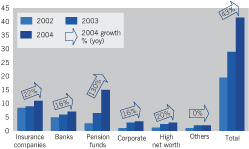 |
Among institutional investors, it is the pension funds that are leading the current march into single hedge funds. Assets invested in hedge funds by Japanese pension funds increased 130% over 2004, according to research by Daiwa Securities, Mercer and Gartmore, compared with just 22% for insurance companies and 16% for banks. Ted Uemae, chairman of the Alternative Investment Management Association Japan, says: “Insurance companies were initially the predominant institutional investors into hedge funds, but over the last 12 months their allocations have slowed, with a few exceptions. Pension funds, however, started investing in hedge funds two or three years later than the first generation of insurance companies and Japanese banks. Most of the pension funds did not start investing until 2002/03, so there is space for them to increase their investments to hedge funds, which is driving appetite.” Market participants point out, however, that only a small proportion of pension funds have allocated assets to alternative investments. And, with a few exceptions, these tend to be only 2% to 5% of total assets under management. Research suggests that Japanese pension funds had just $15 billion invested at the end of 2004.
Miyazaki estimates that only the top 10% of the 1,400 Japanese corporate pension funds have invested in hedge funds. Even so, if this is correct, it represents a large amount, given the size of these institutions. Charles Beazley, global head of institutional and alternative investments at Gartmore, points out: “Some of the Japanese clients we are selling to have more investments in hedge funds than we have – some have some $4 billion to $6 billion invested in alternative assets.”
The Mitsubishi pension fund, for example, has $2 billion in assets, of which, some sources claim, 40% is invested in hedge funds. And many of the larger pension funds are currently researching the possibility of investing in alternative assets. The government pension fund, for example, has $500 billion in assets under management and has yet to allocate any of this to hedge funds. However, its executive director, Noburu Terada, says that it will be considering an investment in alternatives, although it has no firm plans as yet.
Pension funds, however, can be tougher investors than financial institutions. “If you call on institutional investors regularly, they are more likely to allocate to you. This is not the case with pension funds, however,” says Investor Select Advisors’ Howard, “But if you can break in, the payoff is big.”
Domestic hedge funds
Howard claims that the limitations of the market are largely a result of the paucity of domestic hedge funds. Japanese nationals, for example, have only recently begun to establish domestic hedge funds. Investor Select Advisors started by offering global multi-strategy funds of hedge funds to Japanese investors but recognized a need for yen-denominated portfolios and so established a Japanese-only fund of hedge funds. “Three years ago we could identify only 50 funds around the world which invest 99% in Japanese securities, but now there are around 130,” Howard says. Of these, he estimates only 40 to be based in Japan, and only about 20 of these to be run by Japanese nationals.
“The star fund manager concept does not exist in Japan,” says Akane Hashimoto, a consultant with multi-manager provider HCAsset Management in Tokyo. “Individuals are not singled out for their performance, there is not a bonus culture and salaries seldom vary, so it can be difficult for Japanese fund managers to make enough money to start a new hedge fund, and to have a reputation in place that would encourage investors to put their money with them. You really need to find a sponsor if you are Japanese and want to start up a hedge fund to attract Japanese investors.”
Kikuchi’s experience is a case in point.His Myojo fund is doing well now but when he set up his Japan long/short fund the going was tough. He had been a Japanese equities fund manager since 1990, was convinced institutional investors would move to absolute-return products and so decided to start a hedge fund. “Initially it was difficult,” he says. “We started with about $2 million that friends and family and myself invested. With no track record, and being so small, it was difficult to attract money. In 12 months we had attracted only $30 million, and that was still too small for institutional investors, who wanted to allocate between $2 million and $5 million but did not want to own more than 10% of the fund.”
Over 2004, however, the fund returned 54.77%, and more funds of hedge funds and family offices were attracted to it. “Those sorts of returns are unsustainable, but once we had established a track record of one year or more, and when we hit $50 million, the pace of money flowing in suddenly accelerated,” says Kikuchi.
Cultural advantage
Although it can be difficult for Japanese nationals to finance the establishment of a hedge fund in Japan, Kikuchi believes that they have a distinct advantage over foreign entrants in running a long/short Japan fund. “It really is a unique culture and you have to know this culture and the language to be able to read between the lines when meeting with Japanese companies,” he says. “Although long/short Japanese funds run by Japanese nationals are still minority players, they rank in more than half of the top 20 long/short Japanese hedge funds.”
Despite increased demand, managers are not expecting the market to become saturated with hedge funds in the next few years. “There may be strong demand, but it doesn’t mean you can just come in and set up a hedge fund and expect Japanese institutions to invest with you,” says a CEO with a hedge fund business. “They are very astute and require commitment, loyalty and a proven track record. It is presumed that Japan is an easy and quick way to make money for hedge funds, but that is nonsense.” HCAsset Management’s Hashimoto says: “It is not that easy. Ten hedge funds can start up here, but in two or three years, eight might have given up.”
Regulatory differences are often listed as a reason why foreign hedge fund managers are reluctant to market to Japanese institutions. One consultant downplays this. “The regulation can be quite confusing, and some will claim it is open to interpretation,” he says. “But it is easy enough to go to the ministry of finance and check that you understand what you are able to sell inside Japan, and what documents you will require.” AIMA’s Uemae points out that help is at hand: over the past two years an increasing number of services designed to help start-up hedge funds have sprung up in Tokyo.
Local presence
ProfitFundCom is one fund run by a foreign manager that is trying to crack the market. Established by Richard Werner in Tokyo in September 2000, it runs a global macro hedge fund, 70% of whose assets under management are accounted for by Japanese institutional investors. Stefan Nilsson, its head of business development and client relations, says that interest from Japanese pension funds has taken off since marketing began a year ago. “I meet with two to three institutions every day now, and I’ve not spoken to a pension fund that isn’t interested in investing in hedge funds.”
Marketing to Japanese investors demands a Japanese base, he believes. “Pension funds do invest with New York and London-based hedge fund managers, but they are cagey about doing so,” he says. “We definitely have an advantage by having a local presence.” The fund also benefits from its founder’s reputation in Japan. Before setting up the fund, Werner worked at the Bank of Japan, the ministry of finance, Nomura Research Institute, the Japan Development Bank and the Asian Development Bank.
Local presence and local reputation is essential, but ProfitFundCom’s Nilsson admits the Japanese take a cautious approach to investment. Like Myojo, ProfitFundCom has a strong track record but has been slow to attract inflows because it has started small. Werner used his own money, backed up by funds from the royal family of Liechtenstein, to start the fund, investing $2 million. The fund’s assets have still reached just $10 million.
For this reason, ProfitFundCom sold a 10% stake to Aizawa Securities, the sixth-largest broker in Japan, in the hope of benefiting from its cross-holdings (keiretsu). Often considered as irksome, the cross-holdings Aizawa Securities is involved in work to ProfitFundCom’s advantage. Aizawa is owned by several major corporations, including a leading life insurer that may now allocate to ProfitFundCom’s global macro fund, increasing its size and thereby its appeal to other institutional investors.
“We’re still fairly small, as launching a new fund from scratch has been tough, but we’re confident that our asset base will grow,” says Nilsson. “The barriers to entry are very high, but you cannot dismiss the fact that Japan is the second-largest economy in the world. It makes sense to be here.”


