 |
| Putin’s plan to curb rouble appreciation backfires |
THE KREMLIN was taught a painful lesson in economics this year after it meddled with exchange rates and nearly brought the Russian economy to a halt. A judo black belt, president Vladimir Putin pitted himself against the invisible hand of market forces and lost. Putin ordered the Central Bank of Russia (CBR) to weaken the rouble against the dollar to give domestic manufacturing some breathing space in its battle against rapidly increasing imports. Although the move did give some sectors a boost, Russia’s ballistic growth halted and the economy began to stagnate by last summer.
By October the Kremlin had conceded defeat and the rouble was given its freedom. The economy looks as if it will bounce back, but Russia is still on a steep learning curve and is ill equipped to deal with the increasingly complex problem of managing its currency.
A mini-banking crisis and the onslaught on the Yukos oil company have been blamed for the slowdown but the financial system’s wobbles are a symptom, not the cause, of Russia’s spluttering recovery, and the destruction of the country’s erstwhile most valuable company was always going to hurt the investment climate.
But trying to force a cheaper rouble on a booming market caused key economic indicators to turn south by the end of last year and the government missed several targets for the first time since the 1998 financial crisis. Annualized inflation was expected to reach at least 11.5% by the end of 2004, missing the government’s 10% target and putting this year’s 8.5% inflation goal in doubt.
GDP growth came in less than the predicted 6.9%, already the smallest gain since the crisis. Industrial production contracted for the first time in four years and gains in fixed investment dropped to single digits. Finally capital flight reappeared in 2004 after the first positive inflows since the fall of communism in 2003.
All this bad news is ironically a result of Russia’s having made huge progress towards becoming a market economy: the Kremlin’s meddling with the rouble caused capital to follow economic logic – and leave the country. It also highlights the CBR’s failure to develop more subtle tools to manage the currency other than intervention in the foreign exchange markets, which has been a staple measure until now. However, as the engine stalled a badly shaken government has woken up to the dangers and is rethinking policy. Putin told a cabinet meeting at the end of November that the “negative tendencies” in the economy had been overcome. “But we need to understand why this happened,” he said.
On the face of it the state’s finances have never looked in better shape. Fitch Ratings followed Moody’s and raised Russia’s rating to investment grade in November. The government’s finances are solid. And while Europe and the US struggle under the burden of growing public debt, Russia became a net creditor in December when its gross international reserves hit $117 billion, exceeding external debt of $115 billion. Twice in October reserves grew by more than $5 billion in a week (Russia had about $5 billion of reserves just before the 1998 default) and rose $28.4 billion between September and December. At the same time debt as a proportion of GDP is down to a modest 25% (most of western Europe is at the Maastricht limit of 60%) and Russia boasts at least nine months of export coverage, behind only Japan and Norway.
Flood of petrodollars
But it is this very wealth that is causing the problems. Individuals can never have too much money, but if countries become too rich, the value of their currency changes. This flood of mainly petrodollars threatens to give Russia the Dutch disease – hard currency earned by oil, gas and mineral exports drives up the value of the currency and suffocates all the other sectors.
Finance minister Alexei Kudrin has acted promptly. He was the force behind the establishment of a stabilization fund that went into operation at the start of 2004 and has taken much of the sting out of petrodollar inflows. The fund serves two purposes. It provides a cushion against a downturn in commodity prices and sterilizes excess inflows when oil prices are high. The law on the fund means the Duma can’t touch it unless the oil price falls below $18 a barrel or the fund has accumulated more than Rb500 billion ($17.8 billion).
With oil prices at about $50 for much of 2004, the fund hit the Rb500 billion level much faster than expected and a debate has begun over what should be done with the excess. Kudrin was pushing for a reduction of external debt (which won’t affect inflation), whereas Duma deputies have been lobbying for everything from infrastructure projects to paying off pension arrears (which will).
Although Kudrin looks as if he is going get his way, this debate will be a feature of Russian politics for the foreseeable future. Many countries that have stabilization funds have found having billions of dollars sitting under politicians’ noses is too great a temptation.
“So far the Russian government has been really good on the fiscal side as it has managed to keep its paw out of the honey pot,” says Peter Westin, an economist with Russian brokerage Aton. “But in other countries, like Argentina which squandered its stabilization fund on social spending, the temptation has proved too great.”
Currently all this money sits in interest-bearing accounts with the CBR but the plan is to invest it in AAA-rated dollar-, sterling- and euro-denominated securities this spring. It is a huge chunk of business and in other countries, for example Norway, the fund was passed to independent managers to keep away from the politicians.
Nothing has been said about who will manage Russia’s fund but bankers worry that the business will go to big state-owned banks – Sberbank, Vneshtorgbank or Vnesheconombank – which will further skew the banking sector away from commercial banks.
The stabilization fund has already made its presence felt in the national accounts. Russia ran a huge trade surplus of $84.5 billion between January and October 2004, compared with $63.5 billion over the same period in 2003. Exports increased by about a third at the end of 2004 while imports only rose by a fifth. Oil and gas exports to countries outside the Commonwealth of Independent States accounted for 60% of the total over this period and much of the $44 billion Russia received from these exports was put into the fund. However, the CBR is still unable to sterilize two-fifths of the dollars flowing into the economy from the export of other products.
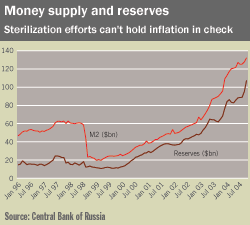
The fund prevents most of the petrodollars from hitting the economy and the growth in money supply has fallen quickly. Economists point to the falling liquidity and worry that the government is over-sterilizing the rouble in an effort to keep its appreciation in check. The broad definition of money supply (M2) was rising by over 60% a year in 2003, but finished last year (2004) up 37%.
Huge surplus
The growth in money supply is relatively low still not enough to hold inflation in check. In addition to the $40 billion surplus from non-natural resource exports in 2004, Russia’s leading banks and companies have returned to grace and have been hitting international capital markets for funds. Despite the banking crisis last summer, banks still managed to borrow more than $10 billion from banking syndicates. Likewise, corporate and banking Eurobond issues beat the 2003 record of $6.1 billion. Companies now account for about half of Russia’s external debt, up from 15% in 1999.
Add this money to the increasing export of such goods as fertilizers and the increase in wealth associated with strong economic growth and the stabilization fund alone is not enough to rein in inflation. “Before GDP was concentrated in fuel and now we are seeing the consumer section of the economy dilute the impact of oil and gas in investment activity,” says Yaroslav Lissovolik, economist at UFG. “And its contribution will clearly grow.”
The finance ministry has stepped in and is sitting on as much budget money as it can. The creditor/borrower roles of the ministry and the CBR reversed in October when the government became the CBR’s biggest net creditor; government funds on the CBR’s accounts overtook the credits the CBR extends to the government. The government ran a whopping 5% of GDP budget surplus, or Rb588 billion, over the first nine months of 2004, way ahead of the 1.5% written into the 2004 budget plan. By banking its fiscal surplus in October the ministry effectively sterilized another Rb225 billion of liquidity – only a quarter of the free cash flowing into the country.
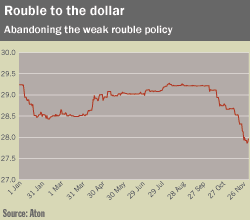
Between them the CBR and the finance ministry have taken some Rb725 billion out of circulation, and yet Russia is still suffering from inflation thanks to the government’s efforts to hold back rouble appreciation. The CBR began intervening on the foreign exchange markets in April to keep the dollar at about Rb29.315. The result was a disaster as returning Russian flight capital, which had been attracted by the rising rouble, turned tail and fled. Foreign investors owned about half of Russia’s domestic rouble bonds at the start of 2004, attracted by high yields and an appreciating rouble, but left the market en masse after the rouble began to fall. The rouble has recovered 90% of the value lost during devaluation in 1998, when the currency was cut to a quarter of its value against the dollar in a day. But, it remains undervalued. Guesses about its fair value are made difficult by the speed of the changes, but economists estimate an appropriate exchange rate would be Rb15 to Rb19 to the dollar.
“If you try to depreciate the rouble by targeting the exchange rate then you will get some appreciation but also higher inflation,” says UFG’s Lissovolik “Targeting foreign exchange rates buys more time for the domestic importers and exporters to get their competitive act together, but it also undermines the inflation targets – and eventually you will miss them.”
At press time it looked as if the government was going to hit its exchange rate target. But it had clearly missed the inflation target of 10% for 2004. “The CBR has too few tools [to manage the economy] and too many targets,” says Lissovolik.
Rising inflation has been squeezing company margins and stalled growth. The CBR caved in to market forces in October and the rouble appreciated by 4% in a month, breaking through the Rb28 to the dollar mark. “Rising inflation rates are undermining growth through the excessive real effective rouble appreciation,” says Lissovolik. “Some sectors are already feeling the strain.”
The idea behind a curb on rouble appreciation was that it would help big domestic manufacturers, but the plan backfired. A strong rouble hurts oil and mineral exporters, as they earn revenues in hard currency but have rouble costs, but inflation is now hurting other sectors that were supposed to enjoy the cheap rouble.
In theory the manufacturing and food processing sectors benefit from a stronger rouble as it makes competing imports, mostly from Europe, more expensive. “As the rouble strengthens against the dollar it weakens against the euro, so imports from Europe priced in euros become more expensive, which gives domestic industry some temporary protection against competition,” says Aton’s Westin.
Russia’s automotive sector in particular has done well out of the policy, with production rising more than 10% in October year on year. And after a decade of dithering, several foreign automotive producers have committed themselves to domestic production.
The temporary success of a weak rouble policy can be seen in the difference between the consumer price index, which measures the inflation of consumer goods, and the producer price index, which measures the prices companies pay for inputs. In October, CPI over the previous 12 months was up 11.6% while PPI was up 27.1%.
Companies are experiencing a much higher rate of inflation but are willing to let input price increases eat into their margins rather than pass them on to consumers. Part of the reason is that the undervalued rouble means there is less competition from imports. Another is that many big companies have debt denominated in dollars and so appreciation reduces their repayment burden. However, these benefits are temporary as CPI will eventually catch up with PPI. “The weak rouble creates a cushion for domestic industry, but it holds back the competition that will accelerate the modernization of industry,” says Lissovolik. “It is also a tax on the population as a rising rouble increases their wealth and this in turn boosts consumer spending (as imports are cheaper).”
There is a fundamental problem with targeting the dollar/rouble exchange rate. The CBR calculates the effective real exchange rate (after inflation is taken into account) using a basket of currencies weighted according to Russia’s trade. Almost all of Russia’s exports are priced in dollars, but a third of its imports are from the eurozone and priced in euros; dollar imports only account for 5% of the total.
Westin notes a paradox: when the CBR tried to follow a weaker rouble policy between April and October the dollar strengthened against the rouble, but by focusing on the struggling dollar this also meant the euro weakened against the rouble. “In effect, you are making imports from the EU cheaper,” says Westin. “The impact on the population of a weaker rouble against the dollar is much more severe than it is if you just look at the real effective exchange rates.”
As the mistakes of 2004 percolated through, the CBR said in December that it would switch to a composite dollar and euro basket to calculate its rouble/dollar intervention to create a more flexible peg for the currency. Aggressive sterilization and the Kremlin’s twin-targeting of real appreciation and inflation has a direct impact on growth, but it also indirectly affects other economic factors, contributing to the general economic slowdown, made worse by uncertainties associated with the Kremlin’s assault on Yukos.
Fixed investment, a major component of growth, slowed dramatically in 2004 and actually contracted by 5.4% in October. Likewise, the mini-bank crisis over the summer knocked the stuffing out of the construction sector – the only sector in Russia that was almost completely debt financed and another source of growth. Squeezing costs and removing cash from the economy threatens to remove the liquidity that has been fuelling a red-hot rise in real-estate prices.
Building work stalled as autumn arrived and, after banks had cut construction companies off from funding, real estate companies got nervous. Many issued rouble bonds to finance construction, with yields as high as 28% to 35%. The possibility of a wave of defaults on these is looming once they come due later this year.
The policy also threatened to destabilize the banking sector. Alexei Moisseev, an economist at Renaissance Capital, says Russia no longer suffers from capital flight but rather normal economic forces drive capital flows in and out of the country. “The main driver behind last year’s capital outflow was not the ‘Yukos affair’, but the CBR’s foreign exchange policy,” he says.
When the rouble began to decline against the dollar, investing in Russia lost its appeal. The resulting liquidity crunch sparked a bank crisis. Ironically the CBR had made it easier for capital to flow in July 2004 when it removed currency controls. After recording its first ever capital inflow in 2003, $10 billion fled the country over the first three quarters of 2004. In the last quarter, after the weak rouble policy was abandoned, Russia enjoyed a net inflow of $2 billion.
“A lack of liquidity could most easily be avoided by a reduction in the tax burden on the oil sector, without which instability could appear in the financial sector,” says Evgeny Gavrilenkov, Troika Dialog’s chief economist. “The liberal faction in the government and Duma is coming to realize that Russia’s economic policy is, in fact, restricting growth. Some change in policy looks inevitable.”