 |
|
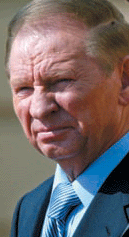
Leonid Kuchma, president of Ukraine, is not allowed to run for a third term. The oligarchs must decide on a strategy for a post-Kuchma Ukraine after the October elections. |
To integrate or not is the question facing Ukraine?s powerful oligarchs in the last months of president Leonid Kuchma?s 10-years in power.
In Ukraine as in Russia, the fall of the Soviet Union led to the rise of a few powerful businessmen who control large parts of the economy. Three of the most powerful are Rinat Akhmetov, who owns metallurgy companies and Shakhtar Donetsk football club; Viktor Pinchuk, Kuchma?s son-in-law, who owns pipe company Interpipe, newspapers and TV channels; and Viktor Medvedchuk, head of the presidential administration and boss of a large business empire that includes football club Dinamo Kiev.
All three recently figured high in a list of the richest men in central and eastern Europe compiled by Polish magazine Wprost. Akhmetov was sixth with $1.7 billion, Pinchuk 10th with $1.3 billion and Medvedchuk 18th with $800 million.
All three have done well through the Kuchma regime, which has allowed them to flourish much as Russia?s oligarchs did under former president Boris Yeltsin.
However, elections are due in October, and the constitution debars Kuchma from a third term. The oligarchs are now split over strategies for a post-Kuchma Ukraine.
What is to be done?
Some oligarchs, such as Medvedchuk, are opposed to any change in the rules of the game. Medvedchuk was influential in recent attempts to amend the constitution to allow Kuchma to stand again. The attempts failed in April, after which the Kuchma camp put forward prime minister Viktor Yanukovich as the pro-Kuchma candidate. Medvedchuk believes in keeping Ukraine as a relatively closed economy controlled by local elites.
Other Ukrainian oligarchs are thinking the same way as Russian oligarchs did in the past few years, deciding that robber-baron capitalism is outmoded. To survive, they argue, oligarchs must eschew politics, clean up their businesses, and integrate with the international economy.
The main example is Pinchuk. At present a member of parliament, he has announced that he plans to leave politics. He has also brought several leading western businessmen and statesmen to the Ukraine in attempts to improve both his and the country?s image abroad. ?Ukraine is far better than its image testifies,? he has told the Ukrainian press.
Wooing the west
Pinchuk was responsible for recent invitations to investor and philanthropist George Soros, George Bush senior, and other figures including former US national security adviser Zbigniew Brzezinski and former Nato commander Wesley Clark. These visits have generally been opposed by Medvedchuk, whom Soros accused of organizing an intimidation campaign against him during his visit.
Pinchuk has cooperated with Soros in setting up a legal advice fund in Ukraine, has been active in working on the UN?s Aids awareness campaign and is on the board of the International Crisis Group, all of which seem to be the activities of an enlightened, pro-open economy oligarch. He was also, according to local politicians, instrumental in persuading his father-in-law not to alter the constitution and stand for a third term.
This makes the controversy over the privatization of Kryvorizhstal Steel in mid-June all the more surprising.
Ukraine?s largest steel mill, Kryvorizhstal was put on the block earlier this year, attracting multinational steel companies, including India?s LNM, US Steel, and Russia?s Severstal. However, a clause in the tender document released by the state property fund stated that bidders had to have produced at least a million tonnes of Ukrainian coke for the previous three years.
A consortium including Pinchuk and Akhmetov duly won, buying 93% of the steel mill for $800 million, despite the fact that all the other bidders offered about $1 billion.
The biased terms caused an outcry among foreign investors, with Severstal taking the decision to court. As one Ukrainian analyst says: ?Of course it has damaged the image of the Ukraine among foreign investors. It may scare some of them away.?
Why was there such a heavy-handed asset grab, considering Pinchuk?s attempts to improve Ukraine?s image abroad?
Taras Kuzio, a Jamestown Foundation fellow, believes the hasty privatization might be a deal between pro-Kuchma presidential candidate Yanukovich and the oligarchs. They will bankroll his campaign and support it in their media; in return he will not look into previous privatizations when elected.
The oligarchs could be afraid, Kuzio suggests, that the other leading presidential candidate, Viktor Yushchenko, would investigate their holdings if he took power, even though he has said he would not look into the legitimacy of previous privatizations.
If oligarchs such as Pinchuk have ditched their enlightened credentials and thrown in their lot with Yanukovich, there is cause to wonder whether the post-Kuchma era will be any different to the past 10 years.
Yushchenko tops the polls at the moment, but his campaign is being hampered by dirty tricks and intimidation. ?The only way there will be fair elections in the country in October is if large foreign powers insist on them,? says a Ukrainian analyst.
Blinkered US policy
The US clearly has a large influence. Local politicians say Kuchma decided not to stand for a third term after Pinchuk put pressure on him, saying other Ukrainian politicians could share the fate of former prime minister Pavlo Lazarenko, on trial in the US for money laundering. However, US foreign policy could be blinkered by Iraq. Ukraine has contributed troops to the coalition, and such support tends to be noted.
Russia is also an important influence, and the Kremlin could have the biggest hand in making the elections fair. Russia has traditionally been opposed to Yushchenko because he is seen as more US-friendly than Kuchma and his supporters. However, the Kryvorizhstal privatization might indicate to the Kremlin that the choice is not between a pro-US or a pro-Russian regime but between an open economy, where Russian companies can compete for Ukrainian assets, and a closed economy, where they cannot.
The hope for the Ukrainian reform movement is that, rather than trying to wring the last dollar out of the economy, the more enlightened oligarchs will accept that change is necessary. Pinchuk seemed start down that path. But will he continue?


