The US Federal Reserve?s upward interest rate move at the end of June came as no great surprise on Wall Street. It might well have been noteworthy for being the first rise in four years but noises about inflationary concerns and US economic growth had already made a 1.25% rate a dead cert. ?The 25 basis points increase had been priced in a month before,? says one Wall Street trader.
Wall Street has therefore been surprised and confused by the economic figures that have followed. Employment data have shown a far weaker than expected 112,000 job creation figure for June ? a sharp slowdown from previous months and below the levels required to sustain strong economic growth.
Add to this weak retail spending and auto sales figures, disappointing second-quarter earnings, and a cut in US industry output to 0.3%, and economists have been left wondering what inflationary pressures it was that the Fed was worried about.
But Fed chairman Alan Greenspan is keeping his rose-tinted glasses firmly on his nose. In a semi-annual report to Congress at the end of July, he released the forecasts of the central bank’s policy-setting committee, including a prediction that economic growth would reach a robust 4.5% to 4.75% this year. June?s slowdown, he claimed, was a blip. ?Greenspan donned his Goldilocks outfit, arguing for robust growth, low inflation and a measured Fed,? says Lehman Brothers chief economist Ethan Harris. ?We think he is being a bit overly optimistic.?
Harris is not alone in his views. Several economists and analysts have voiced their doubts about the upbeat mood of the Fed, and believe the decision-makers will be disappointed in the second half of the year. ?The risks all seem to point to the downside,? says Merrill Lynch?s chief North American economist, David Rosenberg.
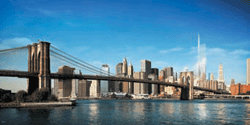
Interest rates are not the only thing whose rise will be monitored carefully and critically by Wall Street. On July 4, the 20-ton cornerstone of the Freedom Tower was laid around the corner on the site of the World Trade Centre, and that building?s vaulting ambition heightwise is also prompting concern.
The skyscraper, which will form the centrepiece of the reconstructed World Trade Centre, is a collaboration between two architects: Daniel Libeskind, winner of the design competition, and David Childs of Skidmore Owings and Merrill, who was appointed to represent the views of leaseholder Larry Silverstein. It is being heralded as a candidate for the tallest building in the world at 1,776 feet ? 408 feet taller than the loftiest of the Twin Towers that it replaces. And if plans to erect an antenna on its spire are effected, the height could reach 2,000 feet, putting an even greater distance between itself and the current record holder, Taiwan?s Taipei 101 Tower, which soars to 1,667 feet.
Shock
But the 1,776 foot target (chosen to commemorate US independence in 1776), is not inspiring quite as much awe as the tower?s designers would like. ?It was quite a shock to many New Yorkers when the plans were unveiled,? says a Manhattan resident. ?Given that the Twin Towers were a terrorist target largely because they were so tall, many people cannot understand why the replacement will be even taller. I don?t think anyone would feel comfortable working there.? Indeed, although New York?s Port Authority plans to occupy at least one-third of the office space, no private-sector tenants have been found.
To respond to safety fears, Silverstein has insisted that only 70 floors be occupied, so that the highest offices will be a relatively modest 1,100 feet up. ?So, why not just build it to 1,100 feet and make people feel a little safer still?? a taxi-driver asks.
The use of the space in between the seventieth floor and Libeskind?s spire is another source of controversy. Both Libeskind and Childs agree that there should be an observation deck, a restaurant and event space, and a garden but Childs has modified Libeskind?s original design so that part of the area will now house wind turbines to generate 20% of the building?s electricity.
A project of this sort has never been implemented in a high-rise structure before, and has been a major cause of friction between the two architects. Newspaper reports go as far to say that they now refuse to speak to each other outside of conferences.
The limit on tenants and the high cost of the proposed turbines are also prompting some observers to question the project?s economic viability ? the cost of building is put at a hefty $1.5 billion to $2 billion.
With costs only likely to increase from here, it is believed that the turbines, along with the empty spire, which was designed to emulate the Statue of Liberty?s torch, are likely to be axed during the construction process anyway. But if the spire goes, so too will the title of tallest building in the world.
In the surrounding area, several monuments will be erected, including the Wedge of Light ? an area designed to remain free of shadows every September 11 morning. But some families and friends of victims of 9/11, while supporting the reconstruction, fear that the design will be become more of a commercial venture than a memorial.
New York state governor George Pataki has made it clear that he is hoping the Tower will regenerate downtown Manhattan, turning it into a thriving commercial area. However, some architectural critics are drawing parallels with the original Twin Towers project in the late 1960s and early 1970s. This, they argue, was oversized, commercially inefficient and rushed through by the city?s governor. ?It?s farcical,? says one New Yorker. ?The architects have once again been forced to rush the design through. I don?t even listen to what they?re doing as the chances are the Freedom Tower we end up with in 2008 won?t resemble the Freedom Tower of today?s plans at all.?


