 |
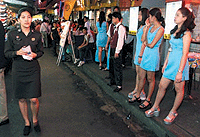
It is just past midnight at The Morning Night Bar a few doors down from Bangkok’s notorious Nana Entertainment Plaza and the party is in full swing. Loud rock music belts from speakers, clouds of cigarette smoke hug the pool tables and groups of inebriated western men clutch younger-looking Thai consorts as the Singha beer flows and the good times roll.
On one wall a plaque proudly announces the bar’s first anniversary in August 2003. If prime minister Thaksin gets his way, it is possible that the Morning Night Bar might never get to celebrate its second.
Should such a tragedy occur, it might well be in good company. In mid-February, Thaksin’s government announced the latest measure in its highly controversial law and order campaign. Outside certain designated entertainment zones, with effect from March 1 2004, all bars, nightclubs, discotheques, massage parlours, shops selling alcohol, cocktail and karaoke lounges and tea houses with female escorts will be forced by law to close at midnight.
Within the designated zones, about which there is growing debate and confusion, establishments may now only stay open until the already curtailed time of 2am.
Youth protection
In a country legendary for its racy nightlife that for years has attracted millions of visitors, Thaksin’s new closing times would appear to fall nothing short of tourism suicide. For a government that has prided itself on the rehabilitation of Thailand’s economic prowess, particularly in its domestic economy, the move seems especially bizarre.
Yet there is method, although perhaps ham-fisted, in the madness. Thailand has a serious and pernicious problem with its youth, especially underage sex, violence and even gang rapes. In an effort to get tough on juvenile crime, Thaksin wants to see youths out of the bars and even considered taking them off the streets. Tabled measures for a Children and Youth Protection Act included a 10pm curfew for under 18-year-olds as well as a ban on sex, dyed hair and using rude words and gestures.
How these measures would have been enforced is now open to debate. They have been taken off the agenda, according to local media.
What remains on the table is the new closing time, along with confusion about whether the rules will be strictly enforced or if new entertainment zones will be introduced to appease livid bar owners.
Some seem to have already decided on their strategy. “I think it’s crazy,” says the Morning Night duty bar manager with half a smile. “I’m not even sure when I’ll have to close. It depends if the police come. I’ll just try to pay them off,” he says, exaggeratedly doling out imaginary baht. Then his mood turns more sober. He shrugs. “Otherwise half the staff will go.”
The owner of the nearby Tunnel bar across the main road is equally unimpressed, but does not agree that the solution will be so easy. “It’s a police state now,” he says caustically. “Before, you could bribe the police. Now even that doesn’t work.”
It won’t be just bar staff among Bangkok’s estimated 8,000 affected establishments who will suffer, to say nothing of thousands around the country, if the new regulation is strictly enforced. Pim, 23, from Chiang Rai in northern Thailand, works the bars around Nana Plaza and is very worried about her future, “I work here,” she says, gesturing towards the neon lights, raucous music and drunk men. “This is my job. What am I going to do? I don’t work anywhere else.” She turns away and starts to scan the streets for punters.
“I don’t agree [with the early closure],” says Sutthata, a desk clerk in one of Sukhumvit’s many tourist hotels. “Two am is OK. Midnight is too early. Now we have to start drinking at 5 or 6pm; the sun has not even gone down,” she laughs. “I don’t think it’ll go through. I think he’ll [Thaksin] change his mind.”
Jun, a taxi driver in Bangkok says: “If I was Thaksin, I’d leave the bars open 24 hours. They can stop underage drinking. This is stupid, the bars closing at midnight. Very bad for tourism.” He shakes his head in disbelief. “Also bad for taxis ? no business.”
Jun has a point. If the the new measure aims to crack down on underage drinking, why not just enforce a strict age policy in the bars?
Social cost
“Most of the bar owners never respect the rules anyway,” explains Dr Kongkiat Opaswongkarn, chairman and chief executive officer of Asset Plus Securities in Bangkok. “A lot of Thai parents are very worried about underage drinking.”
He acknowledges the potential hit to local entertainment businesses, but explains the other side of the argument: “Of course it will hurt a lot of businesses,” he says. “But the cost to society is too much to bear in the longer term. It’s kind of a trade off, I guess.”
It could turn out to be a costly trade. According to CLSA, Thailand attracts 10 million tourists a year, 36% of whom come from western countries (including Australasia). The plan is to attract 20 million arrivals by 2010. While it is impossible to calculate the effect that Thaksin’s latest social order measure could have on this target, it certainly will not help.
It is not perhaps the economic cost that will be the heaviest to bear for Thailand. Speaking in the local English daily, The Nation, one French resident sums up what might prove to be the heaviest cost of all.
“We will soon see hundreds of girls available on the pavements of Bangkok, just around midnight. No expensive drinks, no bar fines. Just girls ? younger, cheaper, vulnerable, more easily abused and exploited. Thaksin, you’re our hero.”