 |
|
On February 10th Malaysians woke up to discover that Eric Chia Eng Hock had been arrested in conjunction with one of the country’s longest running financial scandals. |
THE HEADLINE-GRABBING arrests made by Malaysia’s Anti Corruption Agency (ACA) last month are the subject of much discussion in Kuala Lumpur’s financial community. It isn’t the allegations of impropriety that have got Malaysians talking so much as the fact that the government appears to be doing something about it. The arrests have attracted widespread praise. But the questions on people’s minds now concern just how far the government is prepared to go and what the consequences will be.
Prime minister Abdullah Ahmad Badawi spent his first 100 days in office carefully spelling out his agenda, including promises to clamp down on corruption, cut red tape, and improve transparency in the award of government contracts.
The first arrest came just two days after the prime minister celebrated his 100th day in office, an event that was orchestrated to remind people of what the new head of government had achieved and promised since he took over from his predecessor, Mahathir Mohamad. With Badawi likely to call the next general election some time between March and May, the arrests were particularly timely.
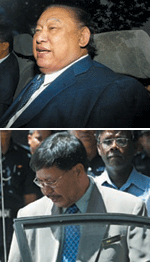
Longest-running scandal On February 10, Malaysians woke up to the news that an arrest had been made in connection with the country’s longest-running financial scandal, the collapse of steelmaker Perwaja Steel. The scale of the problem at Perwaja, which had amassed a US$2.6 billion mountain of debt and losses of US$790 million, was first revealed in parliament by former deputy prime minister Anwar Ibrahim back in 1996. Eric Chia Eng Hock, the managing director of the company between 1988 and 1995, now 71 years old and in a wheelchair, was arrested after ACA officials followed him from a hotel to his house and charged him with criminal breach of trust for dishonestly authorizing a payment of M$76.4 million (then worth US$27.5 million) on February 18 1994. Chia, who pleads not guilty, is scheduled to come to court on August 2 this year and faces a possible 20-year prison sentence and fine.
Malaysians had barely digested the news of the businessman’s arrest when they were hit with another, this time of a politician, just two days later. Kasitah Gaddam, the lands and cooperative development minister and cabinet member, was arrested on February 12 and charged with two crimes that together carry a maximum penalty of 19 years’ imprisonment and a fine. Kasitah, who pleads not guilty to both charges, is accused of exploiting his position as executive chairman of the Sabah Land Development Board for financial gain by arguing for the approval of a proposal to sell shares held by the board in a company called Sapi Plantation to Briskmark Enterprises when he was promised shares in the plantation company. The size of the transaction is said to be M$40 million (US$13 million). He is also accused of deceiving the board by concealing an offer for the shares from another plantation company, PPB Oil Palms.
Although some opposition politicians have dismissed the arrests as an electioneering ploy, the prime minister’s office has revealed that ACA is currently investigating 18 more potentially high-profile cases, some involving cabinet members.
“One of [ruling coalition member] Umno’s problems towards the end of Dr Mahathir’s rule was that many Malays felt that the party had lost its ethical compass,” says Bob Broadfoot, a regional analyst at Political and Economic Risk Consultancy in Hong Kong. “Policies were seen to be benefiting too few, with too much going to a small group of chosen people. What Badawi is doing is showing that the government is not going to help these special groups of people any more. It helps Umno regain the moral high ground and I think it will work. Umno should increase its share of the vote in the coming election,” he says.
Stopping short of a witch hunt
|
|
|
Chia and Goddam: first high-profile arrests send a clear signal that Abdullah Ahmad Badawi is prepared to carry out his declared intention to crack down on corruption and controversial mega-projects |
When Perwaja was declared insolvent in parliament in 1996, it was said to be as a result of mismanagement and large questionable payments. To some it seems that ACA has not done a complete job. The charge against Chia of simply authorizing the illegal payment also seems incomplete. Where did the money go? The ACA investigation followed the money from Japan to Malaysia to Hong Kong and then to Switzerland. Swiss authorities released the details of the accounts to the Malaysian investigators but the identities of the account holders have never been made public.
The theory in the salons of Kuala Lumpur is that Chia is the chosen fall guy whose sacrifice will appease the people, obfuscate other issues surrounding the Perwaja affair and make the government look good.
Again, Kasitah Gaddam may be a cabinet minister but he is still relatively small fry – a low-profile minister who before his arrest was not a household name.
Pak Lah’s anti-corruption drive might not be as thorough as some would like but it is a start that sends a signal to corrupt politicians and businessmen to clean up their acts. A witch-hunt would be in no-one’s interest because too many people have skeletons in their closets and some could easily take others down with them. It could also be unpopular and disruptive. The perception of endemic corruption in much of southeast Asia is best understood as neo-patrimonialism – a development of the traditional system of authority based on the distribution of benefits and privileges.
Abdullah recognizes that if Malaysia is to progress and remain competitive, this system has to change – and the signal that people can no longer expect to remain immune, but that there will be no witch-hunt, is probably the best way to go about initiating change.
Those who remain sceptical about Abdullah’s clean-up drive should note that it has gone further than the few token arrests. Abdullah has also set about tackling corruption in the police force: he set up a royal commission to investigate, headed by former chief justice Mohamed Dzaiddin Abdullah, and appointed a new inspector general of police, Mohamed Bakri Omar.
Abdullah has also promised to increase transparency in the award of government contracts by ensuring that more projects are put out to open tender. Abdullah’s government has already pulled the plug, at least temporarily, on some of the most controversial mega-projects awarded through direct negotiation towards the end of the previous administration.
The first was the ambitious plan to build an M$14.5 billion double-track electric railway running the entire north-south length of the Malaysian peninsula. The contract for that project had originally been awarded to a consortium comprising the state railway companies of India and China but was controversially replaced by another consortium of two Malaysian companies, Gamuda and MMC, the latter being controlled by influential businessman Syed Mokhtar Al Bukhary. Syed Mokhtar is the man credited with the
success of the Port of Tanjung Pelepas in the Malaysian state of Johor. This has been giving neighbouring Singapore’s port a run for its money, and is seen as a favourite project of Mahathir. The Malaysian railway consortium snatched the contract from the Indians and Chinese by putting in a substantially lower bid at the last moment, which it was able to do by substantially changing the parameters of the project.
The other mega-project that Abdullah has frozen is the controversial M$4.5 billion Bakun hydroelectric dam in the Malaysian state of Sarawak on the island of Borneo. The Bakun Dam, which is projected to flood an area of rainforest the size of Singapore to produce electricity for the Malaysian peninsula several hundred kilometres away across the South China Sea and supplied via an undersea cable, had long been seen as expensive and unnecessary.
The decisions to halt the projects are popular with both the public and investors and show that Abdullah is committed to rebalancing the budget even if this means going against powerful business interests.
Syed Mokhtar is involved in the Bakun Dam project through his participation in GIIG Capital, a joint venture with Mohamed Ali Alabbar Alabbar, a man with close ties to the Dubai royal family. The two had promised to build a $2 billion aluminium smelter, the enormous electricity requirements of which would have helped make the dam economically viable.
Although both projects were frozen because they are expensive and not immediately vital, the fact that they are both associated with Syed Mokhtar shows that the prime minister is not prepared to compromise with big business when it is not in the nation’s interest.
Beefing up the finance ministry Malaysia’s prime minister has also pleased the financial community with his appointment of a new second minister of finance. In addition to being prime minister, Abdullah is also the finance minister and home minister. His decision to appoint Nor Mohamed Yakcop, a former civil servant with private-sector experience, as the second minister of finance in January 2004 has been widely welcomed.
Observers credit Nor Mohamed with guiding Mahathir through the Asian financial crisis, including instructing him on how the international foreign exchange markets work. He is believed to have been a key figure behind the implementation of Malaysia’s US dollar peg and currency controls, although the decision to implement it is believed to have been Mahathir’s. The policy, though controversial at the time, is now seen in Malaysia as one of Mahathir’s flashes of genius, a judgement that most in the international financial community now grudgingly admit.
Nor Mohamed is also the man behind another decision that international investors first condemned but then accepted. Valuecap, a M$10 billion government-owned fund that was set up in January 2003 to invest in undervalued stocks, was viewed suspiciously by international investors, who regarded it as a means to prop up failing corporates. But analysts and investors today concede that all Valuecap has done is to make money from investing in undervalued companies and help liquidity during a difficult time. On February 14, Valuecap announced that it had made an unrealized gain of more than M$450 million from the M$4 billion invested so far, a return on investment of about 17%. After tax, Valuecap has earned a profit of M$250 million for the government.
Nor Mohamed is also admired in the market for his work in the restructuring of UEM group, one of corporate Malaysia’s biggest casualties of the Asian financial crisis.
The one glaring blot on the new second finance minister’s CV is the M$15 billion forex loss suffered by Bank Negara, Malaysia’s central bank, in 1993-94 while he was in charge.
Despite this, bankers and investors in Malaysia are pleased with his appointment, especially because he is a technocrat and not a politician – unlike his predecessor, Jamaluddin Jarjis, who lasted just 13 months on the job. Jamaluddin is an influential Umno backbencher who approved the controversial award of the trans-Malaysia rail project to the MMC-Gamuda consortium. Umno is the leading Malay party in the Barisan Nasional coalition government.
“Abdullah does not have a track record for economic policy so is likely to rely heavily on Nor Mohamed and other advisers’ expertise,” says Rajeev Malik, an Asia-Pacific economist with JPMorgan. “Nor Mohamed’s appointment probably signals Abdullah’s intention to depoliticize the ministry, which under Mahathir appeared to have become a vehicle for financing patronage.”
The market has also reacted positively to the February 13 appointment of a new chairman of the Securities Commission – Mohamad Nor Yusof, the current managing director of Malaysia Airlines (MAS) and the former chief executive of Bank of Commerce. Mohamad Nor, who successfully led MAS’s turnround, which involved a M$9 billion debt restructuring, is also a veteran of the finance ministry. He replaces the current chairman, Ali Abdul Kadir, when his term expires on April 1.
“From the business community’s perspective we definitely like what we are hearing from Badawi,” says T Jeyaratnam, deputy CEO of Malaysian investment bank Aseambankers. “He has sent out all the right signals about improving the efficiency of government agencies and has already taken some big steps. Whether or not it will continue and be effective is something we’ll just have to wait and see.”
Investors and the financial community in general tend to value predictability and gradual change over dramatic shifts. What Abdullah has done so far is to make well-calculated steps in the direction of improving transparency and accountability in Malaysia. Although sceptics may dismiss these moves as sandiwara or theatre – in other words designed to appease the people with token gestures and win the election – it is just as plausible that Abdullah feels that he needs to improve Umno’s share in the coming election to gain a stronger mandate and enhance his position within the party before he can do more.


