 |
AS OPEC’S NUMBER two oil producer and the owner of the world’s second largest natural gas reserves, Iran should arguably be the Middle East’s pre-eminent economy. Indeed, strong oil revenues driven by record highs in prices have given the country a boost in recent years. And in the Iranian year ending in March 2003, the IMF estimated that real GDP grew at 6.8%, led by non-oil sector growth of 7.9%.
Yet Iran is also a country in desperate need of reform. The state controls more than 80% of the economy, almost a third of Iranians live below the poverty line, and inflation stands at almost 16%. The economy remains overwhelmingly dependent on oil revenues, which make up between 40% and 50% of budget receipts. The tax system is underdeveloped and inefficient, and tax avoidance is commonplace.
The country also faces a demographic time bomb. Some 70% of Iranians are under 30 years old, 50% are under 20, and the labour market is under pressure. Unemployment is unofficially estimated at more than 20% of the active population, rising to over 30% among those aged between 15 and 30. BNP Paribas – which in 2002 worked on the Islamic Republic’s first ever Eurobond issue – warned in a report last year that “the growth of the non-oil sector is both insufficient and too poor in job creation” to prevent the upward trend in unemployment and poverty.
Notable economic reforms have been implemented in recent years, including the unification of the exchange rate, the approval of legislation liberalizing foreign investment, the creation of tax-free zones, the cutting of corporate tax rates, and steps towards bank liberalization. In the wake of last month’s legislative elections, however, the question is whether further reforms will be pursued. It is clear that there is strong opposition to liberalization from some clerics ideologically hostile to the private sector, while others are simply out to safeguard vested economic interests.
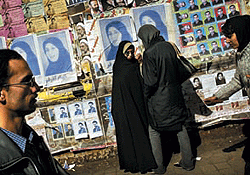
Key decisions Public frustration at the slow pace of political and economic reform, coupled with the mass, pre-election disqualification of reformist candidates, handed conservatives victory in the February 20 poll. Key economic policy decisions now hang in the balance: the 200\4/05 budget has not yet been approved, nor has the 2005-10 fourth five-year development plan (FYDP). The FYDPs are drawn up by government technocrats, and since 1990 have set the country’s economic agenda. Like the annual budgets, in order to become law FYDPs must be approved by the Majlis, Iran’s parliament; constitutional watchdog the Council of Guardians; and supreme leader Ayatollah Ali Khamenei.
The good news for Iran is that the outlook appears broadly positive. Mohammad Ali Nasrollahi, director general of international affairs at Iran’s third largest financial institution, Bank Mellat, argues that “the new parliament will be more flexible with regards to economic reform”. A London-based banking analyst agrees. “The election outcome means that the political squabbling should end,” he says.
According to James McCormack, senior director of sovereigns at Fitch Ratings, the fourth FYDP has essentially been approved by Iran’s key figures. He believes that it will continue to reduce the role of the state in the economy and foster private sector competition, thus contributing to reducing the fiscal deficit as well as public debt and contingent liabilities, especially in the banking sector.
One well-placed source at the Central Bank of Iran says that the next FYDP will focus on three main areas. The first will be structural issues such as banking sector reform, privatization and tax reform via the introduction of a value-added tax. The second will be defining the relationship between the central bank and the government, to give the bank greater freedom from political interference. The last will be to define the fiscal relationship between the government and the National Iranian Oil Company, to give the latter greater autonomy in its operations.
Out of isolation
Iran will also be looking to attract higher levels of foreign direct investment over the next five years, having only recently come out of a 25-year period of self-imposed economic isolation. Ranked eighth in the world at attracting FDI in the 1970s, Iran fell off the chart after the 1979 Islamic revolution that brought the Shiite clerics to power. Recent regulatory changes have, however, reopened the country to business.
After years of political wrangling, a new foreign investment law was finally adopted in late 2002, meaning that for the first time in more than 50 years foreigners can own more than 49% of an Iranian company. However, collective foreign ownership of any one economic sector is limited to 25%. The new legislation safeguards against the seizure of foreign capital and nationalization while allowing for financial disputes to be resolved at international tribunals rather than in the Iranian courts. It also allows for full profit and dividend repatriation, and seeks to ease approval procedure for investors.
By western standards, though, doing business in Iran still appears fraught with dangers. “Political risk is the biggest obstacle to attracting FDI – there’s no question about it,” says McCormack. Concerns about project ownership, payment guarantees and extremely labour-friendly employment laws also abound. In consequence, foreign investment will for the foreseeable future remain focused on the oil and gas sector. Even here, however, outside involvement is limited.
Given the state’s overwhelming dominance of the economy, the sale of public companies is a key plank of the reform process. Yet privatization does not offer a quick-fix solution to Iran’s problems. Despite the lofty goals of the third FYDP (2000-05), receipts from the sale of state assets contributed less than 1% of GDP in 2002/03. A similar level is expected for 2003/04, although it should increase under the fourth FYDP.
Persuasion
The Iranian Privatization Organization (IPO) is officially in charge of the process. In theory, when companies are designated to be sold either wholly or partially, the IPO channels their stock into holding companies; they are then valued and potential buyers are sought. In reality, however, the IPO has found it difficult to convince state companies to sell their stock and subsidiaries. Its authority has also been challenged by organizations seeking to handle the privatization process themselves. For example the Industrial Development and Renovation Organization, which controls most domestic industry, has both directly sold firms and launched shares on the Tehran Stock Exchange. The IPO has opposed such moves, and its objections are clear: when the IDRO sells stock directly, it receives 100% of receipts from the sale; when IPO directs the launch, half the sale value is returned to the state.
Seeking buyers
There is also the conundrum of who will buy privatized firms. The private sector’s weakness means that public pension funds are among the few organizations with enough financial muscle to buy large state-owned companies. According to Parviz Aghili-Kermani, managing director of Bank Karafarin, Iran’s first private bank: “The domestic private sector is too small to be in a position to buy state entities.” The next few years will probably see the government pursue something of a “compromise solution”, says Bank Mellat’s Nasrollahi. “The first step is to sell these companies to pension funds, then the next step will be to bring these shares to the stock market.”
Another option is for the investment arms of state-run banks to purchase shares in other public companies. Nasrollahi offers one such example: “Recently, three investment companies belonging to public banks formed a syndicate and bought $500 million-worth of shares in a state-run marine industries company.”
Some observers have suggested that such quasi-privatization simply shifts inefficient state companies from the government’s balance sheet to those of other state-run entities. For now the full privatization and restructuring of big, overstaffed public firms carries too great a political cost for the authorities, given that unemployment is already so high.
Foreign companies are barred from direct participation in privatizations. Even if this restriction were lifted, international investors might be wary of buying state assets expropriated after the 1979 revolution, given the risk of being taken to court by former owners. Instead, a more likely method of foreigners getting involved will be as minority shareholders in joint ventures with local firms.
The post-revolution expropriation of the assets of most of Iran’s listed companies marked the beginning of two very difficult decades for the Tehran Stock Exchange. The reforms of recent years have, however, helped it to begin bouncing back. Although just 1% of Iranians actively participate in the market, the TSE grew by 116% in 2003 to a market capitalization of $34.5 billion. “We hope that under the fourth five-year development plan the market cap will reach $100 billion, due to privatization and increased trade,” says Masoud Hamidy, head of the TSE’s research and development department.
Changes to TSE regulations have been under discussion for some time. According to Hamidy, legislation to demutualize the exchange and make it self-regulating remains two to three years away. In contrast, having been amended five times by the authorities, regulations clarifying foreign investment limits should be approved within weeks. “The new regulations will mean that approved foreign funds will collectively be able to buy a maximum of 10% of shares in any one listed Iranian company,” he says. In addition, investors will be able to repatriate their dividends wherever they are realized, while being permitted to repatriate the capital after three years, at a rate of 15% each quarter.
Inflationary pressures
Without these regulations, foreigners have struggled to invest in the TSE. EFG-Hermes Holding’s First Iran Fund, which was seeking non-US investors with at least e100,000 to spare, folded last December after the government withdrew its backing. The reason for the withdrawal was apparently concern that the inflow of foreign capital would exacerbate existing inflationary pressures and push share prices up. However, things are now looking up for foreign funds, and Hamidy says a number are waiting for the new regulations to be approved so they can enter the market. “Early entrants will have the best choice of stocks, given the 10% limit,” he stresses.
The approval of the fourth FYDP and complementary regulations concerning the stock exchange, privatization and banking reform will be key to how Iran’s reform process unfolds over the next five years. In its 2003 Article IV report, the IMF set Iran its task: “To place greater emphasis on reducing state intervention in economic activity and on improving economic efficiency” by making “further efforts to liberalize trade, reduce administrative controls, reform labour markets, foster competition, and restructure and privatize public enterprises.”
Predictions of the fourth FYDP’s content indicate that the government believes itself up to the task, and market watchers are largely confident that the reform process will continue. Recent history has shown, however, that translating reformist will into action takes time. Iran has made a good start, but the road ahead is long.
Kate Luxford is a Middle East research analyst for World Markets Research Centre, a London-based country intelligence firm.


