 |
|
Karamanlis: Greece?s new |
Greece?s newly elected conservative government has managed to convince most market participants that it is serious about making good on its promises for faster economic growth. It will, however, have to work hard and deliver fast to avoid disappointing these high expectations in its race against time to prepare the country for the Olympic Games.
The New Democracy party defeated the socialist Pasok party in March with a surprisingly high margin of nearly five percentage points, clinching 45.5% of the popular vote. The party?s second victory since 1981 gave New Democracy a clear majority, making the election of a new president of the republic in 2005 more likely and eliminating the risk of repeat national elections.
?It is important that this government has a full-term perspective. Its mandate is strong, expectations are high and the first fingerprints are good,? says Alexandros Sarrigeorgiou, managing director of Allianz Group in Greece.
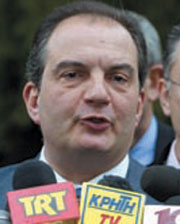
The new government led by prime minister Costas Karamanlis has been preoccupied with the Cyprus issue and has devoted a lot of time and resources to the challenge posed by the Olympic preparations.
This has slowed things down elsewhere as evidenced by delays in filling high-level posts in key public sector entities.
Most market participants are willing to give the government more time to show its true colours.
?It is understood that the government has to cope with important foreign policy issues and the final stretch to the Olympic Games, but I hope it will take the necessary difficult measures in the next six months,? says the head of Allianz Group in Greece.
Sarrigeorgiou applauds the government?s intention to slash corporate tax rates on retained earnings and expects to see some reforms in the social security system.
The government has vowed to push
forward with structural reforms but social security, a political hot potato, has not been high on the agenda. Finance minister George Alogoskoufis has said that the government will unveil a detailed plan to overhaul the taxation system next autumn.
?The new government is facing some short-term challenges, most prominently the Olympic Games, with security being a top priority,? says Vincenzo Guzzo, an economist at Morgan Stanley in London.
He adds: ?Moving over, there are two areas of concern. First, structural improvements such as deregulation and pension reform, and second the performance of public finances.?
Guzzo says Greece has shown spectacular growth in recent years and expects this to be repeated this year which should see a significant reduction in the budget deficit and public debt as a percentage of GDP.
Concerns
?There are concerns about Greece?s performance from next year on but I am not so much worried about the cyclical outlook even after the end of the Olympic Games,? Guzzo says. ?So, something has to be done to correct the fiscal imbalances.?
The deterioration in public finances was confirmed by an audit ordered by the conservatives, disputing figures released by the outgoing socialist government.
The new finance minister says that the general government budget deficit reached 2.95% of GDP in 2003 compared with an initial estimate of 1.7% put out by the previous government. Alogoskoufis has warned that a lot has to be done for the deficit not to exceed 3% of GDP, still a closely monitored mark within the EU.
Alogoskoufis also announced a downward revision in last year?s growth rate to an estimated 4.2% compared with a provisional 4.7% figure and in addition he has scaled down the projected GDP growth for this year to 3.7%.
The changeover in power and the ensuing revision in the budget deficit following the audit has prompted comparisons with Portugal where a similar audit a few years ago produced a budget deficit-to-GDP ratio well in excess of 3% for 2001.
The restrictive fiscal measures taken afterwards to bring down the deficit contributed to Portugal?s economic slowdown.
Morgan Stanley?s Guzzo points out, however, that ?Europe had taken a more orthodox approach to the Stability and Growth Pact at the time while it has adopted a more flexible approach now?.
Fully aware of these comparisons, Alogoskoufis has stated that the Greek administration, unlike the Portuguese, does not intend to raise taxes to bring down the deficit but will remove waste in public expenses to produce the necessary savings.
The deterioration in public finances has had a relatively small impact on Greek government bonds so far. The 10-year government bond was trading at about 23 basis points above the Bund at the end of last month. Some analysts, though, are still concerned that an excessive budget deficit as a percentage of GDP this year might provoke a sell-off in government bonds, driving the yield spread over Bunds to much higher levels.
The new government is determined to keep the economy growing relatively fast and to bring down inflation by enhancing competition, cutting red tape and enhancing transparency, says deputy development minister Yiannis Papathanassiou. ?Our goal is to have the economy growing by 5% or higher to reduce unemployment by 2.5 to 3 percentage points in four years? time,? he says.
The government intends to improve the economy?s international competitiveness, increase the share of domestic investment as a percentage of GDP and attract foreign direct investment.
?We are committed to cutting the marginal tax rate on retained corporate earnings to 25% from 35% at present, and in general overhaul the country?s tax system to make it simpler in a few months? time. We are also committed to passing a new development law to give clearly defined incentives for direct investments,? Papathanassiou adds.
Papathanassiou says the government will do away with unnecessary regulations and downsize bureaucracy to reduce the operating cost of enterprises. In this context, it wants to cut drastically the time required for licensing business start-ups.
?We want to boost competition because this is the healthiest way to combat inflation and protect people?s incomes. To this extent, we upgrade the competition committee and make it truly independent with its own resources and experienced staff, enabling it to oversee the competitive functioning of the markets. We will also be on the side of consumer associations to raise consumers? awareness and seek greater price transparency by using new technologies among other things,? he says.


