 |
|
Nãstase: Romanian premier must speed up political and economic reform or face EU exclusion |
ON MAY 1, 10 states, including eight from central and eastern Europe, will become members of the European Union. Romania will not be among them. And unless it pushes on with political and economic reforms, it is in danger of failing to meet the timetable for being included in the next planned round of EU enlargement in 2007.
That’s the stark message coming from the European Commission and the European Parliament, which over the past few months have regularly berated the country’s politicians for failing to reform the judiciary, respect press freedoms, fight corruption, curb illegal adoptions and restructure and privatize state-owned companies.
Most tellingly of all perhaps, the EC concluded that Romania is the only EU accession candidate that does not yet possess a fully functioning market economy – shorthand for saying the country is still incapable of competing in the EU’s single market.
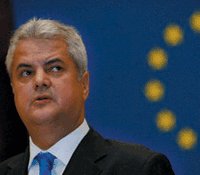
The challenge facing the government of premier Adrian Nãstase is to speed up political and economic change or see Romania face an uncertain period of exile from Europe’s exclusive club of nations. Perhaps most galling of all for Romania is that its bid for EU membership in 2007 could be decoupled from that of neighbouring Bulgaria, which the EU considers to have made far greater political and economic progress than Romania.
Among the banking community in Bucharest there’s a sanguine attitude to the recent criticisms from the EU, with a widespread consensus that they amount to a warning that Romania will have to improve its performance if it is not to miss out on highly prized EU membership.
“The criticisms from the EU are welcome in that they show that the EU cares about Romania and the criticisms should help push Romania to solve the problems concerning EU entry,” says Nicolae Danila, president of Banca Comerciala Romana (BCR), the country’s largest bank. He adds that while EU membership in 2007 remains a cherished goal, the overriding priority for the government should be to push on with reforms that will improve the lot of the general population. “Irrespective of our desire to join the EU it’s in the country’s own best interest that changes are made to ensure that there is economic growth which will lead to improved living standards for everyone in Romania,” he says.
Need for constant improvements There’s a similar message from Steven van Groningen, president of Austrian banking group RZB’s Bucharest-based subsidiary, Raiffeisen Bank Romania. “EU entry for Romania is not simply a question of ticking off a series of boxes,” he says. “It’s about a process of constant improvements and reforms which are necessary if Romania is to be able to compete effectively internationally.”
He adds that that while missing out on EU entry in 2007 would undoubtedly be a blow to the country’s political self-esteem, it would not alter the bank’s fundamental view about its presence in Romania. “We take a long-term view of our investment here and Romania is such a large market that it demands the attention of investors.”
Helmut Bernkopf, vice-chairman of HVB Romania, says that the rigorous and impartial enforcement of new and existing laws is a prerequisite if Romania is to be prepared for EU entry. “It’s very important for the country to get used to working along EU lines,” he says, adding: “There needs to be a level playing field for all companies to ensure fair competition.”
Selcuk Saldirak, chief executive officer of UniCredit Romania, part of Italian banking group UniCredito Italiano, remains confident that despite the recent criticisms from the EU, the present administration has sufficient political will to ensure that Romania is able to join the EU in 2007. “Even if they look to be behind the programme for 2007, the government is making the necessary efforts to solve the problems,” he says.
Hildegard Gacek, the resident director for the European Bank for Reconstruction and Development in Bucharest, takes a similar view: “Is Romania ready to join the EU now? No. Can it be ready to join in 2007? Yes.”
Although the political will in Romania to join the EU in 2007 is not in doubt, the country’s track record suggests that translating will into action has often proved to be a difficult task, with several governments failing to push through much-needed reforms during the course of the 1990s. Following the fall of dictator Nicolae Ceausescu in December 1989, the first attempt to introduce wide-ranging economic reforms by the National Salvation administration of premier Petre Roman ended in chaos after violent demonstrations by the country’s powerful mining unions led to the occupation of government buildings in Bucharest.
Although the National Salvation Front remained the largest party after the 1992 elections, the minority government of prime minister Nicolae Vacaroiu had to rely on the support of ultra-nationalist and communist deputies. This stymied the pace of economic reforms and in the run-up to the 1996 elections lax economic policies led to rising inflation, devaluation and the introduction of price and currency controls that ultimately led to the demise of the National Salvation Front coalition.
The winners in 1996, an umbrella organization of centre-right parties called the Democratic Convention, formed a government under Victor Ciorbea, with the support of the UMDR ethnic Hungarian party and a small social democratic party led by former premier Petre Roman.
Continuing setbacks Although Ciorbea announced radical, market-oriented reforms including the removal of price controls, tighter fiscal and monetary policies and the liberalization of the foreign exchange regime, he failed to carry through the restructuring of obsolete industries. Romania’s failure to be invited to join Nato in 1997 proved a major setback for the Democratic Convention and Ciorbea was dropped in 1998. His successor, Radu Vasile, failed to reverse the government’s growing unpopularity and he in turn was replaced by Mugur Isarescu, governor of the National Bank of Romania.
At the November 2000 general election, the Social Democratic Party of Adrian Nãstase emerged as the largest party and with support from the UMDR has enjoyed a high degree of political stability. Since taking office in December 2000, the Nãstase administration has embarked on a comprehensive programme of economic reforms aimed at combining market reforms with improved social conditions.
It is largely thanks to the reform efforts of the current government that the goal of EU membership in 2007 is even a possibility but the political legacy of the 1990s means that it is having to catch up. “We’re still paying the price for the political mistakes of the 1990s,” says Misu Negritoiu, executive director at ING Romania. He says the failure to push ahead with reforms in the past decade means the present government has been faced with a much harsher environment in which to carry out vital reforms. “Privatization in Romania has largely happened after state sales in other countries in central and eastern Europe, which has had the effect of reducing investor appetite,” he says.
Accelerating the pace of privatization this year will be further complicated because the government faces a general election in November and there are fears the timetable for state sales will slip as a result. However, Henk Mulder, president of ABN Amro Romania, says that irrespective of 2004 being an election year it is vital that economic restructuring is not held up further. “After so many years of delays, Romania is running out of excuses for not restructuring,” he says.
Key privatizations this year include the sale of the country’s leading oil company, Petrom, natural gas distributors Distrigaz Sud and Distrigaz Nord, and power distributors Electrica Banat and Electrica Dobrogea. Successful sales after years of delays – Petrom, for example, was originally scheduled to be privatized in 1999 – will be seen as a definitive indication that the Nãstase administration is serious about economic restructuring.
They are also seen as prerequisites for new agreements with important international sponsors such as the IMF. Although the successful completion last October of Romania’s first-ever standby arrangement with the IMF was one of the government’s most notable successes, any new agreement is likely to prove politically contentious as it will require lay-offs in sectors such as railways and mining. Workers from both industries staged strikes when IMF officials visited Romania in early March.
Although not a privatization as such, the signing of a final sale agreement for 25% plus two shares in BCR to the EBRD and the International Finance Corporation in April is regarded as a key indicator of the government’s commitment to relinquishing its hold over key economic assets – BCR controls around a third of the Romanian banking market.
Benchmark privatization The eventual sale of BCR, which has now been put back to 2006 from an initial date of 2001 arguably represents one of the future benchmark privatizations for any new government that comes to power at the end of this year, say bankers. “You cannot really talk about a functioning market economy with the likes of BCR still in state hands,” says ABN Amro’s Mulder.
For its part the EBRD is confident that its pre-privatization role in BCR will prove to be a constructive one. “We have an institutional-building plan which should help to bring in a strategic investor,” says the EBRD’s Gacek. She adds: “The most important question with any privatization is momentum and in retrospect there was a lack of momentum behind the previous efforts to sell BCR.”
She says that the past attempts to sell the bank were stymied principally by the domestic difficulties faced by US and European banks in the early part of this century rather than any reluctance on the part of the government or the bank’s management to execute a transaction. “You need to have the right product in the right market at the right time and in retrospect although BCR is the right product it was offered in the wrong market at the wrong time,” she says.
Gacek maintains that rather than reinforcing the failure of previous government attempts to sell the bank, the EBRD’s decision to take an equity participation in BCR should ultimately act as a catalyst for an eventual sale to a strategic investor. “By taking equity stakes we encourage transparency, market competition and corporate governance,” she says.
She adds: “We have a good, constructive and effective relationship with the current government, which clearly appreciates the role that we play. As an honest broker between the government and the community the government understands that every investment in Romania is in the best interests of Romania and not those of the EBRD.”
With roughly e2.5 billion committed to the country to date, the EBRD is Romania’s single-biggest investor, accounting for roughly a quarter of foreign direct investment. It has also been a major catalyst for a further e7.5 billion of financing from other sources. “It’s not just about the money we’ve put into Romania, but also the other money we’ve managed to attract to the country that’s important,” Gacek says.
The bank plays a major role across the whole of the economy, with a wide range of investments in the energy, financial services, transport, general and specialized industry sectors. As such its attitude towards Romania carries a lot of weight and the fact that it is increasing its financial commitments augurs well for Romania’s future, say bankers. “Without the EBRD not half of the positive changes we’ve seen in Romania would have been possible,” says ABN Amro’s Mulder.
Whether the EBRD can help to act as a brake on the endemic corruption that is alleged to afflict Romania remains open to question, however. Baroness Nicholson, the European Parliament’s special rapporteur for Romania, has called for accession negotiations to be broken off unless firmer measures are taken to combat graft.
According to the latest Corruption Perceptions Index by Transparency International, Romania ranks 83 of 133 countries surveyed. Perhaps most tellingly, Romania is perceived as having the worst corruption problems among the EU accession candidates. The CPI, which draws on 14 surveys from seven independent institutions, is a poll of polls reflecting the perceptions of business people, academics and country analysts of corruption involving public officials.
Seizing on Transparency International’s finding, the EC’s report on Romania, published in November, concludes: “Surveys indicate that corruption in Romania continues to be widespread and affects all aspects of society. It undermines the effectiveness and legitimacy of state institutions and restricts Romania’s economic development.”
It adds: “While a number of high-profile measures have been launched, the implementation of anti-corruption policy as a whole has been limited. The measures taken have yet to have an impact and substantially increased efforts are needed.”
Despite the Romanian government’s establishment of a National Anti-Corruption Prosecutor’s Office (Napo) in September 2002 to investigate high-level corruption, the EC report concludes that Napo remains seriously understaffed.
The EC also claimed the independence of Napo is jeopardized by the minister of justice’s responsibility for anti-corruption enforcement and the coordination role that the country’s general prosecutor has been given over Napo activities. This means that only the justice minister and general prosecutor can order investigations into the wealth of politicians and high-ranking public officials. Such investigations have been notable by their absence.
Although the government has promised Napo more money, staff and autonomy, the announcement of an initiative to set up a corruption hotline has been greeted with derision. “They might get a few pensioners to call and complain,” says Sorin Ionita, director of the Romanian Academic Society think-tank. “It’s not information that is lacking, it’s political will.”
Macroeconomic progress The thorny issue of corruption threatens to overshadow the solid macroeconomic progress of recent years. GDP has risen by an average of 5% a year since 2001, and inflation has been slashed from 34.5% to 14%. This year, GDP is again expected to rise by about 5% and inflation is targeted to fall below 10%. The recent economic performance is all the more impressive given a recessionary environment in the EU, Romania’s main trading partner.
The one cloud on the horizon is the current account deficit. According to Sandor Gardo, Romania analyst at Bank Austria Creditanstalt, this climbed from 3.3% in 2002 to 5.8% of GDP over the course of 2003. “Due to the election in 2004 no improvement is expected on this front until 2005,” he says.
One positive feature of the economic growth of the past few years has been the boom in bank lending to both retail and corporate clients. It is a welcome development in a country where lending to the non-government sector has previously been just 10% of GDP. This hindered the development of a mortgage market and the expansion of small and medium-size enterprises. Van Groningen at Raiffeisenbank is confident that the positive trend can be maintained in coming years. “Credit growth will significantly outpace the growth of the economy as more and more companies become more bankable and consumers’ incomes rise.” That’s good news for entrepreneurs and young married couples looking to set up home, but they might not want to stay in Romania if it fails to secure EU membership in 2007.
Romania’s capital markets have also shown a burst of activity since the stagnation of the late 1990s. A combination of improved political and macroeconomic conditions has fed through into increased investment and higher valuations.
Much remains to be done, however, if the Romanian capital markets are to catch up with their neighbours’ and to attract further funds from both domestic and foreign investors. For example, the combined capitalization of the Romanian equity market – split between the Bucharest Stock Exchange and the Rasdaq bourse – is still, at around e5 billion, a fraction of those of its near neighbours the Czech Republic (e23 billion), Hungary (e17 billion) and Poland (e40 billion). Even so, Romanian share prices have risen strongly over the past few years, with a 95% increase in 2002, 15% last year and a 24% return in the first couple of months this year.
“We’ve seen a major rally since 2002,” says Dimitris Tamvakas, first vice-chairman of Alpha Finance Romania, one of the country’s top five brokerages. “The market is now trading at 11 times earnings after tax versus five times two years ago.” The problem facing the market is whether microeconomic factors can maintain the rise in the market’s fortunes. “Three years ago the market was significantly undervalued but now it is arguably overvalued,” says Tamvakas. He adds: “We will need to see corporate profits rise strongly to justify any further rise in equity valuations.”
He also argues that the market also needs new blood to counter the danger that it will become overbought. “What we need in Romania is the entry of new companies so that we don’t end up with a very expensive market,” he says. “The problem with the Romanian market is that there are not that many liquid stocks. We need to see more new issues and secondary offerings to aid diversification.”
One hindrance to a broader-based market has been the frequent delays to privatization, which have starved the market of new issues from major enterprises such as the leading bank, BCR, and the leading telecoms operator, Romtelecom. “It would be great if the likes of BCR and Romtelecom came to market. If they did, market capitalization would virtually double and so would the level of investor interest,” says Tamvakas.
The problem recently is that there has been a shrinking number of major stocks available on the market as strategic foreign investors have sought to delist acquisitions. In the past year, France’s Renault has sought to take Automobile Dacia off the BSE, Arcelik of Turkey looked to withdraw white-goods manufacturer Arctic and French group Lafarge made a similar move with cement company Romcim.
The dangers of an overconcentrated equity market are graphically illustrated by oil and gas company Petrom. It has a free float of just 7% and accounts for roughly half of the market capitalization of the BSE. Any delays to its planned privatization this year, or a reverse in its financial fortunes, would have an adverse effect on the entire market, says Tamvakas.
One major development this year that should help to alleviate the narrowness of the equity market is the planned merger of the country’s two bourses – the Bucharest Stock Exchange and Rasdaq. The BSE, set up in 1995, is home to 65 of the country’s major companies and has market capitalization of e3.3 billion. The Rasdaq market, established with the help of the US government in 1996 as a vehicle for Romanians to invest coupons under the country’s mass privatization programme, has thousands of small companies listed but market cap is just e1.9 billion.
The merger, which has been on the cards for several years, is a long overdue move that should help to alleviate the low capitalization and liquidity of the market, say bankers. “It doesn’t make sense for a small market like Romania to have two exchanges,” says ING Romania’s Negritoiu.
Although the exact details of the merger have yet to be finalized, it is hoped that the end result will be a single bourse that offers greater liquidity and choice to potential investors, especially those from abroad.
Tamvakas at Alpha Finance says that 20% to 25% of the equity market is held by foreign investors, principally hedge funds and specialist regional emerging market funds. “Since 2001 we’ve seen a steady increase in foreign interest in Romanian equities which has been helped by the growing belief in Romania’s accession to the European Union.” Alongside buying by funds from western Europe and the US, Tamvakas says that the Romanian equity market is also starting to attract interest from investors in the more wealthy central and eastern European countries such as Hungary and Slovenia.
Retail investors on the rise He adds that as personal incomes have risen there is growing interest from retail customers who are looking for an investment alternative to bank deposits, where rates have fallen sharply in line with inflation in recent years.
Although the development of a growing retail investor base should help to underpin equity valuations in the short term, one important long-term component missing in Romania is a private pension fund industry to act as an institutional investor base.
The EBRD has highlighted the creation of private pension funds as one of its priorities for 2004. “Without private pension funds there won’t be the necessary developments in the capital markets in Romania,” says the EBRD’s Gacek. She adds: “One of the biggest non-achievements in Romania to date is a lack of a fully functioning capital market which would give us an indication of the true value of companies.”
While the equity market is entering a relatively advanced stage of development in Romania, fixed income is still very much in its infancy. Until recently, there wasn’t a corporate bond market to speak of, with the only non-government issuance consisting of small municipal bonds ranging from e400,000 to e3 million equivalent in size. Alpha Finance Romania broke new ground in 2003, though, with a pioneering bond issue for real-estate company Impact. At the equivalent of e1.2 million, the issue was hardly earth-shattering, but more issuers are expected to follow Impact’s lead.
New issues this year The banking sector in particular is set to be a source of further issuance this year, with both BRD-Groupe Société Générale and Raiffeisen Bank Romania targeting new issues. This should provide the first real tests of the extent of investor appetite for corporate bonds. “The bond issue will help from an asset and liability management perspective,” says Raiffeisen’s van Groningen. He adds that the driving force behind the issue is the greater demand for medium to long-term funding to match the increasing need for medium to long-term lending to Romanian corporates.
“We want to have an international standard issue so as to set a benchmark for further issuance. The problem we face, though, is that there is no real yield curve off which to price an issue,” he says.
Negritoiu at ING Romania says that apart from the banking sector there is also potential for issuance from the infrastructure sector such as road and railway companies, which also require access to medium to long-term sources of funding.
He adds that while purely domestic targeted issues are unlikely to be bigger than e25 million to e30 million equivalent in size, such issuers as BRD-Groupe Société Générale and Raiffeisen Bank Romania could do better. They enjoy the backing of strong international banks and could raise as much as $50 million to $75 million through individual issues if they also target international investors that are currently prohibited from buying domestic bonds issued by the Romanian government.
Gacek at the EBRD says that through its mortgage loan programme, the London-based supranational is looking to stimulate the creation of first a mortgage bond market and then progress to encouraging the securitization of mortgage receivables. “In Romania we are ultimately aiming to develop away from traditional products for investment towards more sophisticated instruments.”
Tamvakas at Alpha Finance cautions, however, that while the corporate bond market in Romania has good growth potential in theory, in practice heavy-handed regulation by the national securities commission threatens to hamper its development. “The current regulatory regime is very restrictive,” he says. “A company needs to have a rating to be able to issue an uninsured bond and the cost of securing a rating will be a big disincentive to a lot of potential issuers.”
He adds that if issues are not rated then both the principal and interest payments must be guaranteed. “While guaranteeing the payments on small e2 million to e3 million size issues is practicable for most banks, virtually nobody will be prepared to underwrite a e20 million to e30 million bond,” he says.