 |
|
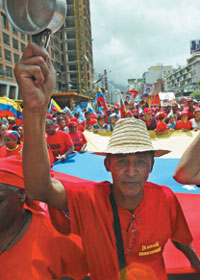
Supporters among the poor also claim he has the right to stand for election again. |
 |
|
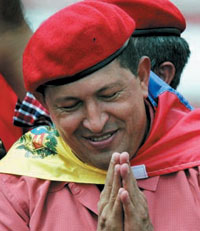
Uncertain future: if Hugo Chávez is removed from power, his party could still remain in charge. |
Hugo Chávez, Venezuela?s unpredictable president, will face a referendum on his six-year rule on August 15 that could oust him from office. The move has unnerved investors, as even though Chávez is sometimes accused of dragging the country towards communism, he uses oil revenues to pay his debts on time. Venezuela has been one of Latin America?s best-performing credits so far this year. Total returns on its debt have contracted by around 1%, compared with a fall across the JPMorgan Emerging Market Bond Index Plus of 4%. Since last month?s referendum announcement, however, Venezuela?s 2027 benchmark bonds have begun to slide in price and the country?s risk spread widened to 615 basis points over US treasuries.
Many analysts expect Chávez to be kicked out of office, creating a power vacuum in the world?s fifth-largest oil exporter. That could mean political violence and general social upheaval, threatening the government?s ability to make its bond payments on time. Moreover, the run-up to the referendum is also likely to prove destabilizing.
?The fundamental picture in Venezuela has deteriorated. We expect a hard-fought campaign in which Chávez seeks to delay and possibly derail the referendum in order to keep his options open,? says Jan Dehn of Credit Suisse First Boston.
No let-up from turbulence
If Chávez loses the vote, elections must be held within 30 days, but a divided opposition has yet to come up with a clear candidate and Chávez?s vice-president might take on the top job, leaving the left-wing government in power. Supporters of Chávez, mainly the country?s poor, also dispute a constitutional interpretation that would prevent the leader from immediately running again if he is defeated. Meanwhile, the electoral council must automate the voting process, a move the opposition says could allow vote rigging or even delay the referendum. According to Venezuela?s constitution, if Chávez lost a recall, his vice-president would take over until fresh elections in December 2006.
?The political turbulence is likely to continue, regardless of of the referendum?s outcome,? says Fernando Losada, a senior economist at ABN Amro in New York. ?Investors will be watching oil prices more than anything. If they stay high and Venezuela keeps exporting crude at current levels, bonds should remain in demand.?
Economic growth surged by 30% in the first quarter compared with a 28% slump in the same period in 2003. The economy is expected to grow by between 9% and 12% this year, after contracting 9.4% last year, which could make it Latin America?s fastest-growing economy in 2004.
Away from politics, Venezuela has cut a path to economic recovery since a deep recession last year, partly on the back of high oil prices. But no-one expects that growth rate to be sustained.
According to central bank data, oil money and strict foreign exchange controls to prevent capital flight have increased the country?s reserves to near a record high of $23 billion in June, from a low of $9 billion in March last year, when Venezuela was suffering the effects of the two-month national shutdown aimed at forcing Chávez out of office. Inflation is coming down, if only slightly. Venezuela?s inflation rate was 22% in the 12-month period to May this year, compared with 35% in the year-earlier period. The government says it also has its fiscal deficit under control and plans to raise $2.6 billion from foreign and domestic markets to cover its budget needs for the rest of the year. That money is expected to come from local bond issues, the Andean Development Corporation, some European import-export banks, the World Bank and the InterAmerican Development Bank, according to the finance ministry.
Venezuela?s external debt rose to $24.2 billion at the end of last year from $22.5 billion in 2002 and the government has issued a further $3 billion on international markets so far this year. About 90% of Venezuela?s $11.2 billion domestic debt matures in 2004 and 2005, and the government is refinancing the borrowings to extend some maturities until 2008 or 2010.