 |
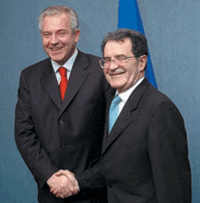
| Sanader (left) and Prodi |
SINCE HE TOOK office on December 23, the actions of Croatia’s prime minister, Ivo Sanader, have confounded those who feared a return to nationalism and isolationism under the Croatian Democratic Union (Hrvatska Demokratska Zajednica – HDZ), the party he now heads. In foreign affairs, Sanader has picked up where the outgoing prime minister, Ivica Racan, president of the Socijaldemokratska Partija Hrvatske, the Social Democratic Party of Croatia (SDP), left off.
To foreign politicians, Racan had personified the new and modern Croatia that sought good relations with western Europe. They approved of him. Now, if anything, Sanader has increased the sense of urgency underlying efforts to secure Croatian membership of the great western alliances.
He has been tireless in his efforts to woo those outside Croatia whose approval it needs to fulfil its ambitions of joining Nato and the EU. In the first few weeks of 2004, Sanader met Irish prime minister Bertie Ahern, EC president Romano Prodi, Austrian chancellor Wolfgang Schüssel, Italian prime minister Silvio Berlusconi, the Netherlands’ Jan-Peter Balkenende, Luxembourg’s Jean-Claude Juncker and Portugal’s José Manuel Durão Barroso.
Only Gerhard Schröder’s ill health saved the German premier from being caught up in this whirlwind of Croatian diplomacy in February.
Sanader has also held meetings with his counterparts in Romania and Turkey, Slovakia and Montenegro as well as with Javier Solana, EU high representative for common foreign and security policy, and Nato secretary general Jaap de Hoop Scheffer and dozens of other officials.
Sanader has also found time to entertain US defence secretary Donald Rumsfeld in Zagreb. As well as being eager to join the EU, Croatia is keen to be seen as an ally of the US in the war on terror and a fully paid-up member of the coalition of the willing.
Rapid action at home Key decisions at home have been taken quickly. Soon after its victory in last November’s election, the HDZ struck a deal with the main Serb political party in Croatia over minority rights. This is important: accommodating restoration of property to returning Serb refugees who fled Croatia during the homeland war is a key test for gaining EU approval this spring to begin a formal process of preparation to join.
Significantly, the new government has cooperated with the International Criminal Tribunal for the former Yugoslavia. Two retired Croat generals, Mladen Markac and Ivan Cermak, appeared before the UN war crimes tribunal towards the end of last month. They are charged with crimes including murder and persecution. Both pleaded not guilty.
When the new government took office at the end of 2003, investors in Croatia had been a little nervous. They did not know quite what to expect.
From January 2000 to November 2003, the SDP-led government had tried to overhaul the economy, establish a western European style of democracy and rule of law and to secure Croatia’s future as an independent nation inside the EU. In April 2003, Croatia had formally signed up to a stabilization and association agreement with the EU.
A reformed HDZ The SDP-led government had also won the support of the IMF, which announced a largely favourable review of the country’s economic performance under its $151 million stand-by arrangement in the run-up to last year’s elections.
So when Croatian voters, perhaps disillusioned by the high level of unemployment that has accompanied economic transition, turned out the SDP last November, no-one knew quite what to expect from the HDZ.
The HDZ was led by president Franjo Tudjman until his death in December 1999. Tudjman led Croatia to independence during the homeland war of 1991-1995 that followed the break-up of Yugoslavia. But in later years his authoritarian government alienated neighbours. Tudjman refused to hand over to the International War Crimes Tribunal army commanders suspected of murdering Serbs during the homeland war. Meanwhile, the economy foundered amid widespread corruption and the HDZ lost power in the elections that followed Tudjman’s death.
But worries about the HDZ’s return to power have been quickly laid to rest. “From its very first day the government has provided a positive surprise,” says Milivoj Goldstajn, member of the management board and director of the capital markets and large corporates division of Zagrebacka banka, Crotia’s largest bank. “It has taken a lot of initiatives on the external front,” he says. “But on the macroeconomic front,” he cautions, “it’s a little early to tell.” He continues: “If we gain access to EU funds and technical assistance funds, we will be able to move forward much faster.”
Bozo Prka, president of the management board of Privredna Banka, agrees that the new government has achieved a lot in the first three months in external relations. But he lays out a demanding set of economic challenges ahead. “We expect the government to improve the overall competitiveness of the Croatian economy by solving legal system issues, improving the country’s capacity to enforce the law, reforming education and boosting the development of small and medium-size enterprises.”
Prka, a former finance minister of Croatia, sits on the national competitiveness council. He suggests that the privatization and restructuring of the banking system, now operating largely under foreign ownership and producing strong results, provides a good model for the rest of the economy. The banks have shed jobs in search of modernization and profitability, and now do a good job of providing credit to corporates and individuals while returning healthy taxes on their profits to the government. Can the rest of the economy hope to follow this model?
Much of the heavy industry of the former Yugoslavia was centred in Croatia. It was mainly geared to Comecon countries and has had to reinvent itself. Unemployment is around 19% but a sizeable grey economy mitigates this. Prka sees no choice but to press ahead with restructuring.
He says: “We must improve competition by disenabling monopolies. The energy sector must be addressed first, then the agriculture sector requires substantial redesign. Shipbuilding requires government restructuring – two or three yards should be put into bankruptcy.”
Privredna lends to one shipyard that it regards as competitive, financially solid and well managed. Prka says: “Others are financed either through the state development bank or government transfers but that is something we should stop.” For its part, Zagrebacka does not lend to shipyards, though it will finance specific projects that have a government guarantee.
Road-building dream Now, as the reformed HDZ returns to power, the economic outlook is uncertain. The good news is that the exchange rate is stable, reserves are high (at $8.2 billion at the end of 2003 up from $5.9 billion at the end of 2002) and inflation is low at about 1.5% in 2003, with 2.5% forecast for 2004.
But the economy, which grew at 5.2% in 2002 and by around 4.3% last year, is now slowing once more. The draft budget presented to parliament at the end of February and accepted last month, forecasts GDP growth of 3.2% for 2004. Investment has been the main driver of growth, much of this being in the public sector, notably related to highway construction. Consumption has slowed and imports are outstripping exports.
The highways are not futile projects. One of the country’s greatest assets is the 1,000km Dalmatian coast and its 1,100 islands, which face Italy across the Adriatic. Finding better ways to accommodate more tourists is vital for long-term prosperity. Within 500km reside some 50 million potential visitors to the Croatian coast in Austria, Germany, Hungary and Slovenia. Two key efforts are the Zagreb-Split highway and that from Dubrovnik to Split. Croatia aims to build 270km of new roads by the end of next year. Completing these is a great dream for Croatians.
The government has borrowed money and invested it in some of the most expensive new highways in Europe. The 20km from the Slovenian border into Croatia has cost about e20 million per kilometre, compared with a more typical average cost of e5 million. The fault lies with what one financier calls Croatia’s “idiotic topography” – the road crosses mountainous terrain through tunnels and over viaducts.
Despite a strong tourist season in 2003, Croatia faces a current account deficit of about 5.5% of GDP in 2003, with 4.5% forecast for 2004.
What’s more, the government has K22 billion ($3.65 billion) of debt falling due this year. Although Croatia is keen to finance itself domestically, the prime minister himself drew attention to the fact that foreign debt had risen to $23.7 billion, increasing by $8.2 billion in 2003. The budget includes revenue of K79.4 billion and spending of K84.9 billion, implying a state deficit of around 4.5% of GDP.
Goldstajn at Zagrebacka says: “It remains to be seen whether the government will try to manage the debt – which peaks in 2004 – in an opportunistic way from transaction to transaction, or in a programmatic way with leading institutions such as the IMF and international banks which may come up with a structural framework which removes dependence on the market’s moods.”
Local capital markets Croatia is developing local capital markets that the government and Croatian corporates are tapping in increasing volumes to fund investment. Pension reform has driven this and banks provide a lot of liquidity in the domestic bond market, which has grown from nothing in 2000 to the point where corporates are beginning to use it more and more.
In February, for example, food processor Podravka raised e23 million. Bankers say the company could access local currency and euro bank loans, local bond markets and the Eurobond market. The local fixed-income markets accepts deals that are too small for Eurobond investors to consider, and that provide longer maturities and less onerous covenant restrictions than domestic bank loans. The big added benefit for corporates is funding diversification into a new investor base. They have also been issuing more domestic commercial paper of 180 to 365 days’ maturity.
But it is the government that is likely to remain by far the biggest issuer in the domestic fixed-income market, with in the region of K10 billion expected this year.
One bright spot for Croatia, certainly one that the international ratings agencies take comfort from, is the strength of the bank
ing system itself. Croatia has 43 banks, of which 20 are foreign owned, accounting for 90% of assets in the banking system. The top six account for 83.5% of assets in the system.
The leading bank, Zagrebacka, is owned by Italy’s UniCredito, the second largest, Privredna Banka, is owned by Intesa. These foreign owners have imposed new standards of corporate governance and a drive for efficiency and profitability. Zagrebacka has achieved a cost/income ratio of 56%; Privredna has reached 52%.
The banks have a strong appetite for lending. Indeed, in 2003 the Croatian National Bank was forced to limit loan growth to 16% by requiring banks growing assets above this rate to invest in low-yielding government bills. Credit growth had been about 30% in 2001 and 2002. This was a measure the Croatia National Bank felt able to relax at the start of this year as the economy slowed. Credit growth fell to around 15% in 2003, although some analysts suggest this underestimates the true figure and that more loans have been booked through head offices outside Croatia as well as through leasing structures.
In future, the Croatian National Bank is likely to ask for additional provisioning on annual credit growth above 15%. Boris Vujcic, deputy governor of the Croatian National Bank, stresses the present robustness of the banking system: “Right now default rates are low and non-performing loans as a percentage of total loans are declining. We think that banks have budgeted for healthy – not excessive – credit growth. Large corporates have easy access to low-cost funds as do the governments and households.”
If Vujcic has one concern about the banks’ role in supporting the country’s economic development it is that “the SME sector has been a bit neglected”.
The national development bank, Hrvatska banka za obnovu i razvitak (HBOR), founded in 1992 to support Croatian exporters, channels credit to SMEs through the banks. And Vujcic expresses an interest in schemes in other countries such as Italy where the government subsidizes insurance on loans to SMEs. But he wants the banking sector to take more initiative.
The banks have strong incentives to take up this challenge. They have plenty of exposure to the government and large corporates and a growing business with retail customers.
But Goldstajn at Zagrebacka says: “The one segment we have not fully exploited is SMEs. That’s where the bank’s future revenue growth will come from. And even though that revenue may be volatile, it will see a lot of growth in coming years.”
Prka is particularly enthusiastic. He senses a capacity for the Croatian economy to develop beyond reliance on a few large companies that are regional and international players in pharmaceuticals, chemicals, food processing and metals and the booming construction sector.
He points out that foreigners are buying houses along the country’s fabulous coast, providing liquidity to Croatians that some will divert into small and medium-size enterprises. Privredna has developed lending programmes for SMEs concentrating, according to Prka, “in zones where entrepreneurs enjoy tax benefits and where land and infrastructure is cheap and well supported”.
He claims that this emerging SME sector is very promising for the Croatian economy and his bank. “There are plenty of them and many are cross-border oriented.” He points away from the coast to the east of Croatia near the border with Slovenia and Hungary. “Here unemployment is under 5% and you find many families that may run two or three small businesses.” He says: “That is the future of this country.”
That future will look even brighter once the path to EU membership becomes clear.