What are the principal challenges facing the National Bank of Kazakhstan today?
 |
|
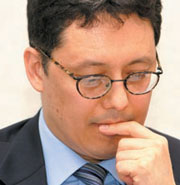
Anvar Saidenov: Kazakhstan must diversify its economy and find niches where it can be competitive. |
For the moment, the country is the beneficiary of high oil prices and the government has a budget surplus and enough funds for building infrastructure and other industries. But this could change quite radically in a couple of years and then the economy could face some serious problems.
How do oil revenues affect monetary policy? The inflow of oil revenues puts a lot of pressure on the local currency, which has appreciated quite considerably over the last couple of years. On the other hand, we have a legal obligation to keep prices stable, and that is our sole priority at the moment.
We do not hesitate to intervene to take some of the pressure off the currency through a ?sterilization? exercise that involves us issuing short-term notes to take out liquidity. This counteracts inflation but it is quite costly for the National Bank of Kazakhstan and we expect to sustain losses at the end of the year.
What is your outlook for inflation? We have a projected inflation range of between 5% and 7% of the CPA for this year. Right now we are still within this range, but we are at the higher end and it is quite tight. For example, between the end of July 2003 and the end of July 2004 inflation grew by 7.1%. The average annual inflation rate is 6.6%, so we are within the targeted range, but not by that much.
What is your solution to the inflation issue? This will be the approach we have followed for some time. We will try to sterilize liquidity and squeeze the money base. We intervened extensively in July, by issuing tenge-denominated short-term notes valued at KT8 billion ($58.7 million). This sterilization exercise is left to the National Bank of Kazakhstan as the government is prohibited from issuing bonds while the budget is in surplus. We are issuing as much paper as possible to deal with this money supply problem.
We spent KT10 billion on sterilization last year and expect to spend even more this year. Our most pessimistic scenario for 2004 is that we will have to spend KT18 billion on this exercise. While the reason for this expenditure is to deal with oil revenues, we should not forget the contribution of our copper exports, where world market prices are also high.
Of course we are having to suffer losses on our sterilization programme. The returns are declining on our foreign assets and this is a source of disappointment, although it is obviously for reasons beyond our control. For the period from June 2003, the returns from international markets have been quite low. The value of the fixed-income instruments in which we are mostly invested has recently gone down because of the US Federal Reserve’s increase in interest rates. So on the mark-to-market valuation we are losing again.
Our reserves are growing, but we will still have a lower return on our gold assets and foreign exchange assets this year than last year. This is not related to domestic issues. The treasury department managing our reserves is very experienced and capable.
To what extent are you able to use the National Oil Fund to soak up revenues? That is another valuable channel for oil revenues. The finance ministry, which is responsible for this fund, transfers extra tax payments from oil-producing companies to the NOF at the end of each year. Last year $1.6 billion was transferred to this fund in December. This year we expect to transfer, on a conservative basis, $1.2 billion. This will be made up of extra tax payments from oil-producing companies and proceeds from the sale of land and privatization receipts.
Could you further assess the state of the country’s reserves and the condition of the tenge? Reserves are growing significantly as we increase our purchases of dollars to prevent the sharp appreciation of the tenge against the dollar. During the first six months of 2004 we purchased $1.2 billion-worth of dollars.
During the first two weeks of January, the tenge appreciated sharply, from 143 to 139, against the dollar. There was a general panic as the public went to exchange bureaux to exchange their dollars for tenge and we had to intervene quite extensively in the markets. Since then our intervention have been smaller and more gradual and the tenge continues to appreciate but at a much slower pace.
Does the National Bank of Kazakhstan target a specific rate for the tenge against the dollar? We do not have any specific figure. Since we dropped the term ?free-float? from our description of the exchange rate regime and started intervening in the markets, we have described our exchange rate as ?floating?. Now, we are allowing the tenge to appreciate against the dollar but with a smoothing effect. The primary issue for us is to maintain the competitiveness of our exporters and in this respect we are looking at the real effective exchange rate. We calculate this against a basket of 24 currencies from our major trading partners, of which four are from countries of the former USSR and 20 are from countries farther afield.
We have some room for manoeuvre here. If we take the December 2000 figure as the base, the current real effective exchange rate against the basket of currencies is 94%. Our exporters are more competitive today than in 2001 and 2002.
What is your view of the sovereign rating upgrade of Kazakhstan by Standard & Poor’s? It came as good news, for the country as a whole, but particularly for corporate borrowers, which will benefit from better borrowing terms. The terms for borrowing by Kazakhstan names are particularly favourable right now.
Kazakhstan’s banks have been active borrowers in the international markets. What is your view of this? Net borrowing by banks for the first half of the year was $350 million. This is another source of foreign currency coming into the country, and we have to react correspondingly. Banks are meeting a currency mismatch in their books and they have to find local borrowers. They are using Eurobonds to extend the maturity of their borrowing. They can also issue longer-term domestic bonds, and some of them have issued seven- or 10-year domestic bonds, as Halyk Bank did recently. Banks may borrow up to $1.1 billion in 2004.
Can we expect the Republic of Kazakhstan to issue in the international bond markets in the foreseeable future? The finance ministry has no intention of borrowing in the international markets. It has to repay a $300 million Eurobond in late October but has made clear it will either issue a bond locally or use funds in the national budget to repay the bond.
The prime minister of Kazakhstan has made critical comments about the banking system, saying its lending margins are high and that it needs radical reform. Do you agree? I do not agree, although I accept there is a need for reform. The banking system is developing and what was right from a regulatory point of view five years ago needs to be reconsidered. We are discussing the proposals involved with Basle II compliance and we have to react. We are focusing on the need for consolidated supervision in our regulatory regime. We accept that our asset classification procedure is not up to international standards.
We put particular importance on meeting international standards in the management of our banking system, so there are things we need to change. But there is no need to demolish the system and replace it totally.
I can, of course, understand why the government is not happy with high interest rates and high margins as they want small and medium-size enterprises to have greater access to credit and loans. But if the government wants to develop particular industries to diversify the economy, it should develop a set of measures like tax incentives, government-backed guarantees and co-financing mechanisms to decrease interest rates for companies.
Banks have a role to play in this process. Margins are really too high if one looks at the cost of borrowing so banks should work harder to reduce their administrative costs. There may be savings to be made in the processing of loan applications, and I welcome the local banks’ decision to set up Kazakhstan’s first credit bureau.
Is the banking system over-regulated and over-bureaucratic, as some bankers claim? The system is very tightly regulated and this toughness has paid off. That is why, unlike Russia, we have managed to avoid major shocks to our banking system. You may be right in saying we are over-regulated, and maybe the system should be liberalized at a later stage, but this should be done only very gradually.
I know the banks are quite unhappy and want us to remove some reporting requirements. They also want us to liberalize our asset classification procedures and our provisioning requirements. But here we see no more than the usual conflict between the regulator and those who are regulated.
How concerned are you by Russia’s liquidity problems? We do think it could affect us. Some of our banks were affected by recent banking liquidations in Russia. For example, some had documentary operations with Kredit Trust, which went into voluntary liquidation. But our financial supervision agency has run stress tests on the negative effects on our system of the crisis in the Russian banking system, and we are looking at their conclusions very closely.
Russia is our biggest trading partner and many of our banks service customers and companies trading with Russia. So our top 10 banks are all involved with Russian banks.
This is exactly why our very tight banking regulation is so necessary and we must deal with the risk of spill-over effects from the Russian problem.
Coming back to domestic matters, the Kazakhstan stock exchange surely does need something to move it forward? Here I agree that something radical should be done. But all the attempts in the past, like placing stakes on the exchange from privatized government companies and introducing a programme for blue-chip companies, have not produced results. The finance ministry is aware of the urgency of the problem and has proposed a three-year programme aimed at developing the stock market. This is now being reviewed by the government but I am not sure how successful this programme will be.
What are the major problems faced by the stock exchange? There is a whole complex of reasons why the exchange is not working well. These are both on the regulatory side but also on the potential issuers’ side. On the regulatory side, we face a problem with national accounting standards and with transparency in companies in the real economy. Companies in the financial sector have implemented international accounting standards since 2003 but the non-financial sector still has some way to go in this respect, although the finance ministry is working hard to encourage them.
On the issuers’ side, we have many owners who have seen what has happened in Russia and are therefore unwilling to share their ownership rights. They fear that if they bring in other investors from the exchange, they will be taken over.
What are the prospects for privatization in the financial sector? The State Accumulation Pension Fund is still completely state-owned and might be privatized next year with the assistance of the European Bank for Reconstruction and Development, with which we are working right now. Although the government is the only shareholder in the SAPF, the National Bank of Kazakhstan has paid in some additional funds to capitalize the pension fund and will become the biggest shareholder. We will shortly announce an additional issue of shares, perhaps 10%, which we will sell to the EBRD. The EBRD will then start to seek a strategic investor for the SAPF. We hope some part of the SAPF equity will be traded on the stock exchange.
What new financial regulations should we look forward to from Kazakhstan? The most important development is a new version of our law on currency regulation through which we are planning to move to full liberalization of our capital account transactions. A draft of the law is currently being reviewed by the government and it will be submitted to parliament at the end of 2004. If the measure is approved, there will be a gradual liberalization of currency controls by 2007. This will substantially liberalize the present procedure whereby capital transfers have to be licensed.