Six years of haggling came to an end last month when Russia and the EU finally signed off on a bilateral trade agreement that clears away a major obstacle in Russia?s efforts to join the World Trade Organization.
The EU has been blocking Moscow?s application to join the international trading club ? a top Kremlin objective since president Vladimir Putin?s election in 2000 ? in an effort to squeeze out concessions on Russia?s energy policy.
The EU is worried that its own companies won?t be able to compete with what it interprets as energy subsidies that Russia?s companies enjoy because of the low cost of power. Moscow has countered that Russian gas is cheap because Russia has lots of it.
Moscow started its horse trading from a weak position ? and one that got weaker after Washington?s promise of support evaporated last year after Russia joined France and Germany in their vocal opposition to the invasion of Iraq.
However, the Kremlin kept one card up its sleeve by refusing to sign off on the Kyoto protocol that introduces worldwide norms to protect the environment. As one of the biggest polluters, the protocol is meaningless without Russia?s participation ? particularly after America walked away from the agreement in 2001 ? giving it a de facto veto.
EU trade commissioner Pascal Lamy and Russian trade minister German Gref laid all their cards on the table at the end of May at a Moscow summit, trading off their trumps.
Lamy agreed to drop EU demands that Russia increase energy prices to international levels, while Gref said that Russia would push ahead with ratifying the Kyoto protocol.
?The fact that the European Union has made concessions in our WTO negotiations cannot but have a positive effect on Moscow’s attitude towards ratification of the Kyoto protocol,? Putin said, standing on the sidelines as the two trade ministers signed the deal. ?We will accelerate our efforts to ratify this protocol.?
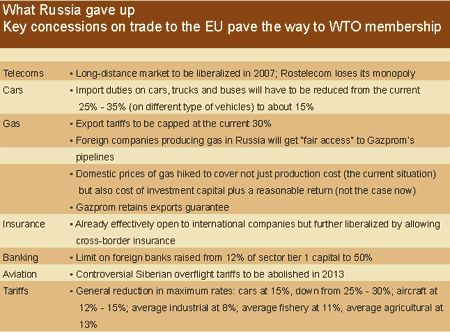
The agreement is a breakthrough. In October, the EU was down to six final demands, all related to energy: an increase in domestic gas prices; equalization of domestic and export prices for gas transportation; lowering export duties on gas (30% since the start of the year); free access to gas transit through the Russian pipeline system; permission for the construction of private gas pipelines; and an end to Gazprom?s monopoly over exports.
Moscow made concessions but not on all the points. Gref promised to increase domestic gas prices for industrial users from $27 to $28 per 1,000 cubic metres to $37 to $42 in 2006 and $49 to $57 by 2010. Gas prices in the EU are more than $100 per 1,000 cubic metres.
He said more independent gas producers would be given access to the state-controlled pipeline network as a step towards establishing a market-based price for gas. But he has stopped short of ending Gazprom?s control over exports or saying more than that the 30% export tariff would not rise.
Brussels will be happy to see the deal signed as Russia is already one of the most important European markets. EU farmers were badly hit by the Russian financial crisis in 1998, which, among other things, caused the price of pork to collapse after Russian orders disappeared overnight.
Hurt pride
?Today, the EU and Russia cement further their trade and economic relations. This deal brings Russia a step closer to the international trade family, the World Trade Organization, where it belongs,? European Commission president Romano Prodi said at the ceremony.
Russia is by far the largest economy that is not yet a member of the 147-member world trade governing body. Although a WTO club card has important trade implications, as Russia?s main export is raw materials, which lie outside the WTO?s rubric, exclusion from the club hurts Russia?s pride more than anything else.
?Clearly, Russia?s political profile will be the main beneficiary of entering the WTO, as the integration to global markets continues to be one of Mr Putin?s highest priorities,? said Anton Khmelnitsky head of equities at Brunswick Asset Management in a note.
The long-term benefits of membership are less tangible but as important. The Kremlin wants to diversify its economy, and WTO membership not only provides guidelines for growing companies but adds another level of policing as foreigners watch for abuses. The US is already complaining about the estimated $1 billion a year its companies lose to Russian video, music and software pirates.
Moscow will also be pleased that it has finally cleared the way for membership, even though tricky trade deals with Japan and US will still have to be pinned down before the next natural opportunity for Russia?s accession ? the biennial ministerial meeting in September 2005.
In the meantime Moscow has already opened negotiations to sign more trade protocols with other WTO members. Trade agreements have already been signed with Kyrgyzstan, New Zealand, Israel, Bulgaria, the Czech Republic and Hungary. And Gref says talks with Japan, South Korea and Oman will start soon while protocols with the 10 new EU member states that joined at the start of May are nearly complete.