 |
|
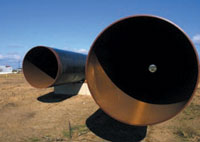
Gazprom pipeline: for years foreign investors have got around restrictions on owning shares in the Russian gas company through grey trading schemes. News of a crackdown hit its share price |
Foreign investment sentiment was already being battered by the Yukos affair, the Kremlin’s attack on what was Russia’s biggest oil company. However, waning confidence was dealt a fresh blow in August when a Duma deputy officially called for an investigation into ?grey? schemes used by foreigners to hold billions of dollars-worth of Gazprom shares.
On August 17 the legislator, Yuri Savelyev from the Rodina (Motherland) party, sent a letter to head of the federal security service (FSB) Nikolay Patrushev, interior minister Rashid Nurgaliyev and prosecutor-general Vladimir Ustinov. It accused Russian investment bank United Financial Group (UFG) of running, ?a scheme under which anonymous foreign companies and individuals can own shares in Gazprom, bypassing a 1997 presidential decree that bans the ownership of Gazprom shares by foreign companies and individuals or Russian companies with more than 50% foreign capital?.
Gazprom’s share price immediately plunged 12.5%, wiping more than $6 billion off the company’s market capitalization in a day as investors ran for cover, fearing that the Kremlin was about to launch a crackdown on the schemes and confiscate their money.
Savelyev, a former rocket scientist, warned that the government was ?in danger of losing control of Gazprom? and said that foreigners had already built up a 6.5% stake in the company illegally since 2000.
?This is the first serious and direct comment on the grey schemes to have been made by the government or a Duma deputy,? says Paul Collison, an oil and gas analyst with Brunswick UBS Warburg. ?Given the Yukos situation it highlights the sensitivity of investors. The government has never made a serious effort to limit the grey schemes before.?
Despite the ban, no-one denies that foreigners have invested billions of dollars in Gazprom local shares and nearly every Russian investment bank openly offers a scheme enabling them to do so. One of the most common is to set up a Russian company that is permitted to buy Gazprom shares and then sell shares of this holding company to foreigners. The value of the holding company’s shares is linked to the value of the underlying Gazprom shares.
?The risks of investing in Gazprom have definitely gone up,? says Collison. ?The grey schemes may not break the letter of the law but they are clearly in contravention of its spirit.?
However, it may be that the investigation has less to do with law enforcement and more to do with an obscure private argument. UFG, which is 40% owned by Deutsche Bank, says the call for an investigation is linked to a long-standing shareholder dispute that came to a head last month and was intended not as an attack on the grey schemes but on UFG.
Charles Ryan, the UFG CEO, says a Russian businessman approached him earlier this year, claiming to own part of UFG’s Gazprom holding. In 1995 about 110 million Gazprom shares were stolen from custodians and sold on the open market. The businessman claimed that some of the shares held by UFG were drawn from these missing shares and now belonged to him through the debts of companies under his control.
Bare knuckle fight
?We told him that our ownership of the shares had already been confirmed by the authorities and he replied that if we paid him a chunk of money he would go away. If not he would sue,? says Ryan.
A case was started and had its first hearing at the end of August, but once it became clear UFG was going to tough it out, the gloves came off.
?We started to fight back, so he threatened us with a black PR campaign,? says Ryan. ?Again we told him to get lost and sure enough the very next day this Duma deputy pops up and calls for a FSB investigation.?
The interior ministry confirmed that it had received a request to investigate UFG and the grey schemes, but analysts say they now believe the whole scandal will blow over.
Oleg Vyugin, the head of stock market watchdog the federal service on financial markets (FSFM) said a few days later that he saw no reason for a wide-ranging investigation into the grey schemes.
Having spent several years working at investment bank Troika Dialog, Vyugin is well aware of these schemes and how they work. He went on to say that although the FSFM would follow up on any official requests, he would not start a witch-hunt. By August 25 the Gazprom share price had recovered to $1.89, still off from the $2 it was trading at before the scare.
Gazprom is probably the last heavily undervalued company on Russia’s stock market: the company is worth about $30 billion by market capitalization but its own accounts estimate that its gas assets are worth more than $100 billion.
Breaking the ring-fence
The government has said repeatedly that it intends to bring the ring fence down ? probably this year ? but it has also offered strong hints that it wants to take a majority stake in the company first. The government has clear title to just under 39% of the company but Gazprom has another 17% of its own stock on its books, recovered from share-pledge deals signed under the old management.
The problem is that if the government wants to take this stock over it needs to pay about $7 billion for it at current market prices, something the Kremlin would rather avoid.
As the dust started to settle it seemed that unintentionally Savelyev’s comments might have spurred the Kremlin into action. Arkady Dvorkovich, one of president Vladimir Putin’s liberal economic advisers, said on August 25 that the Kremlin wanted to increase its stake to half and was now actively looking at the question.
?The Russian government is holding additional consultations on the issue, which may be tackled in the near future,? Dvorkovich said. ?Whether or not the government needs the controlling stake is a question of choosing the best scenario.?


