?
 |
The list is pretty impressive and by no means unjustified. Beset by rising violent crime, the city has long been nicknamed “Nairobbery” by locals and visitors, and makes Johannesburg feel safe by comparison. Armed robberies and hijackings of cars are common and the best thing to do if you are involved in one is to comply with the assailant’s demands. If you do what they say then they probably won’t shoot you, goes the advice. Driving here is hazardous at the best of times when having to squeeze between the next crater-sized pothole and the matatu drivers, careering all over the road in their decrepit Nissan minivans packed with brave passengers.
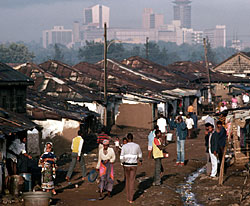
But crime does not top the city’s problems. Drive away from the high-rise business district and beyond plush suburbs such as Westlands and the city quickly descends into rubbish-strewn slums.
In October, housing minister Raila Odinga decried the fact that 60% of Nairobi’s population were living in slums with no roads and no sewerage system, pipe-borne water or electricity.
Kenyans hope president Mwai Kibaki, whose National Rainbow Coalition (Narc) took power last December, will make a difference. After 26 years under the dictatorial Daniel arap Moi and almost 40 years with his Kanu party in power, some still can’t really believe an opposition coalition has made it into office.
In a country where average life expectancy for men is only 43, Moi’s regime, which fostered rampant political and institutional corruption and economic decline, is all that many can remember. “Kibaki’s not like Moi, he’s a good and honest man and he’s respected here,” says a hopeful Nairobi resident. With financial and political swindles rife, respect for politicians is a scarce commodity, particularly among the 50% of the population who live below the poverty line.
But Kibaki will have his work cut out to fulfil his election pledges to root out corruption and tackle Kenya’s economic decline. GDP growth fell below 1% in 2002 because of erratic weather, poor investor confidence and low donor support. Aid from international donors had been halted before because of the Moi government’s failure to institute anti-corruption measures. And according to Transparency International’s Corruption Perception Index published in October, Kenya is still the world’s fifth most corrupt country.
Kibaki has already made some important changes. In October he made official visits to the US and the UK, where he was promised financial support. Nearly half of all senior judges have been suspended in an investigation into corruption in the judiciary. The government has pledged to invest in education and healthcare and in January introduced free primary education, prompting 1.5 million new pupils to turn up in the first week alone.
Fears for the future Yet the new government also has its critics – there is infighting among coalition members and some are wary of the fact that Kibaki was until 1992 a member of Moi’s government. Some think renewed international funding will do more damage than good. Among them is Ababu Namwamba of the Chamber of Justice, a body set up to promote access to justice for underprivileged groups. “When we see our finance minister grinning at the prospect of increased funding, we should mourn for Kenya,” Namwamba said recently. “The truth is that successive regimes have exhibited a strain of opulent living and unfettered appetite for new loans which has effectively mortgaged our children.”
What the citizens of Nairobi and Kenya as a whole desperately want is change – their worst fear is that they will get more of the same again.