|
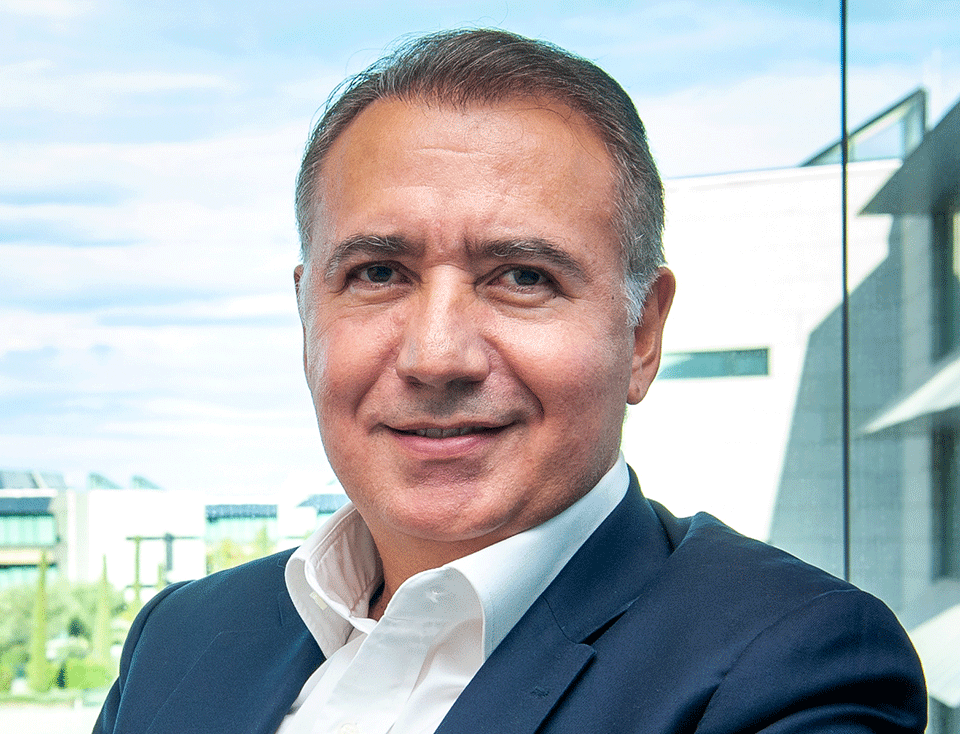
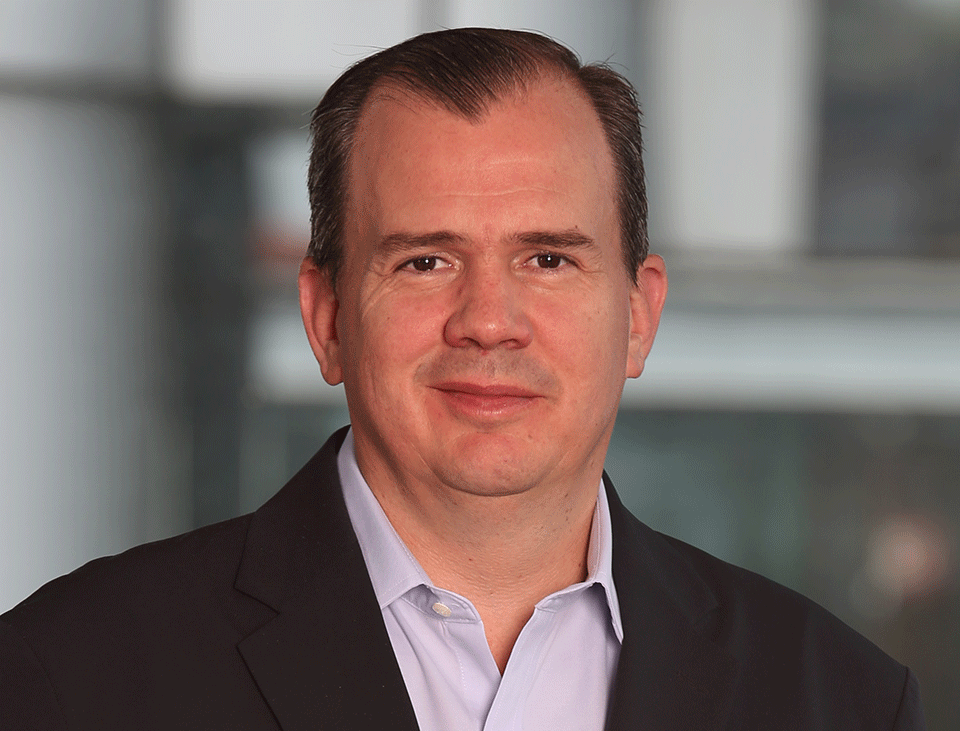
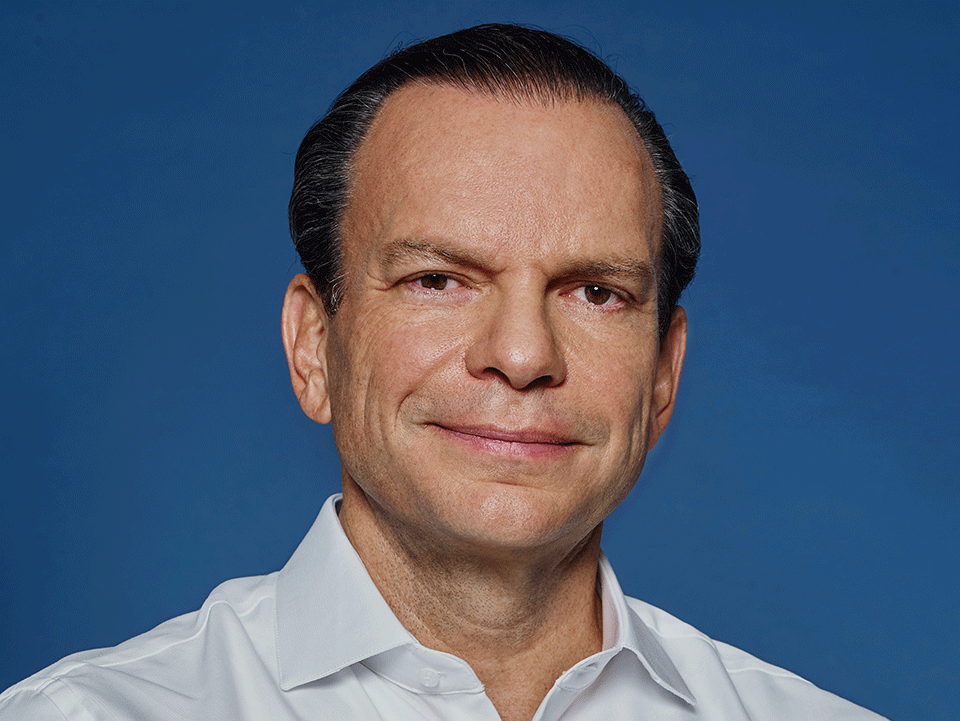
Grayson (l) and Auerbach: the ardent traveller |
Everyone dreams of having the one big idea that makes their fortune. Jonathan Auerbach and David Grayson had one – a network connecting US institutional investors to local equity brokers worldwide. Ten years on, the company’s staff has grown from three to 35, it has established relationships with about 85 local brokers from Jakarta to Palestine.
Jonathan Auerbach, co-partner says the rationale for the equity brokerage company was clear to him back in 1992, though other brokers must now be kicking themselves that they didn’t pick up on the idea. He says: “I was chairman of Cresvale International, a broker on the NYSE. It was clear that as the global equity businesses were expanding at the big investment banks, local brokers were finding themselves increasingly marginalized.”
Local knowledge Auerbach, who had also run his own firm in London, had worked closely with several local brokers in Europe, and knew their strengths, relative to the big investment banks. He says: “I talked to a few of them about setting up a company in the US to act as their New York office.” The model made sense: the local brokers would get access to the biggest pool of institutional investment in the world; the US investors would get access to the prices, research and local knowledge of the local brokers; and Auerbach’s company would get 50% of all commissions. As Auerbach says: “The beauty of it is its simplicity.”
He launched the company in 1993, with three local brokers affiliated – in France, Switzerland and Austria – and with four people working in New York. By the end of the second year, the network had grown to 20 markets.
David Grayson joined as a partner at the end of 1993. He had been managing director of ABN Amro’s New York clearing office. He and Auerbach knew each other from a committee on which they both sat at the New York Stock Exchange. Grayson pitched for Auerbach’s clearing business for ABN, and won the mandate. Soon after, he resigned from ABN to try to take over another NYSE brokerage. The attempt failed and Grayson was out of a job. Auerbach was going on a trip to Europe, so he suggested Grayson use his office in the meantime. When he came back, Grayson was enthused by what he had seen of Auerbach’s business model.
Soon, the two were partners, with Grayson responsible for travelling and locating suitable local-broker partners and Auerbach responsible for liaising with US institutional investors in New York. Auerbach says the two roles suit them well: “I’m a trading-day-to-day market guy. David loves to travel. Last month, in a 10-day period, he went to Shanghai, Singapore, Jakarta, and Bangkok.”
Auerbach says: “We do a great deal of due diligence to get appropriate dealers. We have to go there, see their offices, meet the management, and they need to be able to provide institutional research in English. In many cases, it is the leading local firm.” Their partners include winners of Euromoney awards for local brokers such as Publikum in Slovenia or Carthill Asset Management of Uzbekistan.
The research from all these brokers is available to all clients over Auerbach Grayson’s website, at www.agco.com. The company, miraculously for a New York office with just 35 staff, is ranked by Nelson Information fifth out of all investment banks for its number of equity analysts. It has access to 378 analysts covering 1,812 companies, putting it ahead of Credit Suisse, JPMorgan, Morgan Stanley and HSBC.
The company also prides itself on beating the banks into new markets. For example, it set up a partnership with a local broker in South Africa before competitors recognized the potential. Auerbach says: “We did some extraordinary business out of South Africa as US investors recognized that sanctions would be lifted and the country had entered a new phase.”
More recently, Grayson has visited Baghdad, looking for new partners there. Auerbach says: “There is a great capitalist tradition in Baghdad, even if the stock exchange shrunk under Saddam. Within the Middle East, it’s a real trading centre. I’m a great believer that we’ll see a remarkable economic recovery there.”
Obviously, the local brokers at some point might decide they could form a collective, minus Auerbach Grayson, and scoop up more of the commission from US investors for themselves. But the US company is ahead of the game there too. It is working with software company Omiris to set up an electronic network called AXES, on which all clients can trade 24 hours a day. Local brokers will also be able to white label the technology for their clients.