| RTS |
 |
| Source: Renaissance Capital |
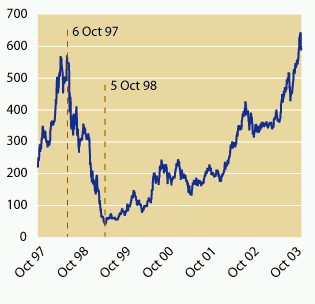
Even before the arrest last month of Mikhail Khordorkovsky and the freezing of a large block of Yukos shares, Moody’s decision on October 8 to raise Russia’s sovereign credit rating, from Ba2 to Baa3, had been greeted with as much concern as joy. The RTS closed that day 3% up at an all-time high of 628.98. Yields for Russia’s 2030 Eurobond contracted by 40 basis points.
Mobile Telesystems and Magnitogorsk Metallurgiisky Kombinat, delayed bond issues to take advantage of the move. Gazprombank increased its five-year bond issue from $300 million to $750 million, with many bids coming from retail investors.
Some analysts were euphoric. UFG said: “Russia’s macro and financial strength have long deserved an investment grade.” Renaissance Capital’s Alexey Moisseev and Pavel Mamai said: “In our view, an upgrade to investment grade is an event of such magnitude that it is difficult to underestimate.”
However, the upgrade also raised some eyebrows. Market participants were expecting an upgrade of one notch, after the Duma elections in December or the presidential elections next March.
Stephen Jennings, CEO of Renaissance, worried it might further the over-heating of the economy. He says: “We’re beginning to see bubble-like conditions due to huge international liquidity, when many structural issues haven’t even begun to be addressed.”
Michel Perhirin, chairman of ZAO Raiffeisenbank Austria, RZB’s subsidiary in Russia, agreed: “We can look forward to an avalanche of funds. It was perhaps a bit too early. Moody’s could have let Russia prove itself first. It’s essential the government and central bank should begin reforms.”
The central bank was not best pleased
either. Chairman Sergei Ignatyev said the upgrade made it difficult for the bank to control inflation and rouble appreciation. The bank bought $1 billion the day after, to control appreciation against the dollar. Oleg Vyugin, first deputy chairman of the bank, said investors were “using the rating upgrade as a pretext for speculation”.
Some now characterize the upgrade as speculative with Moody’s betting the next government will be as disciplined as the present. One senior economic commentator says: “There’s not a small chance that the government’s budgetary stance could change in the next parliament in a way that might not warrant an investment grade. The underlying fiscal stance is deteriorating, and it’s difficult for any government to resist pressures to increase expenditure after boom years. I don’t know why Moody’s did it.”
Moody’s sovereign analyst Jonathan Schiffer, who made the upgrade, says it looks at two criteria – a country’s ability to pay, and its willingness to pay.
He says: “If the ability to pay is so overwhelming, you don’t have to worry so much about the willingness. Their numbers are so good, that there’s very little risk they
couldn’t pay their debt.” He knows the market expected Moody’s to wait until after elections, but says “if we upgrade before the elections, it means we don’t think there will be much change”.
Standard & Poor’s, by contrast, kept its rating at BB. Russia sovereign analyst, Alexei Novikov, says he is more worried about the lack of structural reforms. He says: “Russia is not investment grade because several fundamental risks remain.” These include the low diversification of the economy, a weak banking sector, lack of administrative reform and the lack of effectiveness in the state sector. He adds that the institutional environment and judiciary are weak and the wealth of the population is $1,000 lower per capita than the average investment-grade country. Novikov thinks S&P’s rating has been vindicated by the arrest of Mikhail Khordorkovsky.
“Our BB rating covers the political risk and the opaque and unpredictable institutions shown by such events,” he says. Fitch’s sovereign analyst, Edward Parker, says the arrest of the oligarch underlines the risks in Russia now being revealed by the forthcoming elections.
Schiffer is aware of these risks. But he sets them aside for ratings purposes. He says: “In a country that’s inefficient, with not much rule of law, where politics is centralized in one office where you also have a firm budget and strong commodity revenues, there’s no question but that it will be able to pay its debt. We don’t rate Russia’s ability to have a great economy. And we don’t grade countries on whether they carry out this reform or that reform. That’s the IMF’s job.”
Goohon Kwon, IMF representative in Russia, says: “Moody’s is looking at countries’ specific ability to pay debt, just at the numbers. Standard & Poor’s is looking at wider structural issuers.”
Moody’s is clearly impressed by Russia’s planned $7 billion stabilization fund, which it thinks could balance out any volatility in oil prices. But one senior economic adviser says: “The intended size is modest – $7 billion is only 2% of GDP. If the oil price falls six dollars, that takes out 2% of GDP.” He adds: “I think S&P’s approach is more
reasonable. Ability to pay also depends on structural and political issues.”
Moody’s must hope there are no more big surprises in the new government. Renaissance says: “if they have to downgrade Russia to speculative grade in the next half-decade, the whole rating industry is likely to experience a significant crisis.”